Chapter I: The Heritage of Asphalt
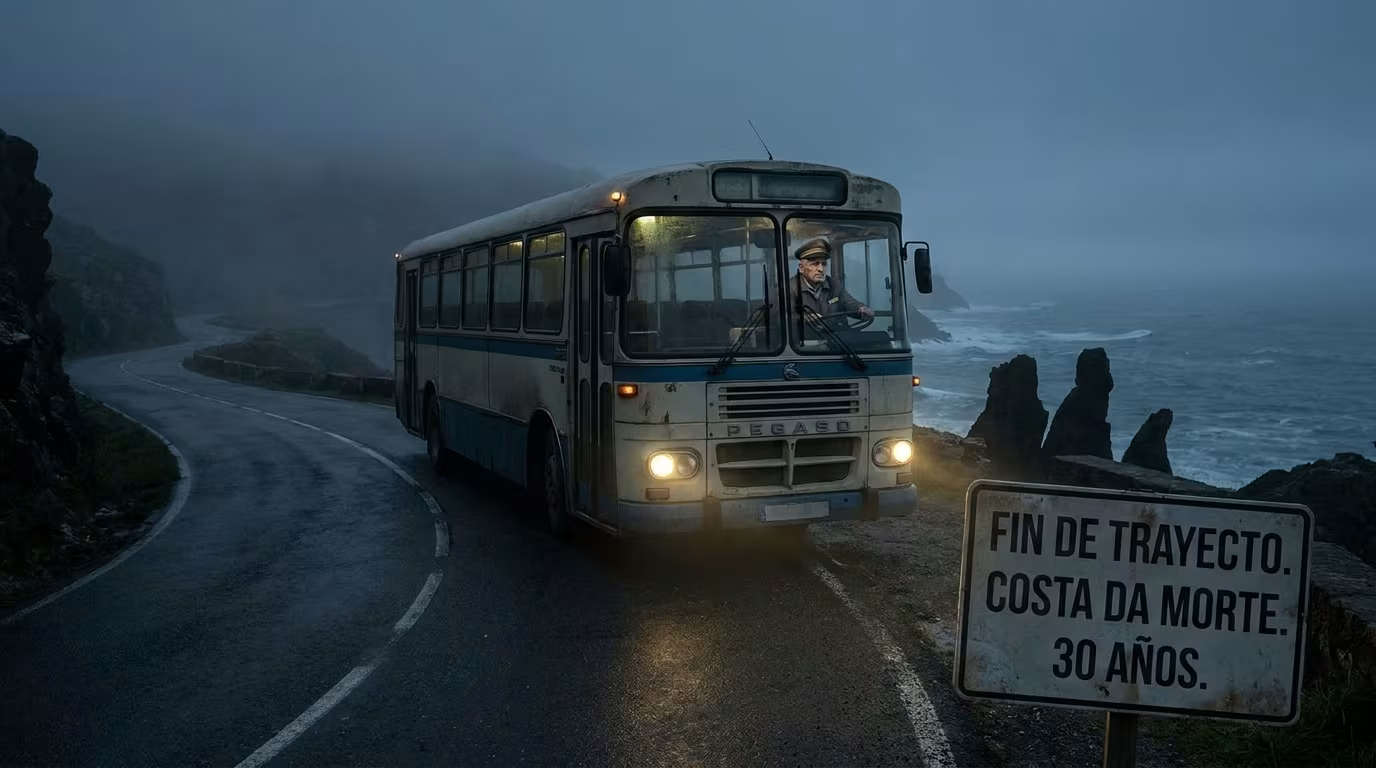
Tomás stroked the worn rim of the steering wheel with the pads of his cracked fingers. That synthetic leather, polished by decades of sweat, grease, and tension, was the only faithful witness to his existence. Tonight was no ordinary night; it was the last. After thirty-five years of blind devotion to the Cantabrian Transport Company, Tomás was retiring. The digital dashboard clock, with its dying green digits, read two-forty-seven in the morning. The old Pegaso bus, a colossus of creaking metal and the stench of stale diesel, rumbled with a vibration Tomás felt deep in his kidneys.
Line 73 was a cursed route, an open secret among veteran drivers. It linked the half-abandoned fishing villages of the Asturian coast with the inland mining basins, winding through rural roads that defied gravity and sanity. At that hour, the fog—that dense, damp mass the locals called "the white scythe"—crept in from the sea, devouring everything. The windshield wiper executed a lazy sweep, emitting a rhythmic squeak that sounded like the metronome of destiny: clack-clack, clack-clack.
—Last trip, old friend—Tomás whispered to the fogged windshield. His voice sounded strange, deadened by the engine's dull roar.

There were no passengers. No one in their right mind traveled at such an hour on a November Tuesday. The bus was a metal coffin lit by flickering fluorescent tubes that cast elongated shadows across the blue vinyl seats, torn and mended with duct tape. Tomás pressed slightly on the accelerator as he lined up the climb toward Alto del Cuervo. The asphalt there was treacherous, bordered by an abyss dropping sheerly down to the jagged rocks where the sea thrashed with invisible fury. He knew that upon reaching the Gijón depot, he would sign his log, hand over the keys, and become simply Phantom another ghost of the company. But the destiny, much like the road, holds bends that no map can foresee.
Chapter II: The Forbidden Stop
The clock shifted with a silent flicker: 03:00 AM. The Witching Hour, that hour when the veil between what is and what lurks grows as thin as cigarette smoke. The bus crested the summit of the cliff just as the weary, yellowish halogen headlights carved out a silhouette on the shoulder.
Tomás felt his stomach drop. An icy shiver, like a needle of frost, pierced his spine. There, beneath the fine, persistent rain, stood the shelter of Cala de las Ánimas. It was a concrete structure eaten away by sea salt, draped in dry ivy and faded graffiti. That stop had been decommissioned over twenty years ago, following the tragic collapse of the old road that had claimed the lives of a dozen passengers. No bus from Line 73 was supposed to stop there. Management had strictly forbidden it.
Yet, the passenger was there.
He remained motionless, standing beneath the concrete slab. He wore a long, dark coat of a fabric that seemed to swallow the meager beam of the headlights. A wide-brimmed hat was pulled down low, plunging his features into absolute shadow. He gave no signal to stop, raised no hand, yet Tomás felt an imperious, absurd compulsion to slam on the brakes. It was a reflex action, a magnetic urge that overrode both his will and his years of experience.
The air brakes exhaled an agonizing sigh, a metallic hiss that shattered the silence of the cliffside. The Pegaso ground to a halt, rocking on its wornleaf springs. The engine sputtered, as though the very fuel resisted burning any longer in such a place.
Tomás pulled the door-release lever. The front doors hissed open with a pneumatic groan. The air that rushed into the cabin was not the damp coastal breeze; it was a frigid draft, reeking unbearably of rotting kelp, sewer muck, and something else—something that reminded Tomás of the family crypt where his grandfather had been laid to rest when he was barely a child.
Chapter III: The Passenger of the Shadows
The man climbed the three steps of the bus with unnatural slowness. His movements were rigid, devoid of the elasticity of the living, as though his joints were rusted or frozen solid. His coat dripped a blackish water that did not seem to soak into the floor, but instead slid across the linoleum like mercury.
Holding his breath, Tomás waited for the man to pull out a ticket or a pass. The passenger did not move. He stood rigid beside the driver's compartment. Beneath the brim of the hat, Tomás could discern no eyes, nose, or mouth; only a void of absolute blackness, an active nothingness radiating a physical cold that froze the breath in his chest. Tomás's exhales plumed in dense white clouds, but the passenger produced no breath at all.
—Good evening… —Tomás managed to utter, his voice trembling with the certainty of one committing an irreparable mistake—. The line doesn't officially stop here anymore, but… Where are you headed?
The passenger did not answer with words. A dry crack, akin to brittle branches snapping beneath ice, resonated from deep within his chest. Slowly, he raised a hand clad in old, cracked leather, pointing toward the back of the bus. At his index finger, the skin peeked through a tear in the glove: it was an ash-gray hue, devoid of a nail, the mummified flesh fused directly to the bone.
Without waiting for a reply, the stranger began to move down the aisle. In his wake, the fluorescent ceiling lights flickered violently, emitting a sharp hum before dying out one by one, plunging the interior of the vehicle into a sepulchral gloom, illuminated only by the sickly green glare of the dashboard.
The passenger took the rearmost seat in the back row. Tomás glanced into the rearview mirror. The seat appeared empty. There was no silhouette, no hat, no coat. Yet, the rear of the bus suddenly sank beneath an immense weight, causing the leaf springs to protest with a groan of fatigued metal. The Pegaso's engine began to labor twice as hard, as though dragging a trailer weighted down with lead.
Chapter IV: The Blurred Route
With hands trembling on the steering wheel, Tomás engaged first gear and resumed the journey. With all his soul he wished to accelerate, to flee that presence, but the road had dissolved into an unknown labyrinth. The fog was no longer white; it possessed an ash-gray, nearly black tone that clung to the windshield like soot. The bus headlights barely managed to pierce a single meter of that physical darkness.
—I have to reach the highway —Tomás repeated to himself, like a mantra to ward off madness—. Five kilometers ahead is the turnoff for the expressway. There will be light there. There will be other cars. There will be life.
But the odometer had stopped. The needles on the instrument cluster danced like madmen, pointing toward impossible values. The digital clock remained stuck at 03:00 AM. Time had congealed, or perhaps they had drifted entirely off their course.
The air inside the bus grew so dense that Tomás struggled to draw breath. It felt as though he were swallowing the dust of open graves. Suddenly, the engine gave a dull, rattling cough, and the vehicle's radio—silent the entire journey—flickered to life on its own. It emitted no music, only a deafening static that clawed at the eardrums. Through the crackle of interference, voices began to surface. They were overlapping whispers, choked laments, names uttered by mouths that seemed choked with earth.
«Tomás…», murmured a child's voice. «Tomás, it's cold down here…», pleaded a woman's voice, one he recognized with a sickening jolt: his wife, dead for a decade.
—It isn't real. It's not real —the driver sobbed, grinding his teeth until his gums bled. He glanced sideways at the exterior rearview mirror. The road behind the bus had ceased to exist. There was no asphalt, no trees, no drop of the cliffside. Only an unfathomable void, an absolute blackness that devoured the path the moment the rear wheels passed over it. The bus was no longer traveling through Asturias; it was crossing the threshold of a domain unknown to mortal maps.
Chapter V: The End of the Line
The temperature plummeted below freezing. A delicate crust of frost began to glaze the dashboard and the inner surface of the windshield, tracing intricate patterns that resembled skeletal hands scratching at the glass. Tomás felt his own fingers grow numb, losing all tactile sensation.
A dry crackle behind him raised the hairs on the back of his neck. The passenger had risen.
Tomás didn't need to look into the mirror to know. He felt the looming mass of cold and death advancing down the aisle. The stench of decay and stagnant brine grew unbearable. He heard the heavy drag of feet across the frozen linoleum. Drag… silence… drag… silence. Every step the creature took made the very skeleton of the Pegaso shudder.
—Who are you? —Tomás shouted, breaking down in tears with the Horror frantic heartbeat of a helpless child—. What do you want from me? I have served my time! This was my final run!
The presence halted directly behind his seat. Tomás felt an icy breath against his right ear—air born not from lungs, but from the absolute void of interstellar space. When the entity spoke, its voice was no physical sound, but a dreadful vibration that echoed straight into the driver's brain, a cacophony of a thousand dead voices screaming in unison within the abyss.
«No one retires from the Night Line, Tomás», the entity whispered. «Those who drive in the dark belong to the dark. Your predecessor brought me here. Now you must guide those who wait in the fog».
Tomás, paralyzed by a cosmic terror that stripped away every instinct of survival, stared straight ahead. The fog parted for a heartbeat to reveal the end of the road. There was no asphalt. The path terminated abruptly at the sheer drop of the Cove of Souls cliffside, yet down below lay no churning sea. Instead, an infinite ocean of grey souls stretched out, drifting through an eternal mist, reaching their pale hands toward the oncoming bus.
The driver tried to slam down on the brakes, but his right leg was completely frozen, turned into a block of greyish ice. The steering wheel no longer responded; it spun freely within his dead hands.
The Pegaso drifted off the edge of the cliff. For one eternal second, the bus hovered in the void, suspended between the world of the living and the realm of absolute silence. Tomás cast one final glance into the rearview mirror. The passenger in the dark coat no longer concealed his face. His hat had fallen away, exposing what lay beneath: Tomás's own face, but with hollow eyes, parched skin, and an eternal grin carved by death.
The dashboard lights flickered out entirely. The engine died. And in the silence of the eternal night, the final run of Line 73 ended without leaving a single trace in the world of the living.
📜Investigation • Frequently Asked Questions
Documentary Archive and Analysis of the Occult • Relatando.com
What does the Pegaso bus and the worn steering wheel symbolize within the iconography of the Asturian working class?
The Pegaso bus and the steering wheel, polished smooth by decades of use, embody the alienation and mute sacrifice of the industrial and transport proletariat in northern Spain. They are no mere mechanical tools, but rather a corporeal extension of the protagonist, condensing thirty-five years of working-class memory, nocturnal solitude, and stubborn resistance against institutional oblivion.
What mythological and folkloric weight does the Asturian fog known as "the white scythe" carry in this liminal narrative?
In Asturian folklore and rural suspense narratives, the dense coastal fog traditionally serves as a liminal veil between the world of the living and the underworld. By dubbing it "the white scythe," the author evokes the inevitability of death and human vulnerability against the specters of the region's industrial and maritime past.
What historical and tragic backdrop is masked by the fictional yet plausible bus shelter at Cala de las Ánimas?
The bus stop, shut down following a fatal cave-in, recalls the grim historical toll of infrastructure failures in the mining and coastal districts throughout the twentieth century. This boundary marker acts as a monument to collective misfortune, unearthing traumatic memories buried beneath the asphalt and subverting the hollow normalcy of Tomás's final work route.
In what way does the temporal coincidence of 3:00 AM underscore Tomás's transition toward retirement as a civil death?
Known in popular demonology as the "witching hour" or the inversion of the hour of death, three in the morning marks the definitive cessation of the protagonist's productive identity. Retiring at that exact hour along a cursed route turns a routine bureaucratic transition into an irreversible descent into existential anonymity.
Do not extinguish the light just yet...
If you have had the courage to make it this far, we have other dossiers that will test the limits of your sanity.

Terms and Figures of this Tale
To delve deeper into the legends, creatures, and dark concepts that inspire this account, consult their entries in our dictionary of the uncanny:



Tu correo no se publica ni se comparte con terceros: solo sirve para notificar la respuesta.