The soapy water stung his fingertips, a dull burn that vied in intensity with the hollow opened in his chest. Fourteen hours on his knees facing other people's grease, fourteen hours swallowing the smoke of a clandestine kitchen where time did not run, but rotted. When the restaurant owner tossed the folded bills onto the stainless-steel counter and told him his gaze "scared the diners away," Carlos felt no anger. He felt an icy relief, the mathematical realization that he had nothing left to lose. The table was bare. The bank account was a desert. And Laura, with that mixture of pity and weariness that had replaced love, had taken even the last picture frame three weeks ago.
I. The Fracture on the Platform
That early morning, Carlos did not walk home. His steps, guided by a spectral inertia, dragged him down to Santuario station. No one quite knew why it was called that, save that it was the euphemism vagrants and suicides used to name the abyss. Santuario had not appeared on any official subway or commuter map since the 1970s. It was an open sore beneath the city streets, a stretch of dead track where the smell of urine and damp concrete gave way to something far older—a metallic stench reminiscent of oxidized copper and dread old.
There are geographies of despair that require no maps; they simply draw in those who have long stopped looking for a way out.
The air shifted violently. The temperature plummeted ten degrees in the blink of an eye, and the city's constant hum died away, replaced by a silence so dense it seemed to bite at the eardrums. He forgot his exhaustion. He forgot the ache in his spine. An invisible pressure—a low-frequency pulse that set the fillings in his teeth vibrating—heralded the anomaly's arrival. There was no public address announcement. No flashing lights pulsed down the tunnel. The train simply occupied the space, materializing out of a fog that smelled of burnt sugar and paper ash.

II. The Convoy of Shells
It was an impossibly scaled steam locomotive, a monolith of black iron that seemed to devour the station's meager fluorescent glare. A thick fluid seeped from its joints, evaporating before it hit the floor and leaving trails of ozone in its wake. Along its flank, chiseled deep into a corroded plaque, gleamed a name that defied all logic: The Harvester. The pneumatic doors parted with a dry sigh, exhaling the stale breath of a century locked away.
Carlos did not hesitate. His despair acted as a perfectly calibrated magnet. He crossed the threshold, seeking any sanctuary against his own wretchedness, and the air within struck him like a blow heavy with stellar dust and rotting memories. The carriage was packed. All around him, men and women from different eras—some in postwar woolen coats, others in nineties casual wear—occupied the garnet velvet seats. No one moved. No one breathed. Their eyes were wide open, fixed upon the opaque glass, yet their pupils reflected nothing. They were dry husks, vessels whose will had been completely drained, leaving behind only the skeletal framework and the shell of their pain.
III. The Mirror of Guilt
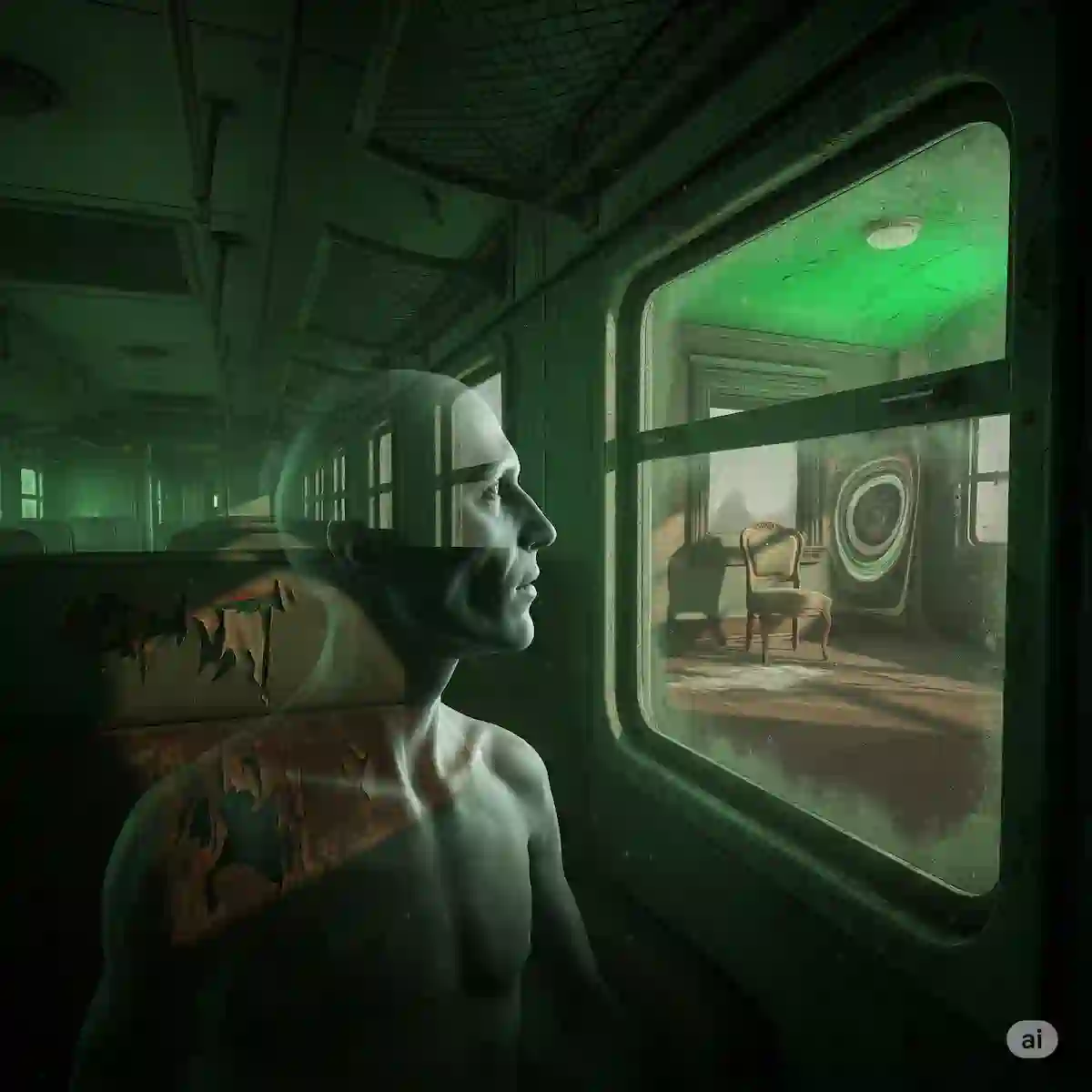
The doors slammed shut with a dull thud that echoed inside Carlos's skull. The train did not lurch forward or backward; instead, the outside world disintegrated, dissolving into a soup of shadows and greenish flashes. Suddenly, the windowpanes ceased to show the blackness of the tunnel. They flickered to life like analog movie screens. On the panel before him, Carlos saw his own living room. He saw Laura packing his clothes into cardboard boxes, her eyes swollen with weeping, but as she turned toward the imaginary camera, her face twisted into a grimace of pure contempt and she screamed his name in silence. The landscape fractured once more: the gray office, his boss roaring with laughter as he pointed down at a humiliated version of Carlos sprawled across the floor.
The train does not transport you to a physical place; the train feeds upon the archive of your defeats until you yourself become the landscape.
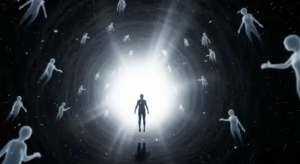
A collective murmur, a litany of overlapping laments, echoed down the central aisle. The passengers were not travelers; they were the fuel. An elderly woman in the adjoining seat watched in an endless loop the exact day her children left the family estate never to return. A young man barely of age relived with his eyes the precise moment the headlights of a truck invaded his lane. Trapped by an invisible paralysis that prevented flight, Carlos struggled against the seat, searching for leverage, and saw a small brass plaque screwed into the front rest: *Javier M. – 1987*. When he looked at the plaque on his own seat, he found it empty, yet the metal throbbed with a feverish heat. As he raised his hands to shield his face, the Horror tore away his final cry: his fingers were no longer flesh. They were translucent. Through them, the red velvet of the seat glowed like an ignis fatuus.
Do not extinguish the light yet...
If you have had the courage to make it this far, we have other dossiers that will test the limits of your sanity.

Terms and Figures of this Tale
To delve deeper into the legends, creatures, and dark concepts that inspire this account, consult their entries in our dictionary of the uncanny:



Tu correo no se publica ni se comparte con terceros: solo sirve para notificar la respuesta.