Chapter I: Dusk over the Gorge
There is an imprecise instant, between twilight and full night, when the mountains of the Jerte Valley cease to belong to the living. Julián did not know that unwritten law when he decided to stray from the marked trail that wound toward the Garganta de los Infiernos. He was an experienced hiker, a man from the capital who placed excessive trust in his vibrantly soled boots, his digital compass, and a pride molded over years of conquering lesser peaks. Yet the Jerte in the dead of November does not forgive pride.
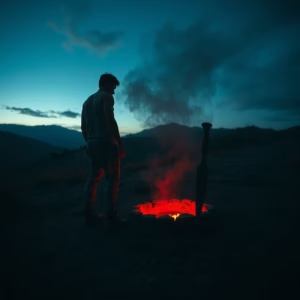
The sun had sunk behind the granite peaks with a bloody swiftness, staining the clouds a putrid violet before being extinguished altogether. Around it, the vegetation mutated. The bare cherry trees, cast into the desolation of winter, raised their twisted branches toward the grayish sky like crippled arms imploring mercy. A dense, low, damp fog —the classic hoarfrost that seeps into the very marrow— began to crawl from the riverbed, devouring the rocks, the path, and every shred of orientation.
Julián reached for his mobile phone. The screen flickered twice before displaying the dreaded dead-battery icon. The extreme cold had drained the lithium in a matter of minutes. He cursed under his breath, hearing how the echo of his own voice was instantly swallowed by the dense silence of the mountain. Not the trill of a single bird was heard, nor the whisper of wind among the oaks; only the rhythmic, almost grating drip of condensed moisture falling onto dry leaves.

He pushed forward blindly for nearly an hour, tripping over treacherous roots and moss-slicked granite boulders. The cold was a sharp, stinging pain in his ears and fingertips. The darkness grew so opaque he could scarcely make out his own hands. That was when the scent shifted. The smell of damp earth and moss was abruptly replaced by an acrid, dense, and suffocating effluvium: the unmistakable blend of melted virgin wax, rural church incense, and something else… something sweet and rancid that recalled withered flowers laid over a forgotten grave.
Chapter II: The Lights in the Rime
Julián stopped dead, holding his breath. Deep in the throat of the gorge, where the ground plunged toward an impassable ravine, he saw the first glimmer. It was an orange spark, wavering, blurred by the veil of mist. Then another appeared. And another still. A sinuous line of tiny points of fire emerged from the thicket, advancing in a chilling order.
"Hello?" Julián shouted, his voice cracked by panic and the hope that he had found a rescue party or some locals. "I'm lost! I need help!"
No one answered. The lights did not scatter, nor did they quicken their pace. They continued climbing the slope in a perfect single file, tracing a little path of fire through the spectral gloom. It was then that Julián's ear caught the sound. It was not the murmur of night walkers, nor the festive chatter of a hiking march. It was a muffled, grave murmur, a chanting in a corrupt and torn Latin that seemed to well up from the earth itself, as if the stones of the valley were vocalizing a funeral prayer.
The Horror, a raw, zoological terror, froze the blood in his veins. He longed to bolt in the opposite direction, to scale the cliff or bury himself beneath the leaf mold, but his legs refused to obey. He stood petrified against the trunk of an ancient oak as the procession drew near along the narrow goat track.
The fog parted before them like the curtain of a macabre theater. The members of the procession wore habits of coarse burlap, of a filthy brown, cinched at the waist with hemp ropes. Their heads were covered by elongated pointed hoods that concealed their faces entirely in shadow. They did not walk; they floated or glided with a rhythmic, unhurried motion, without the ground creaking beneath their steps. Each of them held in his hands a long, yellowish taper, whose flame gave off a sickly glow that barely managed to dispel the gloom, casting aberrant shadows against the rocks.
Chapter III: The Gift of the Night
There were dozens of them. Perhaps hundreds. The Procession of the Souls of Jerte, the Legend which the elders of Cabezuela and Jerte would recount beside the hearth to frighten the children, was now parading mere yards away from him. Julián remembered the whispered warnings heard inside the village taverns: "If you come upon the Santa Compaña of the gorges, do not look them in the eye. Do not answer their song. And above all, never accept anything they offer you».
He pressed his back against the tree bark, squeezing his eyes shut, praying Our Fathers forgotten since childhood. But the stench of virgin wax and rot had become unbearable, so thick he could taste it on his tongue—a greasy, metallic tang.
He felt the procession grind to a halt.
The silence that followed was more terrifying than the chanting. Julián opened his eyes, unable to contain the morbid curiosity that precedes tragedy. Right before him, less than a step away, one of the hooded figures stood. It was taller than the others, and from the cavity of its cowl emanated no breath, nor the vapor the frozen air should have drawn forth, but an absolute darkness, an infinite nothing.
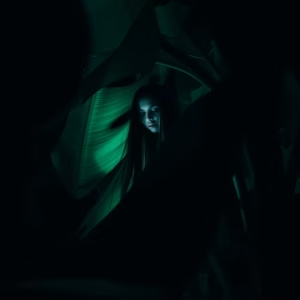
The figure extended a scrawny arm, wrapped in the frayed sleeve of its robe. Its fingers were long, withered, of a cadaverous pallor with blackened nails. In the palm of its hand it bore a lit taper, a candle of yellowish wax dripping thick grease. The flame flickered in a greenish hue.
—Take it —whispered a voice that did not emerge from the figure's mouth, but resonated directly inside Julián's skull. It was a sound akin to the rustle of dry leaves dragged by the wind across granite headstones—. Hold fast the light of those who no longer walk. Keep it until dawn. If the flame dies before the sun's first ray, you will join the procession for eternity.
An irrepressible impulse, an alien and crushing will that annulled his reason, forced Julián to raise his right hand. His fingers, trembling uncontrollably, closed around the shaft of the candle. The contact was horrifying: the wax was as cold as ice from a well, and the texture was curiously hard, porous, and rough in certain stretches.
As soon as Julián took the candle, the hooded figure turned on its heel and the procession resumed its silent march. The sinister murmur rose again, gradually fading into the thickness of the gorge until the last candlelights vanished behind the mist.
Chapter IV: The Vigil of Terror
Julián was left alone in the darkness of the Castilian night, gripping with both hands the candle they had given him. The small green flame lit his terrified face. He knew he could not move. To stray from the path blind would mean plunging down the cliffs of the Garganta de los Infiernos, and the wind that had begun to blow threatened to snuff out the frail light at any moment.
He found a small natural shelter: a hollow between two enormous blocks of granite that partially shielded him from the current. He curled up there, cupping the flame with his hands. Each second was an interminable agony. Time seemed to have frozen in that accursed valley.
During the hours that followed, Julián's mind skirted the abyss of madness. He heard whispers in the fog pronouncing his name in the voices of dead relatives; he saw clawed shadows sliding over the rocks, seeking to extinguish his only salvation. The cold paralyzed his legs, but the adrenaline of pure survival instinct kept his eyes fixed on the flame.

The melted wax dripped onto his gloves, but it did not burn; it left a whitish, viscous crust that smelled rancid. Julián did not dare to stare directly at the candle he held, focusing all his attention exclusively on the tip of the wick, on that tiny point of fire that was his only link to life.
—Hold on… just hold on until dawn… —he repeated to himself in a fevered delirium, his teeth chattering with the force of a pneumatic drill.
The shadows of the night began to thin. The pitch-black of the sky slowly shifted toward a leaden blue. The distant crow of a rooster, sounded from some far-off pen in the ravine, pierced the fog like a celestial blessing.
Chapter V: The Revelation at Dawn
The rising sun began to gild the peaks of the Sierra de Gredos, filtering its first rays through the mist that was rapidly dissolving over the Jerte Valley. The cold morning air carried with it the clean scent of pine and brook water, sweeping away the stench of incense and tomb.
Julián exhaled a ragged sob of relief that tore up from the depths of his lungs. He had done it. He had survived the night of the souls.
The candle flame, meeting the daylight, guttered out on its own, releasing a thin thread of white smoke. With dawn fully bathing the stone shelter, Julián finally looked at what he had been clutching so desperately all night long.
The final horror did not arrive with a scream, but with a paralyzing silence.
There was no wax. There was no wick. What she clenched between her bloodied, contorted hands was not a candle. It was a human femur, yellowed, dry, and worn away by the years. At the upper end of the bone, the area that had been burning, the osseous matter appeared blackened and charred, with remnants of petrified human fat clinging to its knuckles.
Julián let out a visceral shriek and dropped the bone, which struck the granite with a dry crack before rolling down the slope. He looked at his hands: his palms were smeared with an ashen, greasy substance he would never fully erase from his skin.
Two days later, some hikers found Julián wandering along the N-110 highway, near the town of Cabezuela del Valle. He was gaunt, his lips cracked, his eyes bulging with an inexplicable fever. He did not speak, only pointed toward the bare peaks of the valley and shivered uncontrollably.
These days, Julián resides in a care home in the province of Cáceres. Those who visit him say he is a quiet man during the day, but that he never allows anyone to turn off the lights in his room. And when winter comes and the fog descends over the Jerte, Julián sits beside the window, stares fixedly toward the distant mountains, and murmurs that he can still feel in his hands the glacial cold of the bone that burned to save his soul.
📜Investigation • Frequently Asked Questions
Documentary Archive and Analysis of the Occult • Relatando.com
What do the literary and anthropological implications of the contrast between Julián's modern technology and the ancestral environment of the Jerte Valley symbolize?
Carlos Nieto employs the immediate obsolescence of Julián's digital compass and mobile phone as a striking metaphor for the vulnerability of contemporary man against the crushing weight of myth. The November cold and fog do more than just neutralize his gadgets; they strip the urban hiker of his rationalist arrogance, subjugating him to the atavistic laws of the land.
In what way does the use of sensory elements such as incense and virgin wax enrich the atmosphere of supernatural horror in the tale?
The olfactory transition—shifting from damp earth to the acrid stench of beeswax, rural church incense, and withered flowers—operates as an invisible threshold between the world of the living and that of the dead. This sensory device foreshadows the apparition of the procession without resorting to cheap visual jump scares, endowing the scene with a funereal and claustrophobic sanctity.
How does the 'Procession of the Souls' described by Carlos Nieto connect with the rich corpus of Extremaduran folklore and the legends of the Santa Compaña?
Although the Santa Compaña is archetypal of the peninsular northwest, regions such as Extremadura possess parallel traditions of processions of souls in torment that wander through gorges and forgotten paths during the nights of the dead. The sinuous line of orange lights in the mist of the Jerte connects directly to this Iberian mythological substrate, where will-o'-the-wisps represent the errant presence of the dead.
What role does the geographical setting of the Garganta de los Infiernos play in the psychological construction of the dread within the work?
The place name is no accident; the Gorge of Hell serves as a liminal, oppressive space where the rugged topography, the total darkness, and the hoarfrost isolate the protagonist completely. Physical isolation thus becomes a mirror of mental confinement, heightening disorientation and laying the groundwork for awe and terror before the inexplicable.
Do not extinguish the light just yet...
If you have had the courage to make it this far, we have other dossiers that will test the limits of your sanity.

Terms and Figures of this Tale
To delve deeper into the legends, creatures, and dark concepts that inspire this account, consult their entries in our dictionary of the uncanny:

Tu correo no se publica ni se comparte con terceros: solo sirve para notificar la respuesta.