The cardiac monitor flattens into a continuous line, a single-toned shriek cutting through the sterile air of the intensive care unit. In that exact fraction of a second, the crushing weight of the physical world dissolves. There is no pain, no despair; only a sudden, unnerving lightness. Consciousness, once a prisoner trapped within a lattice of flesh and bone, tears free and ascends, watching from an unseen corner as the frantic physicians struggle to wrench a soul back from the gloom. Welcome to the frontiers of the inexplicable: the absolute territory of the Near-Death Experience.
I. The Architecture of the Threshold
For decades, medical science has cataloged cardiac arrest and severe trauma as little more than mechanical failures of the flesh. Yet for those who have grazed the very lip of the abyss, reality fractures beyond repair. The Near-Death Experience, or NDE, is neither a fevered delirium nor a mere chemical hallucination birthed by oxygen starvation in the temporal lobe. It is a phenomenon phenomenon of staggering consistency, reported with identical, unsparing brutality by a peasant lost in the Siberian steppes and by a surgeon in New York. It is a state of hyper-lucidity that defies every clinical dogma—an overwhelming clarity where sensory perception eclipses the dull waking world.
In the antechamber of the end, the human mind does not extinguish; on the contrary, it seems to tune into a hidden frequency that was always there, muted by the noise of life.
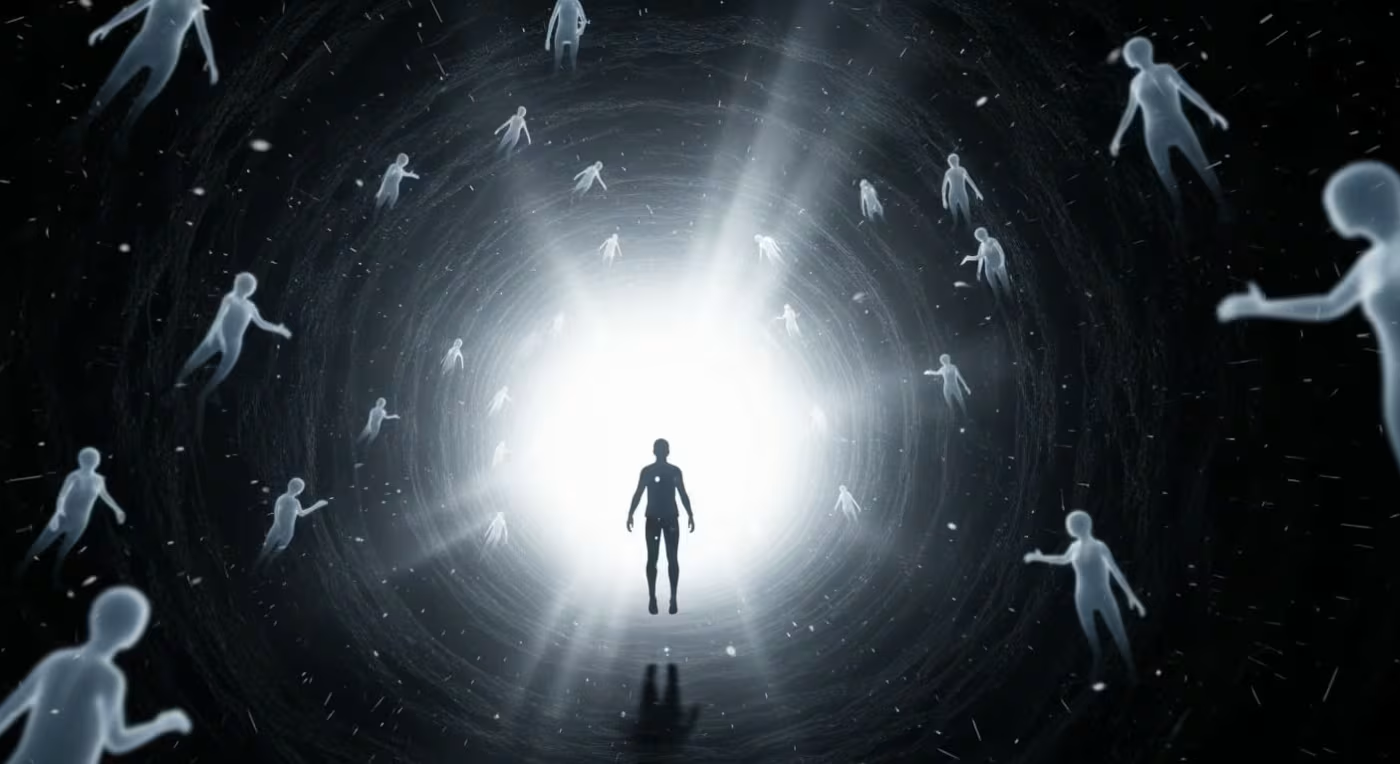
Descriptions of this transition invariably converge upon a disturbing pattern. First comes disembodiment: the sensation of weightless floating, coupled with the ability to perceive one's own inert carcass from a zenithal perspective. Distant sounds distort, time sheds its tyrannical linearity and dilutes into an eternal present. It is the first step down a corridor where the laws of physics lose their mandate and consciousness operates upon a wholly emancipated plane.

II. The Echoes of History and Mythology
To believe this phenomenon belongs exclusively to the era of medical technology is to ignore the deep, ancestral memory of our species. Long before Raymond Moody coined the term in the 1970s and revolutionized parapsychology with his work ‘Life After Life’, ancient civilizations were already mapping these very territories in their sacred texts. In the Ancient Egyptian papyrus known as the ‘Book of the Dead’, in Orpheus's descent into the shadowy Hades of Hellenic mythology, or through the intricate passage of the Tibetan ‘Bardo Thodol’, accounts of journeys into the great beyond share an unmistakable, haunting structure.
Across all these cultures, the dying soul undergoes an intimate judgment—an encounter with a blinding light or entities of incomprehensible compassion—alongside a panoramic review of its own existence. The pioneering work of researchers like Kenneth Ring and Elisabeth Kübler-Ross merely provided a scientific framework for what shamans, priests, and mystics had whispered for millennia. The evolution from myth to medical statistics proves that humanity, across every latitude and era, has always sensed that death is not a full stop, but a radical transformation of perspective.
III. The Mirror of Time and the Life Review
One of the most unsettling aspects of the NDE is the so-called life review. This is no mere nostalgic parade of memories, but a simultaneous, multidimensional immersion. Those who have crossed through it recount reliving every act, every whispered word, and every hidden thought, yet with a terrifying caveat: they directly feel the emotional fallout their actions inflicted upon others. If they caused pain, they taste that agony in their own flesh; if they offered solace, they experience that same warmth magnified tenfold.
This experience operates as an internal tribunal where judgment does not emanate from an implacable external deity, but from the individual's own magnified consciousness. Upon returning to the physical body—a return almost invariably described with a deep sense of frustration or melancholy at finding oneself once more confined within flesh—the subject is forever altered. Priorities shift drastically; the dread visceral dread of death vanishes, replaced by an unshakable certainty regarding the sheer vastness of existence.
IV. The Fracture of Certainty
What truly happens upon the threshold? Science offers hypotheses rooted in massive serotonin surges, cerebral hypoxia, or residual electrical firings within a dying brain. Yet not a single one of these theories can satisfactorily explain how utterly unconscious patients, exhibiting apparent brain death, manage to recount with millimeter precision conversations held down distant corridors or surgical intricacies that occurred while their eyes remained sealed and their hearts lay still.
The Near-Death Experience thus remains an unfathomable abyss, a relentless reminder that our comprehension of reality is merely a fragile husk. When the cardiac monitor flickers back to life and air is forced into the lungs, the traveler returns with secret hidden deep within their gaze, knowing that the veil separating this world from the great silence is infinitely thinner than we dare admit within our mundane daily routines.
📜Investigation • Frequently Asked Questions
Documentary Archive and Analysis of the Occult • Relatando.com
What origin or documented testimony inspired this investigation into NDEs?
The pioneering research of psychiatrist Raymond Moody in the 1970s, compiled in his work 'Life After Life', systematized the testimonies of patients returned from cardiac arrest.
What are the physical signs or anomalies that precede or accompany this phenomenon?
The most frequent reports include the sensation of disembodiment, panoramic vision from an elevated perspective, weightlessness, a radical distortion of time, and passage through a tunnel toward an intense light.
Is there any universally accepted psychological or scientific explanation?
Absolute consensus remains elusive. While medicine attributes NDEs to neurochemical surges triggered by cerebral hypoxia, consciousness researchers debate the autonomy of the mind distinct from the physical vessel.
How do folklore and ancient history respond to these types of transitions?
From the Egyptian Book of the Dead to the Tibetan Bardo Thodol, ancient cultures interpreted these occurrences as shamanic journeys or the soul's transit into spiritual realms prior to rebirth.
Do not extinguish the light yet...
If you have had the courage to make it this far, we have other dossiers that will test the limits of your sanity.

Terms and Figures of this Tale
To delve deeper into the legends, creatures, and dark concepts that inspire this account, consult their entries in our dictionary of the uncanny:





Tu correo no se publica ni se comparte con terceros: solo sirve para notificar la respuesta.