Chapter I: The Threshold of Concrete and Gloom
The torrential rain battering the Cantabrian Mountains had turned the old regional highway into a ribbon of slick, black asphalt, flanked by slopes choked with filthy eucalyptus and eroded stone. Julián kept both hands locked onto the steering wheel of his aging sedan, a vehicle whose suspension groaned at every mountain curve. It was nearly three in the morning. The dashboard cast a faint amber glow over his worn face, accentuating the deep hollows beneath his eyes, carved by twelve unbroken hours of driving from the coast.
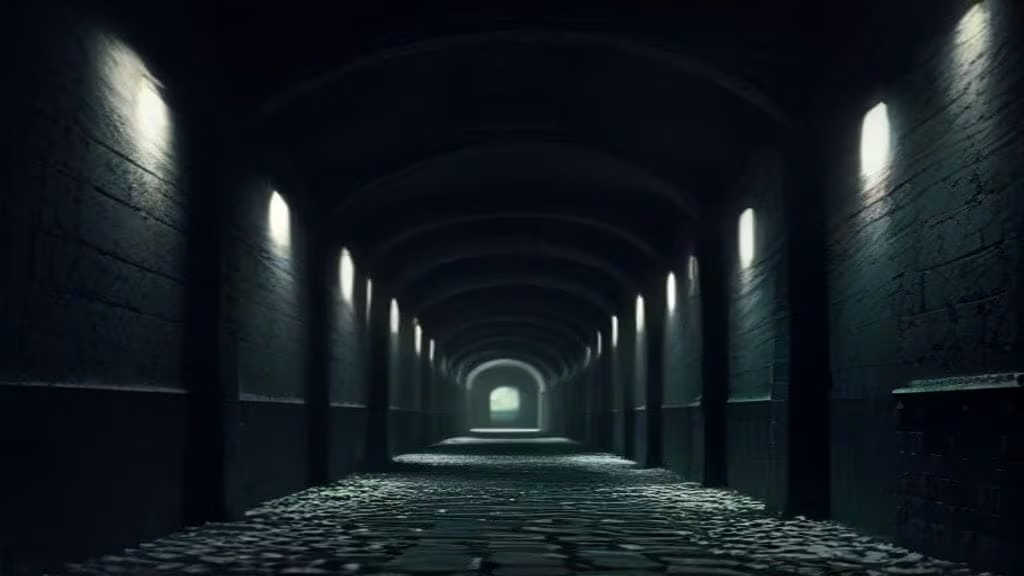
For forty minutes, the radio had been spitting nothing but static, a white hiss that seemed to keep rhythm with the windshield wipers lashing against the glass. It was then that the concrete monolith emerged from the fog: the mouth of the San Amado Tunnel. A rectangular, cavernous, and dismal cavity, bored into the bowels of the mountain midway through the last century to link two valleys forgotten by God.
A rusted sign, partially choked by moss and pockmarked with the lead shot of poachers, bore warning of the gallery's length: 2,000 meters. No exterior light marked the threshold; only the jaundiced glare of the car's headlights pierced barely a couple of meters into the interior blackness. Julián slowed to a crawl. A sudden, dry, bone-chilling shiver crawled up his spine. Sitting in the isolation of the cabin, time seemed to dilate as the car's nose crossed the dividing line between the distant storm and the mineral silence of the cave.

At first, the drive felt routine. Along the vaulted ceiling of the tunnel, aligned in a sickly geometry, the aging sodium-vapor lamps flickered with an agonizing pulse. A light, shadow, light, shadow hypnotic rhythm cast long, distorted shapes across the damp asphalt. Every flicker was accompanied by a low electrical hum, akin to the buzzing of a swarm of mechanical insects trapped behind the concrete walls.
Chapter II: The Anatomy of Silence
As the car crept toward the center of the tunnel, the engine's heat seemed utterly futile. The temperature inside the cabin plummeted so drastically that Julián's breath crystallized into fleeting white wisps that clouded the rearview mirror. The stench of ozone, stagnant dampness, and something else—something akin to cured meat or freshly turned earth from a mass grave—poured violently through the ventilation vents.
Julián glanced at the trip odometer: eight hundred meters covered. More than half the gloom still lay ahead. He checked the rearview mirror. The tunnel entrance was nothing more than a pinprick of blurred light languishing behind him, swiftly devoured by the subterranean fog. Before him, the passage seemed to contract, as though the stone itself were chewing up the space.
And then came the collapse.
It was no gradual failure. At the one-kilometer mark, every single sodium fixture on the ceiling went dark all at once with a dry snap that echoed like a rifle shot through the stone vault. In that exact millisecond, the car's tachometer needle dropped to zero. The halogen headlights, which until then had sliced through the fog with their yellowish beams, flickered twice in agony and died completely, leaving the dashboard utterly dead.
The car lost all traction. Driven solely by the momentum of its prior velocity, the sedan continued to glide blindly across the unseen pavement. Julián slammed his foot onto the brake pedal in desperation, but the power brakes refused to answer; the pedal was hard as a block of lead. The vehicle rolled a few yards further before coming to a complete halt amidst the absolute, thick, and suffocating darkness at the heart of the tunnel.
The silence that followed was unbearable. A dense, heavy, almost organic silence that plugged Julián's ears with the crushing pressure of an ocean trench. The engine no longer roared. The radio had gone dead. Nothing remained except the frantic, hammering beat of his own heart reverberating against his ribs.
Chapter III: A Hundred Palms Against the Metal
Julián remained motionless, gripping the steering wheel with white-knuckled tension. His eyes, dilated to the absolute limit, tried to pierce a blackness so dense it produced the tactile illusion of being submerged in liquid soot. He turned the ignition key. Once, twice, three times. The starter motor didn't even click. The battery seemed to have been instantly drained, emptied by some invisible force inhabiting the cave walls.
—Come on, for the Virgin's sake… come on, start—he whispered, his voice shattered by panic.
It was in that very moment of supplication that the first impact struck.
WHACK!
A dry, resounding, and violent blow echoed directly against the metal of the passenger-side door. The impact was so severe it shook the entire chassis of the car. It did not sound like a stone hurled from the gloom, nor like the collision of a disoriented animal. It was the unmistakable, spine-chilling sound of a bare palm slamming with full force against the exterior bodywork.
Julián jerked in his seat, a scream choked off in his throat. He whipped his head to the right, but saw nothing. Only absolute darkness pressed flat against the window glass.
THUD! THUD!
Two more heavy slaps, this time landing on the hood. The metal groaned beneath the assault. The air inside the cabin turned unbearably thick, saturated with an acrid stench of damp skin and rancid fat. The blows did not stop; they began to multiply in a frantic, chaotic rhythm.
SLAP! THUD! SLAP! SLAP!
Dozens of unseen hands began to batter the sheet metal. They pounded against the trunk, the side panels, the roof pillars, the radiator grille. An unceasing scourging, a rain of dry palms echoing within the car's metallic resonance box as though thousands of hide drums were being beaten by lunatics amid an ancestral rite.
The car began to rock gently on its suspension beneath the pressure of that invisible mob. Julián shrank into the center of the driver's seat, pressing his hands to his head as the frame reverberated with the violence of the impacts. He could feel the vibration of every blow passing through the door frame and traveling up from the floorboards straight into the soles of his feet.
Chapter IV: What Awaits in the Throat of Stone
With his hands shaking uncontrollably, Julián remembered the metal flashlight in the glove compartment. He reached out blindly into the gloom, scattering papers and maps until his fingers brushed against the cold aluminum cylinder. He grabbed it, pulled it out clumsily, and shoved the switch forward.
A thin, pale beam of white light cut through the darkness of the cabin. Julián aimed the beam toward the driver's side window.
What he saw froze the blood in his arteries and paralyzed his lungs.
Pressed directly against the window glass, mere centimeters from his face, was a human palm. But it was no normal hand. It was disturbingly long, with sallow fingers possessing an extra joint, entirely devoid of nails, their tips worn down to expose raw, bloodied flesh. The skin was a cadaverous white, yellowish like wet parchment, stretched tight over slender bones that showed translucent beneath the weak light of the flashlight.
And she was not alone. All along the side window, dozens of those ravenous hands piled up, slipping against the glass, leaving behind trails of a blackish, foul-smelling grease. They beat against the pane with a blind desperation, driven by starving arms that reached out from the deepest black of the tunnel, seeping from the cracks and fissures of the aged concrete.
Julián swept the flashlight beam beyond the glass. The glare partially illuminated the mass surrounding the vehicle. There were no visible faces, only a tight tangle of pale limbs and deformed, naked torsos twisting together in an amorphous, starving heap. Beings that had never seen sunlight, blind and forgotten creatures inhabiting the bowels of the port, drawn by the vibration and warmth of the unwary trapped within the belly of the mountain as the lights died away.
The glass of the rear window began to yield. A web of fine, spider-like cracks spread across the surface under the relentless pressure of ten, twenty, thirty hands pounding simultaneously.
SNAP!
A small fragment of glass flew inward. A long, whitish finger immediately thrust through the hole, thrashing frantically in the air like a blind worm searching for prey.
Chapter V: The Light That Does Not Dispel the Shadow
Supreme panic—the kind that obliterates reason and awakens primal survival instinct—seized Julián. He violently twisted the ignition key with his left hand while pounding the dashboard with the flashlight in his right.
—START, DAMN YOU! START! —he screamed in a guttural howl that grazed the edge of madness.
The engine made an agonizing attempt. A spark spat within the motor. The voltmeter needle jerked hard. Julián slammed his foot all the way down on the accelerator. Suddenly, with a deafening roar that rattled the exhaust headers, the engine sprang back to life. The halogen headlights flared on all at once, projecting a blinding beam straight ahead.
The sudden glare provoked a unanimous, high-pitched screech, akin to the whistle of a steam locomotive mixed with the lament of a thousand dying rodents. Blinded and burned by the incandescent light, the creatures fell back in a stampede, releasing the vehicle's frame with a wet, sucking snap.
Without looking back, without checking the state of the tires, and caring nothing whether he crushed the squirming, blood-slick mass writhing before his bumper, Julián slammed the car into first and floored the gas. The tires hydroplaned across the wet asphalt before catching, burning rubber with a hysterical screech.
The car lunged forward. For the remaining eight hundred meters, pale hands reached desperately for the sides of the vehicle from the edges of the shadows, but the sedan's speed left them behind. Blows struck the rear with sporadic thuds—SLAP! SLAP!—like the death throes of a nightmare refusing to let go of its prey.
And then, with the sudden, wrenching violence of a traumatic birth, the car burst from the mouth of the tunnel.
The night's torrential rain lashed against the windshield once more. The cool, saline air of the outer valley flooded the cabin through the jagged opening of the shattered rear window. Julián did not brake. He drove like a man possessed for more than twenty kilometers until he reached the first illuminated gas station bordering the highway.
There, beneath the sickly hum of the service station's fluorescent tubes, he stepped out of the car on trembling legs, a still-lit flashlight clutched in his hand. As he walked around to inspect the damage, the attendant—who had rushed out at the screech of the arriving vehicle—dropped the fuel nozzle to the concrete and brought his hands to his mouth.
The sedan's metallic paint was ruined. The entire bodywork, from the hood to the trunk lid, was smothered in hundreds of greasy, grayish smudges. Perfect impressions of elongated human palms, their fingers having clawed through the metal down to bare sheet. And right in the center of the roof, etched in a thick, stinking soot that the rain refused to wash away, a colossal print was warped and smeared, as though something of impossible proportions had leaned down from the cave's crown just to watch the survivor pass.
Julián gazed toward the distant mountain, where the San Amado pass loomed beneath the tempest like a slumbering titan. He knew, with the brutal certainty of the damned, that he would never again turn off the lights in his house, and that every time he crossed a shadow, he would hear once more the dry echo of those starved hands waiting in the dark.
📜Investigation • Frequently Asked Questions
Documentary Archive and Analysis of the Occult • Relatando.com
What does the San Amado Tunnel symbolize within the Mythology road lore of the Cantabrian Mountains according to local folklore?
Within the context of narrative anthropology and regional folklore, abandoned infrastructures like the San Amado Tunnel serve as liminal thresholds between the civilized world and the chthonic domains of the mountain. The transition from the raging storm outside into the mineral silence evokes ancient myths of descent into the underworld, leaving the traveler suspended outside conventional time.
How do the sensory atmosphere and the device of flickering light influence the psychological tension of the tale?
Carlos Nieto deploys remarkable technical mastery by synchronizing the flickering of the sodium-vapor lamps with the protagonist's biological and mental rhythm. This intermittent stutter of light, compounded by the electrical hum and the drastic plummet in temperature, scrambles Julián's senses, twisting a routine drive into a claustrophobic descent of depersonalization and absolute isolation.
What documentary and geographical implications does the choice of the Cantabrian Mountains as the setting for this nocturnal incursion hold?
The Cantabrian Mountains, historically defined by treacherous high passes and isolated valleys, lend an undeniable documentary realism to the work. The references to the local county road and the mid-century construction projects anchor the narrative in an era of aborted modernization, where raw concrete and perpetual twilight consume the traces of the region's collective memory.
What analytical interpretation can be drawn from the olfactory transition, from ozone to the scent of freshly turned earth?
From the perspective of literary analysis at Relatando.com, the olfactory evolution acts as an ominous omen. The initial scent of ozone harks back to the natural storm left behind, but its gradual replacement by the stench of cured meat and common grave soil marks the intrusion of the macabre, suggesting that the tunnel is not a mere geographical passage, but a temporal pit harboring unspeakable secrets.
Do not extinguish the light just yet...
If you have had the courage to make it this far, we have other dossiers that will test the limits of your sanity.

Terms and Figures of this Tale
To delve deeper into the legends, creatures, and dark concepts that inspire this account, consult their entries in our dictionary of the uncanny:


Tu correo no se publica ni se comparte con terceros: solo sirve para notificar la respuesta.