The sixteen-ton Scania's engine roared with a dull monotony, a relentless vibration that worked its way into the teeth and hummed at the base of the skull. Mateo gripped the steering wheel with white knuckles, his fingers numb from a heater that never quite managed to warm the cab. Outside, the Pyrenees weighed down like a slab of lead and basalt—a five-thousand-meter mass of sheer rock that choked radio signals and cast the world into perpetual gloom. Ahead yawned the black maw of the Vielha Tunnel: over five kilometers of damp concrete, flickering fluorescent tubes that buzzed like insects trapped in oil, and a dense stench of burnt diesel, mineral rot, and hot tire rubber.
He shifted into high gear and swallowed the darkness. The headlights bounced off curved walls eroded by decades of condensation and winter salt. There was no traffic. At three in the morning, the international route turned into a deserted gorge, a digestive tract through which the heaviness of the night circulated. Mateo lit a cigarette with the dashboard lighter; the metallic click was the only sound that competed with the engine. The bluish smoke hung thick, stagnant in the foul air of the cab, mingling with the smell of stale thermos coffee and his own acidic sweat.
I. The Reflection in the Mirror
A truck's side mirrors are altars to nocturnal paranoia. Through them, the world shrinks into two amber rectangles where distance lies and shapes distort. Mateo cast a routine glance into the right-hand mirror. The ribbon of asphalt gleamed wet, reflecting the distant flicker of the last sodium lamp they had passed. And then, sitting atop the concrete guardrail dividing the emergency lane, he saw her.

She was no vague silhouette. His clearance lights illuminated the figure with unholy harshness. A little girl. She must have been seven or eight, clad in a plastically glossy yellow coat far too big for her frail shoulders. Her legs were crossed with military stiffness, her feet swinging leisurely, as if waiting for a bus at some ordinary city stop. But there were no sidewalks here. Only the belly of the mountain, absolute blackness, and the hollow echo of the engine.
Mateo’s stomach seized in a dry, violent lurch—a visceral knot that choked the breath from his throat. He locked his eyes on the mirror, refusing to blink, for dread fear that the image might vanish, or that his own exhaustion was playing some macabre trick on him. The girl slowly turned her face toward the moving truck. Her skin was a translucent, almost bluish white, and her eyes were utterly devoid of light—two empty sockets, or perhaps simply too dark to reflect the sweep of the headlights. She didn't scream. She didn't cry out for help. She simply watched the heavy passage of the sixteen-ton rig with an icy curiosity.
—What the hell… —Mateo muttered, his voice raw, rasped dry by tobacco.
The darkness beneath the mountain does not hesitate; it waits for the traveler to drop their guard to remind them they were never alone on the road.
He tapped the brakes, feeling the trailer protest with a metallic squeal. He considered stopping, throwing it in reverse, but a visceral urgency—a primary survival instinct crawling across his forearms like electric shocks—ordered him to keep accelerating. They were at kilometer three of the tunnel. Two kilometers left to the southern exit. The air in the cab suddenly grew unbreathable, thick, laden with a metallic chill that did not originate from the ventilation system.
II. The Three Knocks
The truck swept past the figure. Mateo kept his eyes fixed straight ahead, his heart hammering against his ribs like a bird trapped in a shoemaker's box. He thought it was over, that the nightmare was being left behind, dissolving in the rearview mirror. He glanced sideways at the instrument panel, searching for the temperature gauge, anything to restore a shred of mechanical normalcy.
A dry, metallic, and heavy impact echoed against the passenger-side window.
Bam! Bam! Bam!
Three rhythmic knocks, delivered with a force disproportionate to a child's limb. Mateo snapped his head around. Through the tinted glass, coated with a fine film of tunnel dust and grease, he saw a tiny hand pressed flat against the pane. The fingers were rigid, the palm flattened against the surface, leaving a whitish smear of condensation. The hand slowly slid downward, leaving a damp streak as the truck rolled on at eighty kilometers per hour in the underground dark.
The Horror did not hit him all at once; it seeped in slowly, paralyzing every muscle fiber. Mateo couldn't scream. His hands shook so violently on the wheel that the truck veered half a meter into the oncoming lane. The damp, heavy scent of the mountain suddenly flooded the cab, displacing the stale tobacco smoke: an odor of wet earth, of stone decayed by centuries of darkness, and of something sourer—something akin to stagnant water trapped in a sealed cellar.
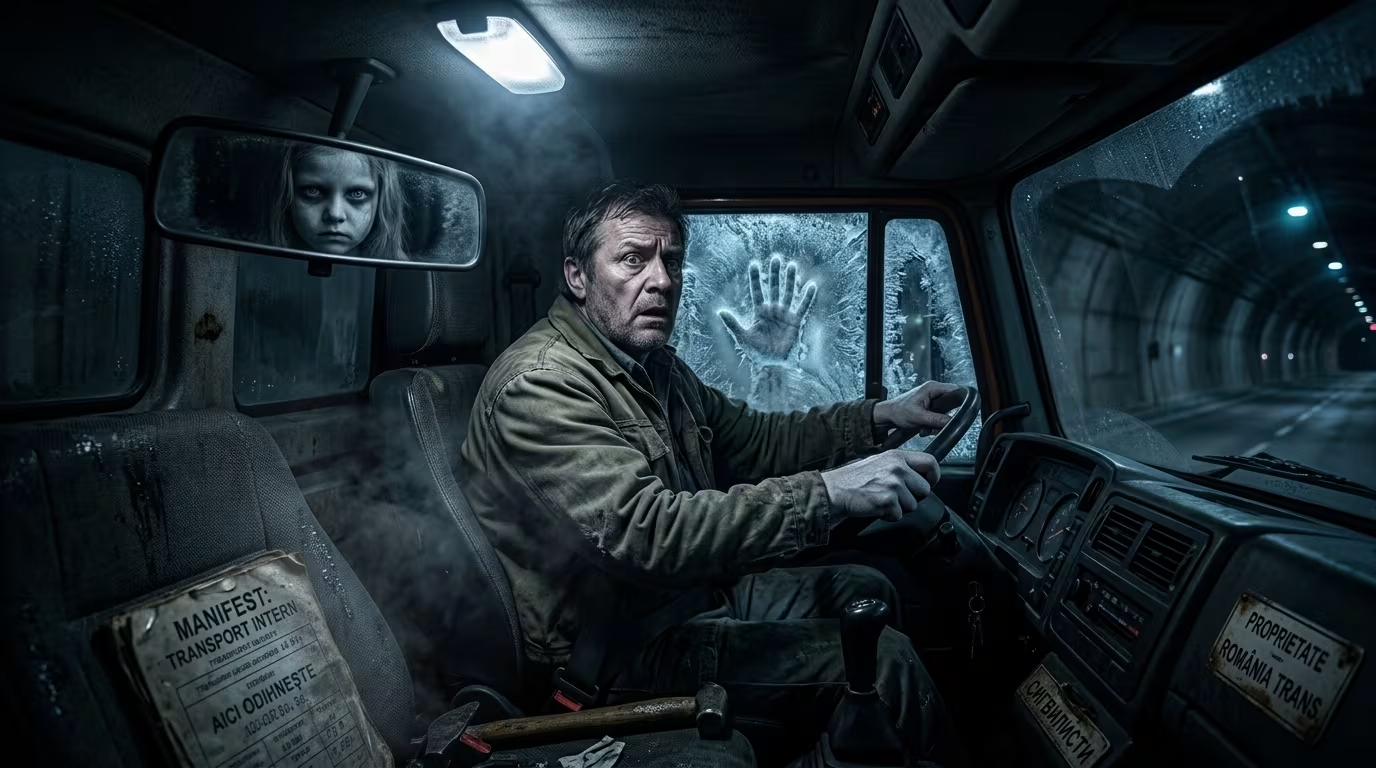
He looked at the passenger seat. It was empty, covered by his work jacket and a crumpled road map. But the glass still bore the silhouette of those five tiny fingers, and the cold emanating from that window was so intense that ice was beginning to crystallize along the edges of the frame.
III. The Exit to the Void
The overhead fluorescents began to flicker faster, turning the journey into a stroboscopic succession of shadows and yellowish flashes. Every time the light died for a second, Mateo thought he saw a white bulk crouched over the dashboard, or breath fogging the windshield from the other side, right before his eyes. He floored the accelerator, ignoring the tachograph warnings, chasing the long-desired clarity of day or at least the leaden gray of the Pyrenean dawn.
The mouth of the tunnel appeared in the distance like a tiny needle of white light. With a deafening roar, the Scania burst out into the open, abandoning the entrails of the rock. The cold dawn air battered the chassis. Mateo slammed on the brakes at the first pull-off outside the tunnel, leaping from the cab before the engine had even finished settling.
The silence outside was absolute, broken only by the steady ticking of the cooling exhaust pipe. Mateo leaned back against the truck door, gasping down mouthfuls of freezing air that scorched his lungs. He looked at his hands: they were still shaking. He walked slowly toward the passenger-side door, driven by an irresistible blend of dread and a morbid compulsion to verify.
He shone his mobile phone's flashlight against the side window. The handprint was still there. But the damp smear on the outside wasn't the worst of it. Through the glass, in the gloom of the passenger seat, the work jacket no longer lay crumpled on the cushion. It had volume. It was bloated, taking on the crooked shape of a small, shrunken body that watched him from within with infinite patience, waiting for him to start the engine again.
📜Investigation • Frequently Asked Questions
Documentary Archive and Analysis of the Occult • Relatando.com
On what myth or real fear is this tale based on?
It feeds on the urban legends of hitchhikers Phantom and the visceral claustrophobia triggered by long journeys beneath the mountains.
Are there documented real cases similar to this story?
Numerous truckers and nocturnal drivers swear they have witnessed figures and inexplicable anomalies deep within the great European highway tunnels.
What does the ending of the story mean?
It represents the impossibility of escaping trauma and how the presences of the road permanently cling to the traveler's psyche.
Do not extinguish the light just yet...
If you have had the courage to make it this far, we have other dossiers that will test the limits of your sanity.

Terms and Figures of this Tale
To delve deeper into the legends, creatures, and dark concepts that inspire this account, consult their entries in our dictionary of the uncanny:


Tu correo no se publica ni se comparte con terceros: solo sirve para notificar la respuesta.