I. Etymology, Folk Roots, and Oral Tradition
At the northern extreme of Sverdlovsk Oblast, where the Ural range folds its spine against the desolation of the Siberian tundra, there rises a stony elevation that Russian cartography christened simply as Elevation 1079. Yet for the Mansi nomads — reindeer hunters of Ugro-Finnic stock who have roamed these taigas since the Neolithic — that windswept pass answers to a far more ominous name: Jólat Siajl, which in their vernacular translates inexorably as the Mountain of the Dead or the Dead Mountain. Far from the usual descriptive toponymy, this name originally alluded not to the absence of arboreal vegetation on its slope, but to an ancient cosmological warning.
Mansi oral tradition records that during a primeval flood—a mythological deluge sent by the wrathful spirits of the taiga—nine hunters of their people sought refuge on the summits of this massif. The waters and the howling winds devoured the fugitives one by one until no trace of their lineage remained. Since then, the number nine has been sealed as a funereal cipher in the shamanic memory of the Urals. Passage along its slopes was forbidden during the winter moons, for it was believed that there dwelt the Menkvi, primordial wild entities born of mud and undergrowth, gigantic beings described not as flesh-and-blood beasts but as condensations of the territory's vegetal and mineral hostility, capable of tearing reason from men by way of whispers that ride upon the blizzard.
Near this promontory rises Mount Otorten, the final destination the 1959 expeditionaries would never reach. Popular wisdom usually renders this term as "Don't go there," feeding the aura of a geographical condemnation. Although Soviet linguists later pointed out that the name stemmed from a Mansi topographic transcription error—referring in fact to the hill where the winds are born—the collective unconscious of the riverside dwellers along the Lozva River embraced the warning as an unappealable truth: the mountain demanded the tribute of absolute solitude, and any intrusion by modern man, equipped with the pride of technique and positivist cartography, constituted a sacrilege against the invisible masters of stone and ice.

II. Morphology, Signs, and Phenomenology
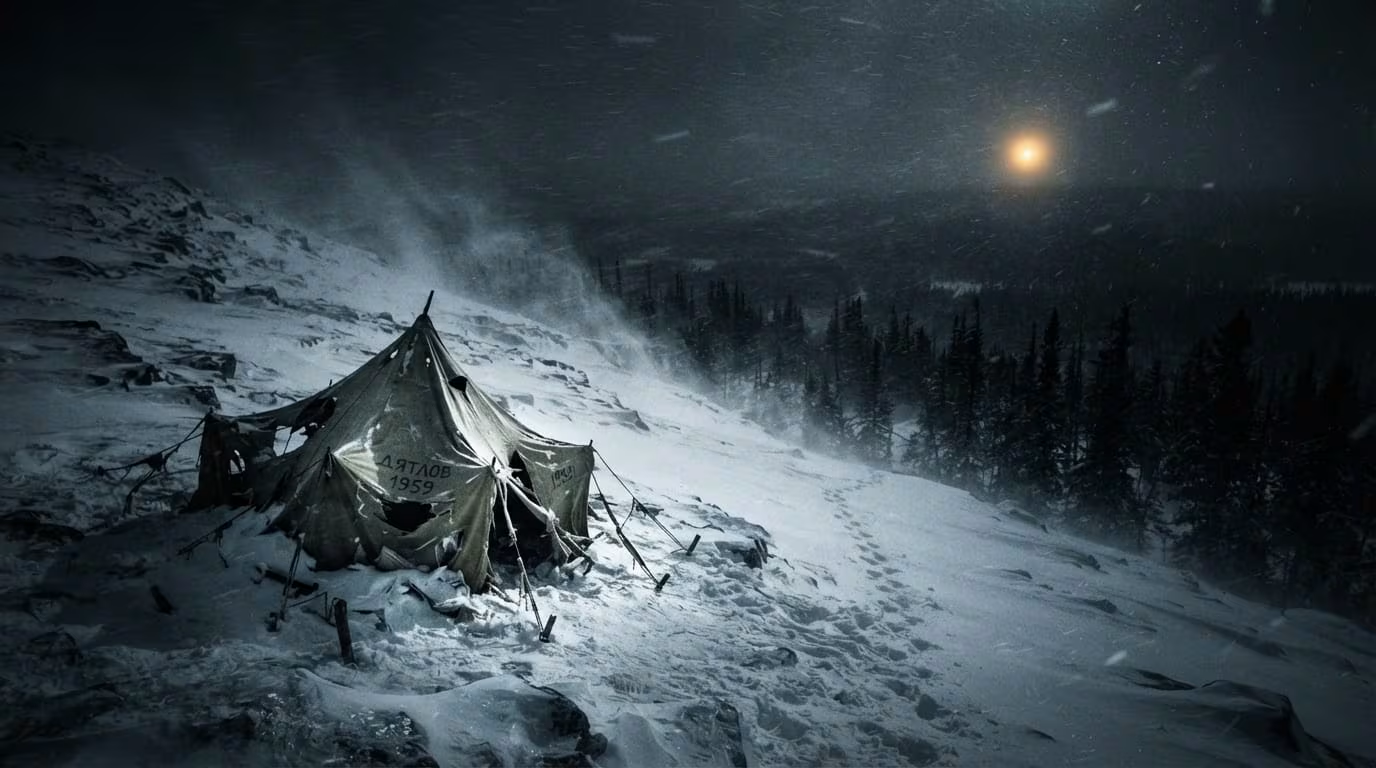
The disaster site unfurls a phenomenology as precise in its material vestiges as it is hermetic in its mechanical causality. On the night of February 1–2, 1959, the temperature on the slopes of Jólat Siajl plummeted to an unrelenting thirty degrees below zero, driven by blizzard gusts that erased any line of horizon. Yet the anomalies detected at the scene defy the elementary biological response to extreme cold. The group's tent, pitched with military discipline on the open slope, was found weeks later slashed from its inner face by desperate longitudinal cuts, which rules out an exterior attack by a quadruped predator or a conventional armed incursion.
The nine hikers abandoned their sole refuge for survival stripped of their heavy winter gear: barefoot, in socks, or in thermal underwear, they set off downhill toward the forest in coordinated formation. The tracks fossilized in the snow proved they did not flee in hysterical disarray, but walked step by step, in an implausible silence, toward the treeline a mile and a half away, as if obeying a peremptory command or seeking to evade a threat that saturated the air—or the tent's own fabric enclosure.
"It is medically inexplicable that subjects in full possession of their cognitive faculties would prefer to face certain freezing in the blizzard rather than remain inside a shelter furnished with blankets and a stove, unless the tent itself had become a trap of intolerable horror."
The anatomical phenomenology of the corpses, recovered in two chronological phases, adds a disconcerting physical dimension. While the bodies found beside the ancient millennial cedar and on the slope revealed deaths by severe hypothermia with superficial burns on hands and feet—evidence of belated attempts to keep a precarious campfire alive—the four hikers exhumed in May 1959, buried beneath four meters of packed snow in a torrent bed, presented injuries of devastating violence. Multiple thoracic fractures and massive cranial depressions of a nature akin to the kinetic impact of a speeding vehicle or gravitational overpressure, yet leaving no bruises, lacerations, or subcutaneous hematomas on the superficial epidermis.
To these invisible fractures were added mutilations of a chilling precision: the complete disappearance of the tongue and the floor of the mouth in Lyudmila Dubinina, the ablation of eyeballs in several of them, and a pigmentary alteration in the dermal integuments, described by military forensic doctors as a coppery, orange, or ashen coloration incompatible with the usual putrefaction below zero. Likewise, the dosimetric analyses performed on the clothing of Kolevatov and Krivonischenko yielded abnormally high levels of secondary ionizing radiation, a spectral trace that official science never managed to link to any declared mining or military activity in the Auspiya valley.
III. Period Chronicles and Testimonial Cases
The expedition, composed of eight men and two women affiliated with the Ural Polytechnic Institute (UPI) and led with iron prudence by engineer Igor Alekseyevich Dyatlov, represented the pinnacle of Soviet Class III hiking. They were athletes seasoned in survival traverses, adept at compass reading and the behavior of snow masses. The preserved testimony of Yuri Yudin, the tenth member who abandoned the march at the mining settlement of Vizhai due to an acute attack of sciatica, forms the last earthly portrait of the group. Yudin recalled the calm mettle of his comrades and the technical certainty with which they faced the ascent toward the sources of the Lozva, oblivious to the shadow closing over the pass.
The legal proceedings drawn up by prosecutor Lev Nikitovich Ivanov and investigator Vasily Tempalov in the spring of 1959 remained entombed for decades in the classified archives of the Sverdlovsk regional bureaucracy. Among the yellowed folios of the criminal record lie testimonial depositions of an inescapable strangeness. Oksman, captain of a nearby military detachment, together with members of another ski patrol camped fifty kilometers south of Height 1079, formally declared having sighted in the night sky of February 1 and 2 strange fiery luminous spheres of brilliant orange that drifted erratically northward, leaving trails of phosphorescent vapor before vanishing behind the peaks.
"In the records of case number 643 there is no human or material conclusion: the file was closed under the formula that the young people met death due to an elemental force of a spontaneous and irresistible nature, which the mountaineers were in no condition to overcome."
Years after the collapse of the Soviet regime, prosecutor Ivanov himself confessed to independent press that political pressure from the highest echelons of the CPSU Central Committee had shut down the investigation prematurely and absolutely. The official admitted that ballistic analyses, radiological samples, and reports concerning bolides or celestial disks had been confiscated by special commissions dispatched from Moscow. Volunteer rescue workers, among them Boris Slobtsov and Mikhail Sharavin—who discovered the half-buried, empty tent with an ice axe driven into the snow and provisions left untouched—recounted how the atmosphere at the military base camp was dominated by a suffocating secrecy, with KGB officers supervising every autopsy performed at the hospital secret in Ivdel, demanding that the sealed zinc coffins be buried in remote peripheral cemeteries without public processions.
IV. The Anatomy of Fear: Psychological and Symbolic Dimension
Beyond the endless quarrel among rational hypotheses —the slab of snow or small delayed avalanche, the tests with thermobaric weapons or R-12 missiles, and the acoustic theory of the Kármán vortex generating wind-induced infrasound—, Dyatlov Pass operates in the universal imagination as an open archetypal wound. It represents the absolute collapse of the inner refuge, the definitive desecration of what Carl Gustav Jung would call the sanctuary of the Ego before the devastating irruption of the Collective Unconscious in its most telluric and hostile form.
The image of the tent slashed open from within condenses a primordial anthropological nightmare: the biological need to destroy one's own protective dwelling in order to hurl oneself into the abyss of cold and exposure. It suggests that whatever materialized inside that enclosed space —whether an asphyxiating gas, a collective psychotic hallucination triggered by infrasonic panic, or the manifestation of a horror beyond physical nomenclature— turned the saving fabric into a suffocating shroud. In the architecture of human dread, cold is usually associated with stillness and silent death; yet on the Dyatlov Pass, cold combines with selective mutilation and the internal shattering of bones, stripping the explorer of their noblest senses: sight, voice, and speech.
The Dyatlov Pass drama stages the defeat of twentieth-century scientific rationalism before the ancestral mystery of the Earth's liminal zones. Those young Soviet technicians, proud standard-bearers of atomic progress and dialectical materialism, carried their notebooks, their Zorki cameras, and their thermodynamic knowledge into the heart of a mountain that Mansi tradition had consecrated to funereal silence. The result was not a civilizing feat, but a tragic vestige where nature —or that which nests in its uninhabited folds— devoured the heralds of modernity, leaving them exposed on the ice as a monument to the frailty of our hubris, a forensic hieroglyph whose key to reading lies irrevocably frozen beneath the snow of the Urals.
📜Investigation • Frequently Asked Questions
Documentary Archive and Analysis of the Occult • Relatando.com
In what manner does the ancestral toponym 'Kholat Syakhl' transcend mere geography to become a cosmological warning within Mansi lore?
Far from being a descriptive designation, 'Kholat Syakhl' embodies an ontological interdiction within the worldview of Mansi hunters. The toponym functions as a sacred boundary marker delimiting the domain of the Menkvi spirits, recalling the myth foundational myth of the deluge and the loss of the nine ancestors, transforming the mountain into a forbidden space.
How did the myth of the nine drowned hunters influence the symbolic and funereal weight of the number nine in the tragedy of Igor Dyatlov's group?
The number nine operates in the shamanic memory of the Urals as a cipher of fatality and ritual tribute. The exact numerical coincidence between the nine modern hikers who died in 1959 and the nine hunters of the primordial myth immediately fed the collective terror, interpreted as the inexorable fulfillment of an ancient territorial sentence.
What historical dissonance exists between popular etymology and Soviet philology regarding Mount Otorten?
While the folklore of the river dwellers translated 'Otorten' as the imperative warning 'Do not go there,' Soviet linguists later demonstrated that it was a cartographic error stemming from the Mansi name for the hill where the winds are born. Nevertheless, the collective unconscious prioritized the Legend of prohibition.
In what way did the intrusion of Soviet positivist cartography collide with the invisible masters of stone and ice at Elevation 1079?
The 1959 expedition represented the triumph of modern technique, systematic exploration, and the pride of the Soviet State over virgin nature. For the inhabitants of the taiga, that incursion equipped with maps and compasses constituted a direct sacrilege against the primordial entities that govern the Jólat Siajl.
Don't extinguish the light just yet...
If you have had the courage to make it this far, we have other dossiers that will test the limits of your sanity.

Terms and Figures of this Tale
To delve deeper into the legends, creatures, and dark concepts that inspire this account, consult their entries in our dictionary of the uncanny:

Tu correo no se publica ni se comparte con terceros: solo sirve para notificar la respuesta.