The mud was not warm, as it usually was at dusk in the estuary, but glacial, viscous, with a density that clung to the ankles like whale blubber. Eliana took another step, burying her toes in the rotten silt while the stench of decomposing mangrove and tepid brine filled her nostrils with a nauseating weight. Ahead of her, barely four strides away among the stilt roots that dropped from the vegetal canopy like opened ribs, walked her mother. She wore the dress of flowers bleached by lye, yet the fabric, strangely, caught not a single splash of the mire that already covered Eliana's knees.
I. The Broken Compass
The first sign was the rhythm. Her mother had always walked with an almost musical ease, swaying her hips with the cadence of coastal women who carry washboards on their crowns without spilling a drop of river water. Now, however, her advance had a dull stumble. A soft, light step, followed by a dry, muffled blow, like that of a pestle sinking into the deep peat.
"Mama, wait," said Eliana. Her voice sounded small, swallowed at once by the thick foliage that cancelled all echo. "One of my espadrilles got stuck in the bottom."

The woman did not stop short. She slowed her pace, twisting her neck at too forced an angle, without moving her shoulders. The toquilla straw hat cast the upper half of her face into shadow, leaving visible only dry lips, cracked at the corners, which seemed to draw taut beyond what was natural when she smiled.
"Leave it, my darling. The mud is hungry today; don't fight it for the garment. Further on I have the shrimp. Big as fists. The ones you like."
Eliana blinked, trying to dispel a hot mist that stung at the corners of her eyes. Her mother had twisted her right ankle three nights earlier while unloading the canoe at the town's rotting wooden dock; it was reasonable that she should limp, that she should drag her leg, that she should seek the firmest footing among the knots of briny wood. The dry snap must have been a submerged branch breaking under her weight. It had to be that.
Yet the drone of the horseflies had ceased. The mangrove was a trap of perpetual noises: the click of fiddler crabs snapping their claws shut, the asthmatic whistle of herons among the treetops, the pulse of water rising with the spring tide. But around that hunched back, the air grew dense, voiceless, with the stillness of a sepulchre where the only vibration was a low frequency, almost inaudible, that boomed in the girl's pit of the stomach.
II. The Heat of Ash
They came to a small clearing of firmer earth, a tiny glade where aerial roots formed a suffocating dome, roofed over by lianas and heart-shaped leaves that filtered a dying light, a bilious green. Not the faintest breeze stirred there. The heat weighed like lead upon Eliana's crown, yet her own skin was prickled by a sudden cold that was born at the nape of her neck and descended in icy branchings down her spine.
The woman sat on a fallen log shrouded in whitish lichen. From the folds of her skirt she drew a smoked banana leaf, folded with care into four parts. When she opened it with long fingers, nails stained a murky violet, a dense vapor rose toward the branches. It smelled of lard, of charcoal, and of a penetrating sweetness akin to sugarcane honey fermented in the sun.
Inside lay a dozen river shrimp, ruddy, plump, cooked in a reddish oil that did not steam from flame but from a residual, dry heat, like that of stones buried beneath living ash.
"Eat, my love," whispered the figure. The voice had her mother's timbre, but it dragged a roughness underneath, a vibration like the rasp of two seashells rubbed together in the gloom. "Eat before they go cold. They're well seasoned. With the salt your grandpa likes."
Eliana hesitated. Her stomach roared with a physical pain, a pang of emptiness so violent it nearly doubled her over.
Since when had she not eaten? Had she left her house that morning, or the previous afternoon, when the chapel bells tolled the alarm for the lost girl?
She took the first shrimp. The shell crackled under her fingertips with the fragility of a dry leaf, but the flesh inside was soft, scalding, and pearlescent. As she put it in her mouth, the flavor overwhelmed her completely: it tasted neither of sea nor river, but of burnt sugar, of black earth soaked by storm, and of an oily substance that instantly numbed the tip of her tongue.
It was to swallow it and feel how the edges of things softened. The pain in his feet, lacerated by the shells in the mud, vanished. A warm lassitude weighed down his eyelids. He tried to recall the face of his younger brother, the one who slept in the hammock slung beside the hearth, but he saw only a blurred silhouette, smudged by a damp rag wiped across a slate of lime.
"What was the boy's name, Mama?" Eliana asked, feeling her jaw strangely heavy, as if pronouncing each syllable required turning gears of stone.
The woman did not blink. Her eyes, now visible under the brim of the hat, lacked any white gleam; the sclera was threaded with bilious amber, and the pupils remained fully dilated, two blind wells swallowing the scant light of the silenced noon.
"Don't think about shadows, child. Eat another. Chew slowly. Let the salt cleanse your head."
III. The Mill in the Mire
Eliana reached for the banana leaf out of pure reflex, possessed by a voracity that was not her own. The flesh of the second shrimp burned her palate, but she did not spit. A dense, placid fog flooded her understanding, convincing her that nothing beyond that circle of roots held any importance. She no longer remembered the color of her door. Nor the sound of the waves breaking against the canoes moored to the pilings.
Then the woman's skirt slipped to one side.
Eliana lowered her gaze as she chewed mechanically. The figure's left leg ended in a normal foot, sallow, with prominent veins and dried mud between the toes. But the right leg had no instep, no heel, no nails.
It was a trunk of rough, gnarled wood, capped by a ridged cylinder identical to the chocolate whisk her grandmother kept on the clay shelf. The wood was alive, rooted into the rotting flesh at shin height by scars as thick as wax worms. Each time the entity shifted its stance, the wooden stump drove into the soft earth with that dry, vegetal, hollow sound that had marked its path through the marsh.
The panic did not arrive as a scream, but as a frozen nausea rising from her guts. The child logic that until then had tried to stitch scraps of normality over the horror tore apart completely. The thing wearing her mother's clothes did not sweat. Did not breathe. The chest beneath the floral cotton remained motionless, flat as a cedar plank.
"You're not" —the girl stammered. The half-swallowed shrimp lodged in her throat, suddenly dry, transformed into ash and salty fibers— "You're not her."
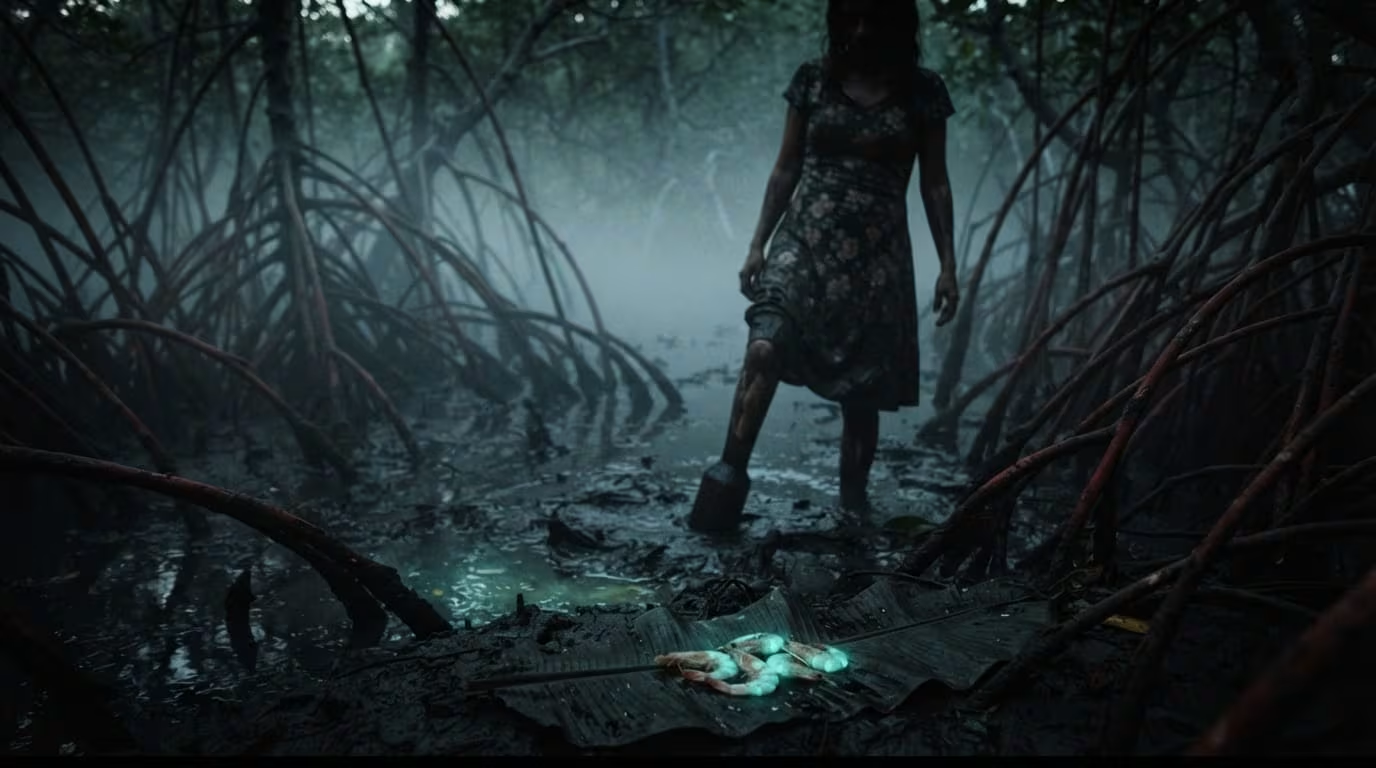
The creature she tilted her head. The corners of her mouth parted a millimeter further, releasing a thread of thick saliva smelling of stagnant swamp water. Her hat dropped into the mud with a dull thud. Her hair was not hair at all, but tangled skeins of matted black lichen, teeming with microscopic blind crabs scuttling among the strands.
"I am the one who feeds you, little fledgling," said the Tunda, and her voice no longer mimicked anyone; it sounded like wind threading through a dry cane field, like wood groaning on a funeral pyre. "I am the one who keeps you from the blows and the dread. Eat another creature. Go on. Open your little mouth. Swallow your name whole so it weighs on you no longer."
Eliana tried to rise, but her legs were two sodden rags. The sweet venom of the shrimp had dissolved the strength from her muscles, turning her bones to gelatinous marrow. She dragged herself forward on her elbows, clawing at the peat, feeling the muck worm its way beneath her nails.
From far off, muffled by miles of impenetrable mangrove and bottomless mud, a murmur arrived. It was not a bird. It was the desperate beating of drums, the dry knock of paddles against the hull of a skiff, and the echo of voices singing an ancient lullaby, burning gunpowder and basil branches to drive off the shadow. The men of the village were searching for her.
They were shouting a name.
A three-syllable name that ricocheted across the living tide.
"Who are they calling for?" thought the girl, her forehead pressed to the fetid mud. "Who was she who left a blue espadrille on the landing?"
The sound of the drums seemed to come from another century, from a world submerged beneath leagues of brackish water that no longer belonged to him.
IV. The Salt Without Memory
The shadow leaned over her. There was no haste in its movements; the entire forest conspired in its favor, braiding its stilted roots behind the trail to seal shut with stone and mortar any path the men might try to hack open with machetes. La Tunda knelt, sinking its molinillo leg into the mire with a gurgle of methane bubbles that burst with the stench of carrion.
With a calloused hand as cold as river stone, it lifted her chin. Its fingers tasted of rancid lard when the creature forced her lips apart. Between its skeletal fingers it carried the last shrimp, glistening, almost phosphorescent in the gloom of the sealed-off noon.
"Chew, you lump of clay. Forget the baptism. Forget the teat that gave you bitter milk."
Eliana did not close her eyes. Up close she saw the empty socket of the beast's gaze, the living wood engrafted into the crippled limb, the ants that walked unhurried through the folds of its withered neck. She opened her mouth. The warm, syrupy pulp fell onto her numbed tongue. She chewed. The dense juice slid down her esophagus, and with each swallow, the last spark of memory went out like a match tossed into a black well.
The distant drums fell utterly silent. Not because they had ceased to sound across the open estuary, but because the ear of the creature now lying in the slime no longer recognized the human rhythm of consolation.
When the search party finally found the clearing three days later, guided by the lazy circling of the vultures, they found only a small espadrille floating on the stagnant water and a deep, circular print in the mud, round as the base of a pestle for pounding coffee. Beside it, tiny footprints of a child's feet pressed into the labyrinth of roots where the tide never fully recedes, advancing with a firm and sightless step toward nowhere at all.
In the thicket no trace of pain remains once the name is lost; only the dull persistence of hunger, crouched and waiting for another mother to call at its door in the dead hour of low tide.
📜Investigation • Frequently Asked Questions
Documentary Archive and Analysis of the Occult • Relatando.com
In what way does Carlos Nieto use the sensory elements of the mangrove swamp—such as the glacial mud, the stench of decay, and the sudden silence of the horseflies—to construct the enchanting atmosphere characteristic of myth La Tunda?
Carlos Nieto subverts the customary perception of the Pacific coast by transforming the warm estuary into a liminal and gelid space, where living matter seems hostile and conscious. The contrast between the physical repulsion of the mud and the hypnotic docility with which Eliana follows her supposed mother evokes the classic modus operandi of La Tunda: the creature does not attack with direct violence, but rather numbs the senses and alters the perception of reality through the manipulation of filial affections and the gradual suppression of the ecosystem's natural sounds.
What cultural symbolism is contained in the detail of the bleach-faded floral dress and the toquilla straw hat in the representation of the metamorphic double within Afro-Ecuadorian and Pacific folklore?
In the region's oral tradition, metamorphic entities such as La Tunda habitually assume the form of deceased or absent loved ones, employing everyday and recognizable garments to dispel the victim's suspicions. The dress faded by lye and the toquilla straw hat serve here as anchors of domestic memory and daily labor, deliberately contrasting with the biological monstrosity of the being —evidenced in the rigidity of the neck and the asymmetrical gait— to underscore the psychological tragedy of the mythological abduction.
How does the psychological ambiguity characteristic of Horror rural literature manifest in this excerpt, where the reader oscillates between the rational explanation of trauma and the imminence of the supernatural?
The text deftly seeds rational clues that the girl's mind seizes upon as defense mechanisms: the mother's prior limp from an accident on the pier, or the creak of a supposedly submerged branch. Yet this logic collapses before the alteration of the environment—the abrupt cessation of the horseflies' drone and the low-frequency vibration at the pit of the stomach. This unresolved tension elevates the tale beyond regional folklore, turning it into a study of childhood vulnerability before horror.
What role does the geography of the aerial root canopy and bilious light play in the development of the mythical structure of the tundetco abduction within the contemporary narratives of Relatando.com?
The tiny clearing ringed by roots and lianas functions as a 'navel of the world' or threshold into the fluvial underworld, a space where the laws of time and spatial orientation hang suspended. By confining the characters within this suffocating vegetal architecture, Carlos Nieto recreates with ethnographic precision the setting where, according to Pacific oral tradition, the abducted lose their will and are condemned to feed on hallucinatory shrimp and spectral camaraderie.
Don't extinguish the light just yet...
If you have had the courage to make it this far, we have other dossiers that will test the limits of your sanity.

Terms and Figures of this Tale
To delve deeper into the legends, creatures, and dark concepts that inspire this account, consult their entries in our dictionary of the uncanny:



Tu correo no se publica ni se comparte con terceros: solo sirve para notificar la respuesta.