I am Carlos Nieto, and deep within the impenetrable depths of the Dominican Central Cordillera, where the dense foliage scarcely allows the sun's rays to touch the damp earth, hides one of the most terrifying and fascinating enigmas of Antillean folklore. To speak of The Ciguapa is to step into a realm where reality blurs into nightmare. We are not dealing with a mere roadside tale meant to frighten gullible children; we stand before a primordial entity, a creature creature of the night that defies the laws of human anatomy and has left an indelible mark on the collective psyche of the Dominican Republic. Through this exhaustive encyclopedic analysis, we will unravel the best-kept secrets of this elusive being, examining its impossible morphology, its nocturnal hunting habits, and the ancestral methods locals employ to survive its hypnotic pull.
Classified File
- Origin: Folklore and traditional mythology of the Dominican Republic, with deep Taíno roots and potential African and Iberian influences.
- Nature: A wild humanoid creature of strictly nocturnal habits and feral behavior, endowed with hypnotic capabilities.
- Hazard Level: Moderate-High. Not a voracious carnivorous predator, but its capacity to disorient and lead men astray in the deep brush is frequently lethal.
- Weaknesses: Trained black hunting hounds, blessed salt, Catholic religious symbols, and the impossibility of following straight tracks due to its physical condition.
Origin and Etymology
The term ‘Ciguapa’ resonates in the whispered conversations of Dominican peasants like an ancestral echo lost in the night of ages. To understand the birth of this myth, it is imperative to perform an exercise of cultural archaeology, tracing back to the eras when the island of Hispaniola was inhabited by the indigenous Taíno peoples. Although Taíno mythology possessed a rich cosmogony of supernatural beings linked to nature and canoes, the specific figure of the Ciguapa as we know her today displays a fascinating syncretism. Some anthropologists suggest the word might have connections to Arawak languages, while other investigators of the occult point out that the inverted morphology of her feet could be a Caribbean reinterpretation of European myths concerning wild forest beings.
During the colonial era, the culture shock among the Spaniards, surviving indigenous peoples, and forcibly brought African slaves generated a melting pot of legends. The Ciguapa emerged in this breeding ground as the perfect embodiment of the untamed, of that which civilization could neither master nor catalog. The dense forests of Jarabacoa, Constanza, and the foothills of the Northern Cordillera became the natural stages where this myth took on a life of its own. Far from fading with the advent of modernity, the Legend of the Ciguapa adapted, becoming the definitive archetype of the wild woman who rejects social constructs and prefers the absolute freedom of the thicket, even if it entails the loss of her humanity.

Anatomy and Appearance
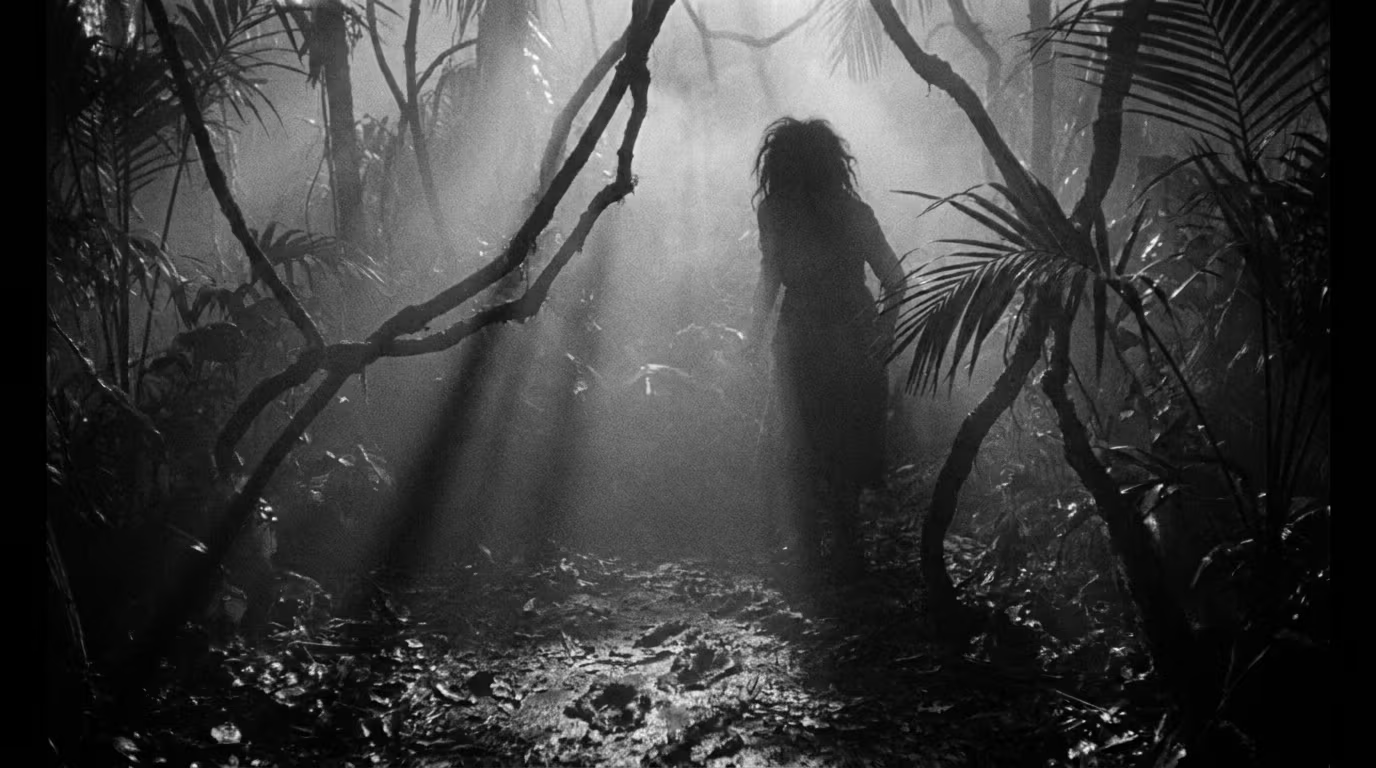
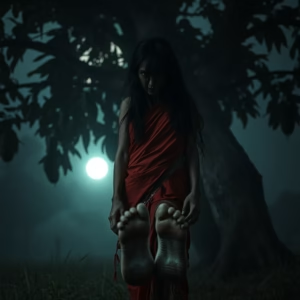
The physical description of the Ciguapa is, without a doubt, the most unsettling element of her anatomy. She is a woman-shaped creature, generally of short to medium stature, possessing a slender and agile build perfectly adapted for breakneck sprinting through the undergrowth. However, her most distinctive and disturbing feature is the arrangement of her lower extremities: her feet are inverted, pointing backward. This means that when the Ciguapa walks or runs, the tracks she imprints upon the mud or leaf litter completely deceive any tracker, making them believe she is heading in the opposite direction to the one she is actually taking.
Her mane of hair is another of her most striking visual weapons. It is described as extraordinarily long, thick, and of a jet-black so intense it seems to swallow the moonlight. This hair reaches practically down to her ankles, functioning not only as her sole natural garment but also as a shroud that partially or totally conceals her body as she glides among the trees. Her face possesses an exotic and feral beauty, with prominent cheekbones and a piercing gaze, glowing in the darkness, capable of paralyzing any unwary soul who has the misfortune of crossing her path during waking hours.
Modus Operandi and Powers
The Ciguapa is no blind beast striking with bloodthirsty fury; her method of interaction with human beings combines stealth, fascination, and psychological disorientation. She acts exclusively at night, preferring the hours of the full moon or the dark hours before dawn when the wilderness sleeps. An encounter with a Ciguapa usually begins with a peculiar sound: a pitiful moan, weeping akin to that of an infant, or a smothered laugh echoing among the giant ferns. This acoustic lure is specifically designed to awaken the curiosity or compassion of the solitary traveler, inciting him to venture deeper into the recesses of the forest.
Once the victim catches sight of the creature, her most perilous power comes into play: ocular hypnosis. It is said the Ciguapa possesses a magnetic gaze that clouds a man's reason, plunging him into an amnesic trance state. Under this influence, the unfortunate soul follows the creature willingly, losing all notion of time and space. She drags him to hidden caves or dry riverbeds, keeping him dazed. Though the most gruesome legends claim she can drive her captives permanently mad, the true danger lies in abandonment: when the Ciguapa grows bored or perceives the light of dawn, she vanishes with startling speed, leaving the victim utterly disoriented, miles from any known trail, exposed to the real perils of the mountain.
Weaknesses and Protective Rituals
Despite her elusive nature and apparent invulnerability within her natural habitat, the Dominican savannah and wilderness have developed over the centuries a corpus of countermeasures to neutralize the Ciguapa. The most celebrated and effective weakness against this entity is the use of black dogs. Due to their instincts and a supposed sensitivity to the paranormal, a pack of hounds with entirely dark fur is capable of successfully tracking the creature, as they are neither deceived by the inversion of her feet nor by her hypnotic tricks; their furious barking manages to frighten her and force her into a precipitate flight.
Likewise, the oldest peasants of rural areas recommend always carrying traditional protective amulets, such as blessed crucifixes, Saint Benedict medals, or sprigs of rue and rosemary. It is believed that the Ciguapa, being a creature of the fringes of civilization and untamed nature, experiences an instinctive repulsion toward the sacred symbols of Catholicism and the pungent odors of certain ritual herbs. In the event of encountering a suspicious footprint on the trail whose toes point backward, the unwritten rule dictates turning back immediately and reciting the Lord's Prayer aloud, avoiding at all costs pronouncing her name in a whisper so as not to summon her attention.
Documented Cases and Famous Legends
In the annals of Dominican oral tradition, accounts of encounters with the Ciguapa number in the hundreds, passed down from generation to generation around the hearth. One of the most famous cases compiled by folklore researchers in the Constanza region dates back to the mid-20th century, when a muleteer known locally as Don Pancracio vanished for three days after attempting to take a shortcut along an old royal path at dusk. Upon being found by local rescue parties, the man was seated at the mouth of a grotto, babbling incoherently with a vacant stare. The most disturbing aspect of the case was not his temporary catatonic state, but that he swore he had walked hand-in-hand with a beautiful woman of endless hair who laughed while leaving inverted tracks in the mud.
Another celebrated tale hails from the vicinity of Armando Bermúdez National Park, where a group of mountain hunters swore they saw a Ciguapa feeding on wild fruit in the crown of a leafy tree. When they attempted to surround her to capture her as proof of her existence, the creature let out a shrill screech and dropped into the void, vanishing among the ferns with superhuman agility. Although authorities and official science attribute these testimonies to hallucinations provoked by exhaustion, thick mountain fog, or the ingestion of local plants, to the inhabitants of the Dominican countryside the existence of the Ciguapa is a truth as tangible as the air they breathe.
Comparative Analysis
To grasp the true mythological dimension of the Dominican Ciguapa, it is illuminating to draw a parallel with other creatures of universal folklore that share morphological or behavioral similarities. If we analyze its most iconic feature—feet pointing backward—we find startling parallels in South American mythology, specifically in southern Brazil and Argentina, with the figures of the Curupira or the Caipora, forest guardians whose inverted feet serve the exact same purpose: to confound poachers and cause them to lose their way in the impenetrable jungle.
Yet, while the Curupira is a grotesque, male goblin dedicated almost exclusively to punishing those who despoil the environment, the Ciguapa aligns more closely with the archetype of the supernatural femme fatale, distantly akin to classical sirens or Celtic banshees, employing seduction and beauty to disorient men. This duality between the forest's protective nature and the latent threat to the solitary traveler makes the Ciguapa a unique specimen within the bestiary Latin American fantastic, fusing it psychological terror with the tragic poetry of the Caribbean wilderness.
📜Investigation • Frequently Asked Questions
Documentary Archive and Analysis of the Occult • Relatando.com
What exactly is the Ciguapa in Dominican mythology?
She is a legendary woodland creature in the likeness of a woman, with exceptionally long hair and the anatomical peculiarity of having her feet turned backward.
Why does the Ciguapa have her feet turned backward?
Her inverted feet serve to confuse trackers and hunters, tricking them into following false trails deep into the dense brush.
Does she attack or pose a danger to people?
She is not carnivorous, but her hypnotic gaze and haunting calls disorient wayfarers, leaving them hopelessly lost within the mountain's depths.
Do not extinguish the light yet...
If you have had the courage to make it this far, we have other dossiers that will test the limits of your sanity.

Terms and Figures of this Tale
To delve deeper into the legends, creatures, and dark concepts that inspire this account, consult their entries in our dictionary of the uncanny:

Tu correo no se publica ni se comparte con terceros: solo sirve para notificar la respuesta.