In the darkest, most ancient mists of Gaelic mythology, where the boundaries between the mortal world and the Otherworld (Tír na nÓg) blur with the equinoctial dew, lurks one of the most enigmatic, volatile, and terrifying entities ever conceived by the Celtic psyche: the Púca, manifesting in its most imposing and terrifying form as the Black Stallion of the Harvests. I am Carlos Nieto, and in this exhaustive journey through the abysses of folklore and mythical cryptozoology, we will unravel the true nature of a being that is no mere spirit of the fields, but a primordial force capable of altering the fortune of entire villages during the night of Samhain. Hold fast, for stepping onto the pastures once trodden by this equine beast of blazing eyes is to peer directly into the abyss of the inexplicable.
Classified File
- Origin: Celtic Mythology (Ireland, Wales, Scotland, Cornwall).
- Nature: A shapeshifting spirit of the earth, a chaotic and primordial fae.
- Hazard Level: Moderate to High (Capable of inflicting severe physical harm, temporary madness, or abduction into the Otherworld).
- Weaknesses: Cold iron, blessed bread, the presence of sea salt, and the firm, respectful refusal to speak its name with disdain.
Origin and Etymology
To understand the genesis of the Púca, we must trace back to the pre-Christian roots of the British Isles, where man's relationship with the land was a matter of visceral survival and superstitious dread. Etymologically, the term 'Púca' (also found as *Puca*, *Pookah*, *Phouka*, or *Puck* in English folklore) derives from the ancient Celtic root denoting a goblin, spirit, or sprite, directly akin to the Germanic and Scandinavian *puck*. However, within the Irish cultural substratum, this entity creature evolved beyond the archetype of the mischievous spirit to become a shape-shifting titan of the countryside. The form of the black stallion is inextricably linked to the agricultural cycle and the close of the harvest. October and November—the threshold of Samhain—marked the time when offerings had to be left in the fields to appease the Púca's wrath. If the harvest was prosperous, his blessing was assumed; if hail destroyed the wheat or barley, it was known with absolute certainty that the great black stallion had ridden across the furrows, trampling the fruit of human toil with hooves of spectral fire. The ancient Celts saw in this entity a direct personification of nature's duality: generous and bountiful when respected, relentless, destructive, and savage when man dared to defy its ancestral domains.
Anatomy and Appearance
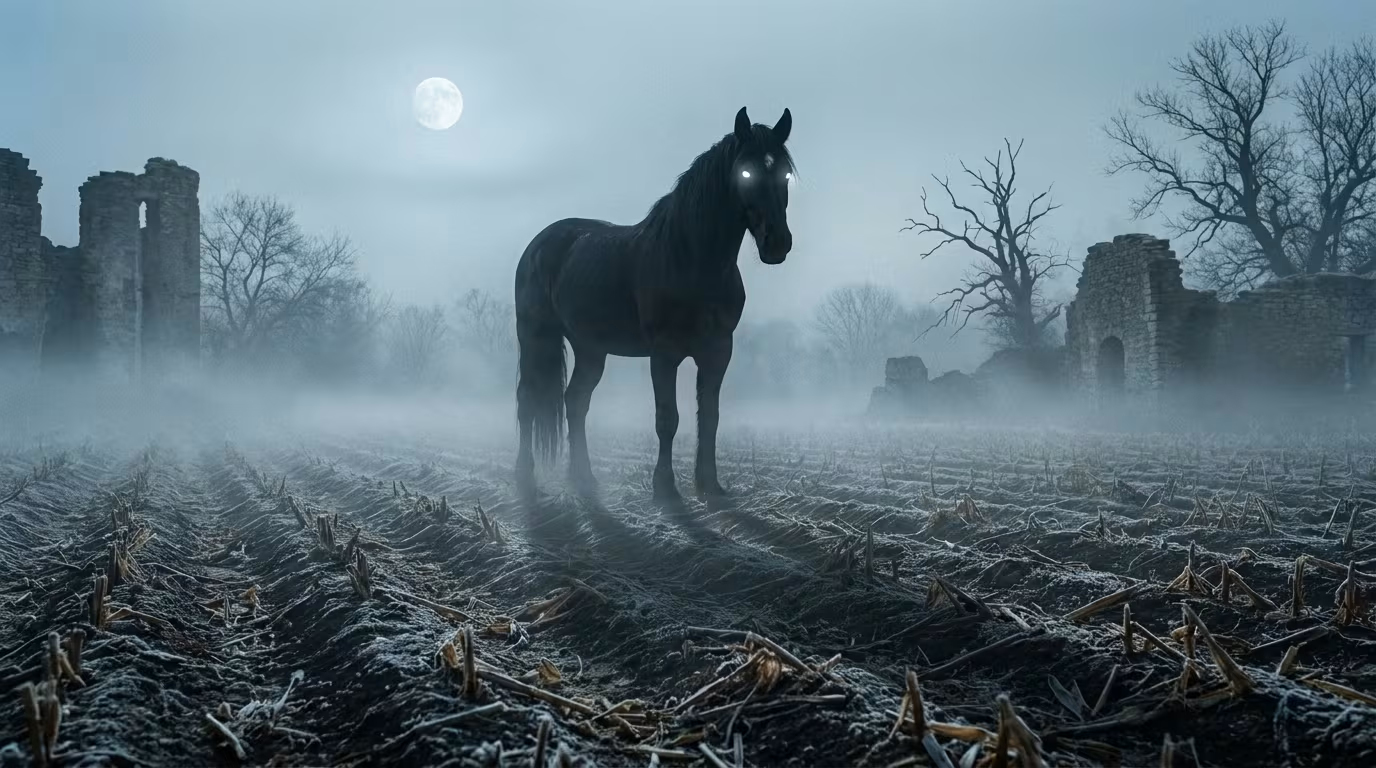
Though the Púca is a consummate shapeshifter capable of taking the form of a skittish hare, a raven with metallic feathers, or even a humanoid chimera with goat-like features, it is its incarnation as the Black Stallion of the Harvest that has inspired the most chilling tales told around winter bonfires. In this equine form, the creature defies all natural anatomical logic. It appears as a horse of titanic proportions, its musculature seemingly sculpted from liquid obsidian. Its coat is a black so deep that it seems to absorb the ambient light, casting an unnatural shadow even beneath the pale light of the full moon. Accounts collected by folklorists during the nineteenth and twentieth centuries describe a mane that floats in the air without the intervention of wind, steeped in a pungent smell of ozone, wet earth, and volcanic ash. But it is the eyes that betray its infernal or fey origin: orbs devoid of pupils, wholly white or a fiery yellow, gleaming with a cold, mocking, profoundly malicious intelligence. Unlike an ordinary steed, the Púca in its stallion form lacks physical horseshoes, yet its hooves leave smoking, scorched marks in fresh grass, killing the vegetation wherever it passes for years afterward. Its mouth, often half-open in a grimace that mimics a macabre equine smile, reveals teeth far too sharp for a herbivore, suggesting a predatory nature that transcends the plant kingdom.

Modus Operandi and Powers
The Púca's behavior as the Black Harvest Stallion follows a meticulous pattern of seduction and punishment. It customarily appears at dusk along solitary rural paths, near the edges of ancient woods or within freshly reaped fields. Its primary tactic relies on the psychological manipulation of the unwary traveler. It presents itself as gentle, saddled, and seemingly abandoned, waiting patiently for a weary wayfarer to yield to the temptation of mounting it to shorten the journey home. Once the unsuspecting victim climbs upon its back, the true nightmare begins. The Púca ascends into the heavens in a dizzying, frantic flight that defies the laws of gravity and physics. It tears across jagged cliffs, churning rivers, and impenetrable briars, subjecting the rider to a psychological terror and absolute physical ordeal. The purpose of this feral flight is not necessarily to kill the victim outright, but to terrorize them to the very brink of sanity. By dawn, the stallion typically hurls the unfortunate rider into the depths of a muddy ravine, atop a rooftop, or right back to where their journey started, leaving them exhausted, babbling, and scarred for life with a visceral dread of horses. Beyond this nocturnal torment, the Púca exerts absolute dominion over local weather during harvest nights, capable of unleashing localized hailstorms upon specific homesteads if it deems the owners have failed to pay it proper tribute, leaving the soil barren and families on the precipice of starvation.
Weaknesses and Protective Rituals
Despite its immense fae power and chaotic nature, the Púca is not invulnerable. Rural Irish folklore has passed down specific methods across generations to repel or appease this equine beast. The first and most effective defense is the use of cold iron. As an Otherworld creature predating the Metal Ages, pure iron acts as a spiritual corrosive to the Púca; carrying a simple iron horseshoe in one's pocket or driving a metal nail into the stable threshold is enough to keep it away from domestic livestock. Likewise, peasants would traditionally leave a portion of the final harvest—usually wheat or apples—at the edges of the fields as an appeasing offering, traditionally known as 'the Púca's share,' thereby securing its benevolence. Should one have the misfortune of coming face to face with the Black Stallion on a dark path, the golden rule is never, under any circumstances, to attempt to mount it or utter direct insults. The intonation of traditional prayers or the display of a piece of blessed bread can force the entity to dissolve into a cloud of pestilent fog. The elders also advised always carrying a pinch of sea salt in one's pocket, a purifying element capable of shattering any illusionary spell cast by the cunning dweller of the hills.
Documented Cases and Famous Legends
The chronicles of Irish folklore are peppered with fascinating accounts of encounters with the equine Púca, the most celebrated being the case of the County Clare lowlands, documented in the late 19th century by local folklorists. The Legend narrative tells the story of a boastful farmer named Liam MacNamara, who, defying the warnings of the village elders, wagered that he could break the legendary black stallion that stalked the wheat fields after the feast of Samhain. According to the neighbors' testimony, Liam mounted the beast on a moonless night. What followed was a nightmarish ordeal lasting exactly three days and three nights. Villagers claimed to have seen an equine silhouette cutting through the stormy skies with a rider screaming for mercy. On the fourth day, Liam was found sprawled on his own front porch, completely mute, his hair turned ivory white and his gaze lost in an eternal void. He never spoke a single word again, spending hours on end staring blankly toward the pastures, waiting for his captor's return. Another notable case occurred in the Connemara bogs, where a local priest, Father O’Flaherty, confronted the Black Stallion as it terrorized parishioners returning from midnight mass. Armed with holy water and a wrought-iron crucifix, the cleric managed to trace a protective circle around the animal, forcing it to reveal its true form before vanishing amidst guttural shrieks that shook the foundations of the old church. These accounts, transmitted with an almost documentary rigor by the chroniclers of the era, demonstrated that the Púca's threat transcended the myth realm of mere superstition, evolving into a traumatic experience deeply etched into the rural collective memory.
Comparative Analysis
When analyzing the Púca in its form as the Black Harvest Stallion, it is inevitable to draw crucial parallels and distinctions with other mythological equine entities of global folklore, such as the Scottish *Kelpie*, the *Aughisky*, or the *Bicorn*. The uninitiated often confuse the Púca with the Kelpie, but the discrepancies are fundamental. While the Kelpie is an inherently malevolent, man-eating water spirit that lurks in lochs and rivers to drown its victims and devour them beneath the surface, the Púca is a terrestrial and aerial creature whose primary purpose is not bloodshed and murder, but chastisement, disorientation, and psychological terror. The Kelpie seeks the physical death of the unwary; the Púca seeks submission and respect for the cycles of nature through dread. On the other hand, in comparison with the *Nuckelavee* of Orkney —a demon marine creature shaped as a fused horse and rider that brings plagues and droughts—the Púca reveals itself as a far more ambiguous and fickle entity. The Púca can be benevolent if treated with proper deference, rewarding the prudent farmer with bountiful harvests, whereas the Nuckelavee is pure, unredeemable destruction. This moral duality places the Celtic Púca in a category entirely its own within mythical cryptozoology: a stern, capricious, and terrifying guardian of the fields, reminding us that nature is never fully tamed and that mankind remains a fragile guest in a world ruled by ancient forces.
📜Investigation • Frequently Asked Questions
Documentary Archive and Analysis of the Occult • Relatando.com
What precisely is the Celtic Púca?
It is a shapeshifting spirit from Celtic mythology, tied to the land and the harvest, able to shift its form among animals such as hares, crows, and an imposing black stallion.
Is it dangerous to encounter the Black Stallion of the Harvest?
Yes, it is highly dangerous. If you mount its back, it will subject you to a terrifying flight through the entire night, mocking you and testing your sanity.
How can one protect oneself from the Púca?
By using cold iron, leaving food offerings in the fields after the harvest, carrying sea salt, and avoiding speaking its name with disrespect.
How does the Púca differ from a Kelpie?
The Kelpie is a malevolent water spirit that drowns and devours its victims in lakes, whereas the Púca is of the land and seeks to terrify and to admonish.
Do not extinguish the light yet...
If you have had the courage to make it this far, we have other dossiers that will test the limits of your sanity.

Terms and Figures of this Tale
To delve deeper into the legends, creatures, and dark concepts that inspire this account, consult their entries in our dictionary of the uncanny:

Tu correo no se publica ni se comparte con terceros: solo sirve para notificar la respuesta.