Welcome to a new in‑depth analysis on Relatando.com. I am Carlos Nieto, and today we will delve into one of the most terrifying, enigmatic, and tragic files of cryptozoology and modern folklore in the United States. Between November 1966 and December 1967, the small industrial town of Point Pleasant, West Virginia, became the epicenter of a lucid nightmare. We are not talking about a simple Legend urban, woven slowly over centuries, but rather a subtle, documented, and brutal incursion of the unknown that culminated in one of the greatest urban catastrophes in North American history: the collapse of the Silver Bridge. For months, a colossal humanoid entity, armed with immense wings and hypnotic eyes of bright red, stalked the shadows of the abandoned military plant known as ‘The TNT Area’, sowing panic among locals and leaving a trail of sightings that defied all rational logic. In this exhaustive encyclopedic article we will unravel every layer of this event, analyzing the testimonies of eyewitnesses, the inexplicable connection with the phenomenon UFO, the prophecies of the enigmatic Indrid Cold and the perpetual shadow of a foretold tragedy that forever altered the destiny of Point Pleasant.
Classified File
- Origin: Point Pleasant, West Virginia, United States (1966).
- Nature: Winged humanoid cryptid of presumed interdimensional origin, paranormal or mutagenic.
- Hazard Level: Tall (associated with precognition of massive catastrophes and psychological terror extreme).
- Weaknesses: Unknown with certainty; the entity appears to fade under massive media attention and vanishes after the fulfillment of its prophetic warning.
Origin and Etymology
The term ‘Mothman’ (translated into Spanish as the Mothman) did not arise in the pages of a pulp novel Horror pulp, but in the chronicles of the local press in West Virginia at the end of 1966. On November 15 of that year, two newlywed couples—Mallette and Linda Scarberry, along with Ray and Connie Mallette—were driving near a World War II‑era militarized industrial complex locally known as 'The TNT Area'. Passing by the abandoned munitions plant, they spotted a monstrous figure perched beside the road. They described a being over two meters tall, with a robust humanoid body but lacking a visible head, and two enormous, luminous, circular eyes that reflected the headlights with a blood‑red glow. The creature unfurled bat‑like or insect‑like wings spanning over three meters and took off vertically, pursuing the terrified vehicle at speeds exceeding one hundred and sixty kilometers per hour with barely any aerodynamic effort. The local press quickly christened the entity 'Mothman', drawing indirect inspiration from Batman comics and the stories of monsters B‑movie that flooded popular culture of the era, though locals soon realized it was no joke.
However, the origin of the myth transcends the mere journalistic anecdote. Subsequent researchers of the Fort Wayne phenomenon, such as the famed John Keel, author of the seminal work ‘Las apariciones del Mothman’ (The Mothman Prophecies), discovered that Point Pleasant lay upon ancient Adena burial mounds, which had been desecrated or altered by modern industrial development. This anthropological and mystical perspective suggests that the Mothman It is not an unknown beast emerging from a cave, but a manifestation or ‘tulpamantic’ of subterranean tensions, an ancient guardian or a harbinger of doom directly tied to the region’s spiritual imbalance. The etymological roots of the name cast the creature as insectoid, yet early sightings pointed instead to an impossible anatomical chimera, a biological landmark that defied terrestrial evolutionary law and seemed to fit seamlessly into the vast tapestry of spacetime anomalies.

Anatomy and Appearance
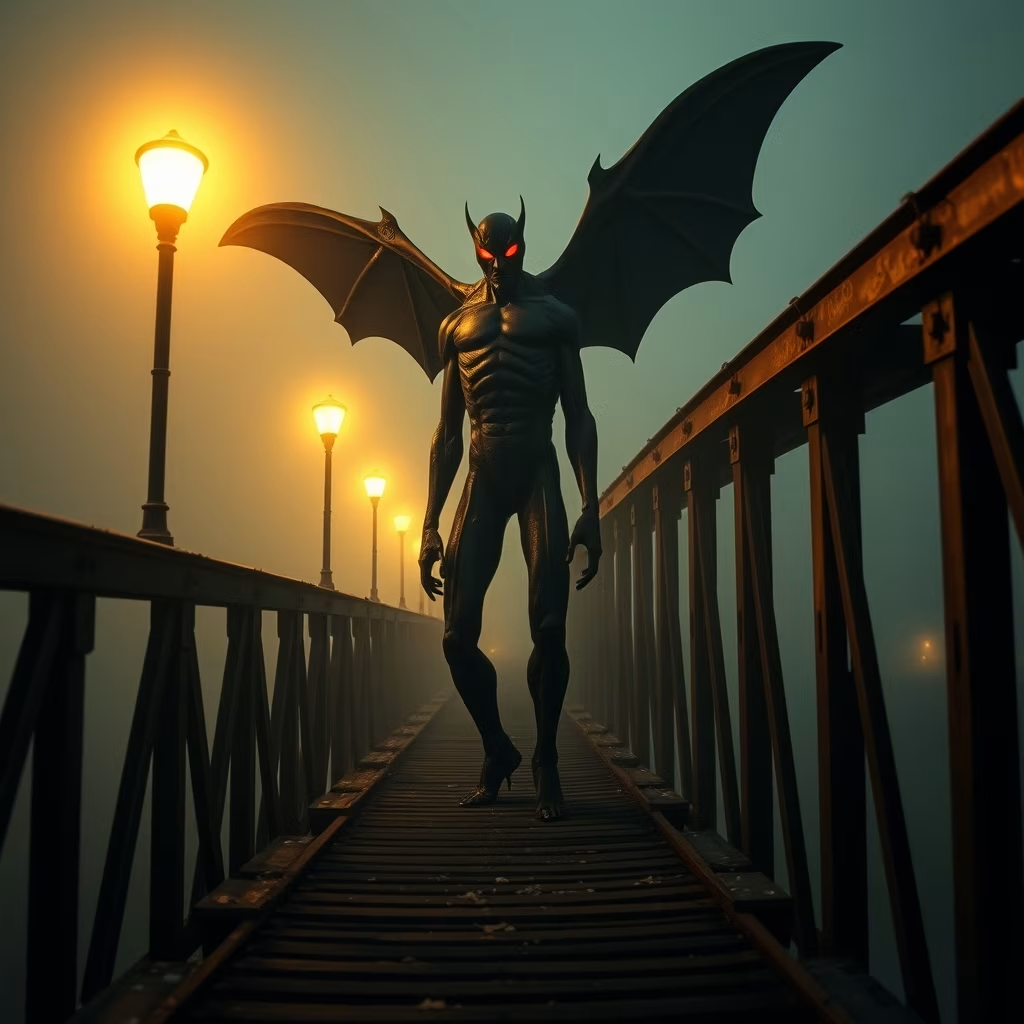
The physical description of the Moth Man remained strikingly consistent across more than a hundred official sightings recorded between 1966 and 1967. Witnesses—ranging from teenagers to seasoned police officers and clergy—concurred that the entity stood between 2.10 and 2.30 metres tall. Its body was massive, a broad, muscular torso like that of a hulking man, yet it possessed no neck; the head seemed to melt directly into the shoulders. The most hypnotic and terrifying feature of its anatomy were its eyes: enormous, round, glowing a ruby‑red or incandescent amber, set atop the thorax or on the sides of the head, emitting their own light independent of ambient illumination, capable of disorienting or momentarily paralyzing anyone who stared unflinchingly into them.
The Moth Man’s upper and lower limbs also sparked fierce debate among zoologists and cryptozoologists. Early reports made no mention of clearly defined hands or claws, only dark talons capable of latching onto vertical surfaces with prodigious force. Its wings—the hallmark that earned it its name—were membranous, a dusky gray‑brown, reminiscent of bat wings or the rigid appendages of a gigantic nocturnal insect. The truly unsettling aspect of its anatomy was its ability to fly: witnesses claimed the creature rose from the ground in a perfectly vertical thrust, without a running start or visible propulsion, beating its wings with excruciating slowness or holding them rigid as it glided at speeds impossible for a mass of its size. This biomechanical paradox led many theorists to posit that the creature employed some form of antigravitational field, or that its physical presence was merely a three‑dimensional projection of a parapsychic nature.
Modus Operandi and Powers
Unlike conventional biological predators, the Mothman did not strike directly at its witnesses to devour them or inflict severe physical harm; yet the psychological terror wrought by its mere presence was devastating. The creature’s modus operandi was to stalk the road’s margins, dart across drivers’ sightlines at moments of heightened nocturnal tension, or perch upon elevated structures—such as the rooftops of the TNT plant or the beams of the Silver Bridge—where it watched the populace in passive silence. Countless witnesses suffered acute nervous crises, chronic insomnia, and anxiety disorders after encountering its red gaze. Some reports claim the entity systematically disrupted local electronics: televisions were beset by severe static, car engines sputtered to a halt, and telephone lines rang with inexplicable metallic hums before each significant sighting.
The most unsettling aspect of its behavior was its direct link to broader parapsychological phenomena, including the mass sighting of UFOs in the form of luminous spheres and flickering lights over the skies of West Virginia. Moreover, the Mothman served as a living omen of catastrophe. Its apparition Constant in Point Pleasant for the thirteen months preceding the collapse of the Silver Bridge, the creature suggested to investigators that it was attempting to warn the community, or was inexorably bound to the negative energy of the impending disaster. Simultaneously, mysterious humanoid figures appeared, such as the self‑styled 'Indrid Cold', a man with an enigmatic smile who reached out to several locals through cryptic telephone calls and home visits, warning of an unavoidable future. The Mothman’s power lay, therefore, in its ability to warp reality’s perception, sow emotional chaos, and act as a cosmic beacon of warning that humanity could not decipher in time.
Weaknesses and Protective Rituals
Compiling a list of weaknesses for a being as elusive and unclassifiable as the Mothman proves a complex task. Since it is not a conventional animal, traditional methods of physical defense proved futile. In fact, several local hunters who patrolled the TNT plant armed with hunting rifles reported feeling a deep revulsion and a dread paralyzing that prevented them from pulling the trigger when the creature materialized among the trees. The harsh glare and the strobe of vehicle headlights did not frighten the entity; on the contrary, they seemed to stir its curiosity, for the creature’s eyes reflected the light with an unnaturally fierce intensity.
From the standpoint of folklore and of the occult researchers who examined the case in the 1960s, the only effective defense against such hyper‑dimensional entities lay in mental fortitude, the shattering of obsessive fear patterns, and the objective documentation of events. John Keel warned witnesses not to become fixated on the creature, for collective dread and focused attention seemed to feed the phenomenon energetically, amplifying its presence in the area. Curiously, the Mothman’s greatest weakness—if it can even be called that—was the fulfillment of its prophetic purpose. Immediately after the tragic collapse of the Silver Bridge on December 15, 1967, the sightings stopped abruptly and permanently in Point Pleasant, as if the energy sustaining it had been entirely consumed by the disaster.
Documented Cases and Famous Legends
The catalogue of Mothman sightings is extensive, yet several documented milestones have cemented the legend on both national and international stages. Beyond the infamous encounter of two couples at the TNT plant on November 15, 1966, the case of Mrs. Newell in the nearby town of Salem, West Virginia, stands out for its raw brutality. Mrs. Newell claimed to have seen a gigantic figure with red eyes in her garden, which emitted a high‑pitched metallic buzz that drove her into an unbearable headache. Another pivotal testimony came from Marcella Bennett, who was driving with her infant in her arms toward friends’ house in Point Pleasant when she saw the creature rise slowly from the grass beside her car, staring at her with its enormous red eyes before unfurling its wings and vanishing into the night’s darkness.
The culminating and tragic climax of this terror chronology occurred on December 15, 1967 at 5:00 p.m. The Silver Bridge, a suspension structure erected in 1928 that linked Point Pleasant with Gallipolis, Ohio, collapsed suddenly during rush hour when a single eye‑bar in its chain failed from fatigue. Forty‑six vehicles plunged into the icy Ohio River, killing forty‑six souls. Months before the disaster, several witnesses claimed to have seen the Mothman perched upon the bridge’s steel girders, watching the traffic with a cold indifference. For the inhabitants of the area, the connection between the monster winged one and the disaster was undeniable: the Mothman had been the messenger of death, a supernatural omen that no one could interpret until the twisted iron of the bridge buried the town’s hopes.
Comparative Analysis
To grasp the true dimension of the Mothman one must contrast it with other archetypes and entities of universal folklore and contemporary cryptozoology. Unlike the Loch Ness Monster or Bigfoot (Bigfoot), legends European gargoyles, winged demons and death‑heralds such as the Banshee Celtic or the famed Black Dog of the Mythology British. Its fleeting appearance, its association with strange lights in the sky and its disappearance without leaving any permanent physical trace firmly place it in the realm of Fortean anomalies and interdimensional phenomena.
If we compare it with the Against the legendary Yeti of the Andes, the Peuchén is not an ice creature but a being that thrives in humidity and darkness. Unlike the Chupacabras, which feeds on blood, the Peuchén feeds on vital energy and dreams, making it a more subtle and psychological threat. Latin American or the North American dog‑men, the Mothman stands out for its complete lack of direct physical aggression toward humans. While other cryptids are feared for their bloody attacks on livestock or unsuspecting hikers, the Mothman operated on a purely psychological and symbolic level. Its purpose was not predatory feeding but prophetic warning and the unsettling of the established order. This ambiguous, border‑straddling nature between the physical creature and the Phantom technological is what continues to fascinate researchers worldwide half a century after its emergence in the swamps of West Virginia.
📜Investigation • Frequently Asked Questions
Documentary Archive and Analysis of the Occult • Relatando.com
Who first saw the Mothman?
It first emerged on the night of November 15, 1966, when two young couples—the Scarberrys and the Mallette— were winding their way near the rust‑crowned ruins of a deserted military installation at Point Pleasant, West Virginia.
What is the connection between Mothman and the Silver Bridge?
Numerous witnesses swore they had seen the creature perched upon the bridge’s cold steel girders months before its tragic collapse on December 15, 1967, cementing its reputation as a harbinger of doom.
Did the Mothman ever physically attack anyone?
No direct physical assaults or deaths were ever recorded at its hand. Its influence was confined to an acute, gnawing psychological terror, the sudden onset of panic, and a maddening interference with local electronic equipment.
Do not extinguish the light yet...
If you have had the courage to make it this far, we have other dossiers that will test the limits of your sanity.

Terms and Figures of this Tale
To delve deeper into the legends, creatures, and dark concepts that inspire this account, consult their entries in our dictionary of the uncanny:






Tu correo no se publica ni se comparte con terceros: solo sirve para notificar la respuesta.