Sergeant Meléndez’s fingers were so parched from the Levante wind that the butt of his pistol clung to his skin as if it were bone. They had been under the relentless sun of Níjar for three days, combing the dusty lanes where wild thyme already smelled of ash and rot. It was not merely fatigue; it was the metallic taste that had lodged itself in their mouths since the first night, a residue of chalky dust and thick saliva that no water‑skin could dislodge. The little Star had vanished from her courtyard as if the siesta heat had vaporized her, leaving only a rag doll with eyes stitched from black thread and a muddy shoe beside the trough. No one heard a car. No one saw a shadow.
I. The Taste of Lime
The Aljibes estate rose like a white scar against the brown spine of the mountain. Its stone walls oozed a fossil‑aged dampness that defied the surrounding aridity. The rookie civil guard, a lad from Baeza named Fuentes, whose 1900 boots left fresh welts on his heels, illuminated with a dynamo flashlight the corners where hens had left a trail of dry feathers and pale droppings. Each time he squeezed the flashlight’s handle, the mechanical hum clashed with the constant chirp of the dry grass.
—My sergeant—Fuentes murmured, and his voice cracked into a dry echo—. It smells here of a long‑dead corpse.

Meléndez gave no answer. He sniffed the heavy air, thick with manure and the sickly sweetness of wilted fig trees. The flashlight's beam swept the floor until it struck the central courtyard, dominated by a gray stone wheel. The structure was sheathed in three slabs of rough concrete, capped in the middle by a fresh cement plug still bearing the clumsy imprint of a trowel. One need not be a forensic expert to see the discord: the rest of the courtyard was cracked by decades of sun, while that gray rectangle resembled a fresh wound, hastily and grudgingly sewn.
If you scream loud enough, the earth swallows your voice so that no one can keep it.
The night silence of the Andalusian countryside is not a placid void; it is a weight that presses against the chest. At three a.m., when the off‑road gauge read eighteen degrees yet the cold seemed to pierce the woolen gabardine, the sound began. It was not a human wail at first, but a metallic scrape, as if a long, filthy nail were clawing the inner face of an iron pipe buried ten metres down. Then the breath followed—a thin thread of damp, fetid air that rose straight from the well’s bowels, raising the hair on the arms with an instinctive revulsion.
II. The Slabs of Silence
With a pickaxe and a claw bar, the two men began to pound the cement perimeter. Each blow rang in the hollow like a muffled gunshot. White dust blinded their eyes, seeping into their lashes and mingling with sweat. Fuentes gasped, mouth agape, swallowing the grit as he struck with blind fury, terrified not by the exertion but by the sound that seeped up again from below.
It was a child’s voice, thin as a broken kite string, repeating a nonsensical litany, a nursery rhyme sung backwards. *"Mama has glass eyes, daddy won’t let me go out to play…"*
—Enough,— Meléndez ordered, though even he felt his knees trembling inside his regulation trousers.
The sergeant pressed his ear to the cold cement. The scent leaking from the freshly broken joint was no longer damp earth; it was an unbearable stench of rancid oil, singed hair, and suffocated flesh. Levering with the bar, the central slab gave way with a dry crack, unleashing a gust of stagnant air that instantly snuffed the flame of the gas lighter Fuentes held in his hand.
III. The Bottom of the Waterwheel
The darkness of the well was not a lack of light; it was a dense substance, a blackness that devoured the powerful beam of the Benemérita’s lantern. Meléndez leaned over the pit, gripping the stone edge as the cold bit into the palms of his hands. Focusing on the dry bottom, some twelve metres down, the light struck an amorphous lump of pink cloth. Yet the truly dreadful thing was not the tiny, dismembered body lying on the rusted farming implements; it was the motion.
The shadows around the little corpse contracted and stretched. And then, from the very depths of the darkness, two little hands with nails completely torn off clung to the exposed brick walls of the pit, beginning to climb upward at impossible speed, on all fours, with broken leg bones forming grotesque angles.
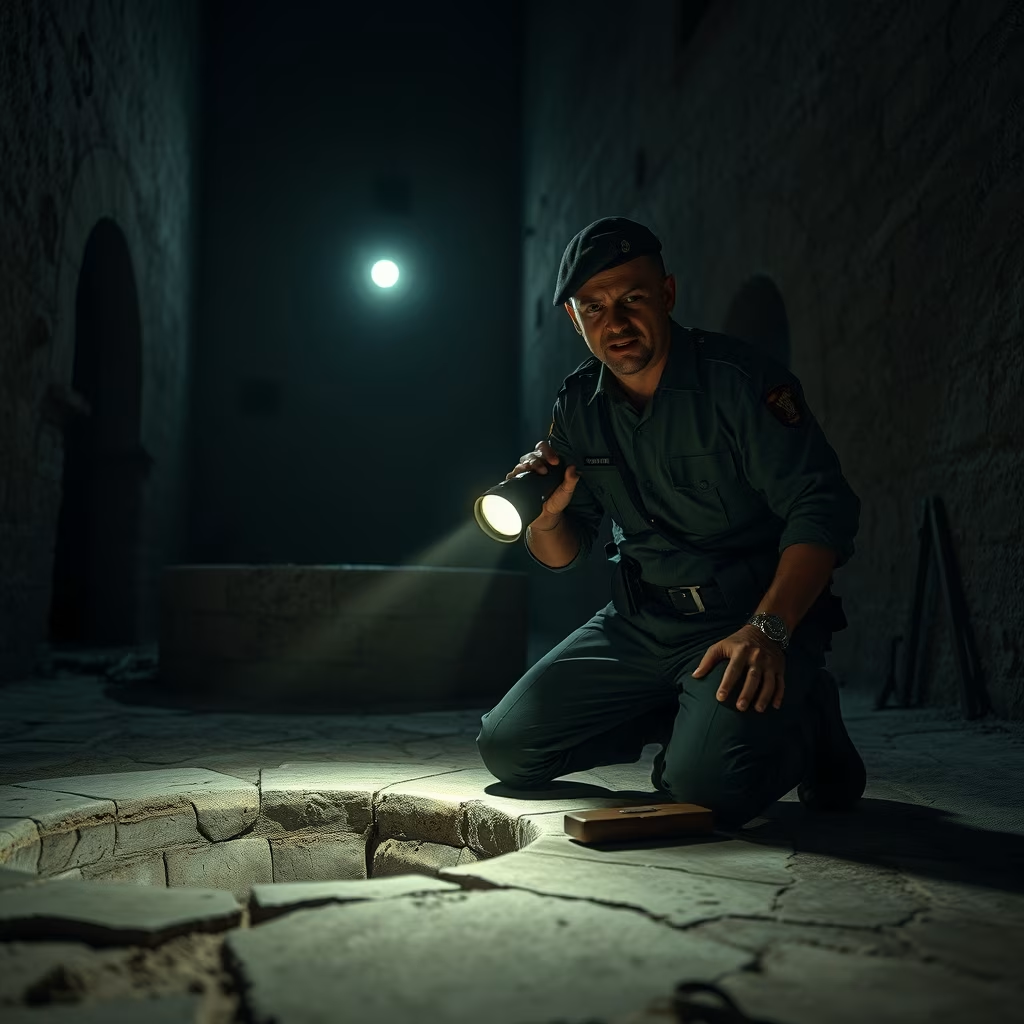
Fuentes let out a sharp scream, hurling the lantern into the void. The light spun in its fall, briefly illuminating a child's face swollen with water and age, eyes white and gaping, exhaling an icy whisper that slipped straight into the sergeant's mind: “I have your boots now, guard… now you descend.”
At dawn, the reinforcement patrol found the 4×4 with its doors ajar and its engine cold. Sergeant Meléndez staggered along the provincial road toward Almería, barefoot, hands shattered, mouth filled with dry earth, unable to form a word, while at the bottom of the well the concrete slabs had once again sealed themselves perfectly from within.
📜Investigation • Frequently Asked Questions
Documentary Archive and Analysis of the Occult • Relatando.com
Which elements of Andalusian folklore and geography does Carlos Nieto employ to forge the oppressive atmosphere of the tale set in the Níjar farmhouse?
Carlos Nieto wields the harsh geography of Níjar’s ramblas and the Levante wind as catalysts of psychological tension. The aridity of the land, the scent of wild thyme mingling with decay, and the solitude of the Aljibes farmhouse summon the duality of myth Andalusian rurality: a beautifully arid beauty that conceals unspeakable human tragedies beneath the weight of peasant silence.
How does the reality of the rural Guardia Civil in the late 1980s surface in the characterization of Sergeant Meléndez and the rookie Fuentes?
Through exquisitely precise sensory details—such as the sores on Guard Fuentes' heels or the gun clinging to Meléndez's parched skin—the narrative renders the lawmen human against the unfathomable. They embody the collision between state bureaucracy and the primordial weight of local enigmas, revealing agents rendered vulnerable by the land's harshness and the terror of inquiry.
What literary symbolism lies in the rag doll with black‑thread eyes and the mud‑caked shoe left by the little Estrella?
The doll, its eyes sewn with black thread, serves as a sinister refuge and a liminal threshold between childish innocence and looming tragedy. As the sole remnant of the girl beside the trough, these objects become spectral vestiges that manifest the sudden disappearance, turning the rural courtyard's quotidian rhythm into the stage of perpetual absence.
In what way does the author construct claustrophobic suspense around the discovery of the stone wheel and the fresh cement?
Suspense is forged through the contrast between the patio's time‑cracked nature and the ominous discord of fresh concrete sealing the wheel. The nocturnal sounds—metallic scrape and fetid sigh rising from the depths—invoke primal terrors, turning the well not merely into a hidden tomb but into a living organism breathing beneath the earth.
Do not extinguish the light yet...
If you have had the courage to make it this far, we have other dossiers that will test the limits of your sanity.

Terms and Figures of this Tale
To delve deeper into the legends, creatures, and dark concepts that inspire this account, consult their entries in our dictionary of the uncanny:



Tu correo no se publica ni se comparte con terceros: solo sirve para notificar la respuesta.