Chapter I: The Solidity of Isolation
There is a silent rot that only thrives in the deep interiors of large cities, where sunlight never arrives pure, but filtered instead through a succession of soot-stained interior courtyards, braided coaxial cables, and rickety, battered blinds. My apartment was one of those cages: a fourth-floor unit in the heart of an exposed-brick building whose foundations seemed nourished by the sludge of the sewers. As a systems architecture programmer, my life unfolded in the penumbra of a makeshift office in the living room, kept company only by the hum of the transformer, the stale vapor of stovetop espresso, and the bluish glare of the plasma monitor.
My only connection to the adjoining apartment was a thin plaster partition coated in cheap whitewash. On the other side lived Don Eusebio. Or rather, had lived. Don Eusebio was a retired calligrapher, a man of cautious gestures and a tread so light he seemed to glide across the tiles without touching them. He lived alone, walled in by mountains of inkwells and butcher paper. Three months ago, however, a thick, sickly-sweet stench began to seep through the baseboards of my living room, flooding the space with a viscous density that only made the pine-scented air freshener all the more nauseating. The police kicked the door in on a torrential rainy afternoon. They found Don Eusebio slumped over his walnut desk, pitched forward with his face pressed against a blank sheet of paper, his physical remains reduced to a blackish liquid that had soaked deep into the floorboards.
Following the removal of the corpse, apartment 4B was sealed off. The oak door, crossed by a band of police tape, remained motionless. No one came to claim the furniture. No one aired out the rooms. The air inside that dead domicile remained trapped behind the wall, fermenting in the absolute darkness of a foreclosed home.

Chapter II: The Latency of Matter
It was during a November night, right around half-past three in the morning, when the logic of my existence began to fracture. I was knee-deep in debugging a particularly dense block of code, an iterative algorithm designed to hunt for redundancies in massive databases. The apartment was plunged in that species of sepulchral silence interrupted only by the thermal creaking of antique furniture.
I rested my right index finger against the mechanical clicker of the mouse. Click.
The sound broke the bone-dry air of the office. A microsecond later, precisely at eye level on the other side of the plastered wall, an exact replica sounded. It was not the settling groan of the structure, nor the expansion of the lead pipes snaking through the building's gut. It was a dry, tiny tap, carrying the exact density of a knuckle striking drywall.
Tock.
I froze, my gaze pinned to the lines of green code pulsing across the monitor. My heart gave a heavy, dull lurch in my chest. Convinced that my exhausted brain was playing tricks on my hearing, I pressed the mouse button again, this time executing a rapid double-tap.
Click-click.
The response from the gloom of Room B was immediate, clean, and mathematically synchronized.
Tock-tock.
A fine, cold sweat broke out along my hairline. I straightened slowly in the office chair. The wall separating my desk from the dead man's room was no more than four inches thick. Through the plaster and latex paint, I could feel the dead, chilled mass of air from the uninhabited apartment. I pressed my knuckles against the wall, holding my breath, careful that the faint brush of my clothes made no sound.
"Is anyone there?" I rasped out in a harsh whisper, ashamed of my own credulity.
No one answered with a human voice. Instead, from the depths of the adjoining flat, a heavy, almost mockery-laden pause ensued. Then, right against that exact spot on the brick, a dry, sharp, vibrant blow echoed through the room, making the plastic casing of my monitor tremble.
Chapter III: The Echo Protocol
For the following four nights I was unable to find sleep. I tried to rationalize the phenomenon applying the Cartesian rigor that governed my profession. I bought a mechanic's stethoscope at a hardware store on Atocha Street and pressed it against the plasterwork. I spent hours listening. At first I perceived only nothingness: the distant murmur of avenue traffic, the thrum of air in the elevator shafts, and the faint pulse of my own blood circulating through my eardrum.
Yet the moment I turned on the computer and my right hand began operating the peripheral, the phenomenon resurrected.
I established a method. A single keystroke: a single response. A rhythmic sequence of three short clicks and two long ones: the identical reply from the other side, executed with an automation-like precision. The sender on the other side of the partition was not using human knuckles. The sound possessed the hardness of stripped bone, or perhaps the tip of an iron tool, striking with a cadence entirely devoid of hesitation.
I understood with mounting horror that the thing was not merely mimicking my behavior: it was processing it. The entity behind the wall was learning the pattern of my fingers. If I accelerated my typing tempo, the blows on the other side compressed into a dense mass of frenzied percussion that chipped flakes of paint straight off the wall.
One night, a Thursday, I decided not to touch the mouse. I left my hands flat on my thighs, shivering under the desk lamp's pale glow. Ten agonizing minutes passed. The silence was so dense my ears ached. Suddenly, without me having made a single movement, the partition echoed of its own accord.
Tock.
It waited two seconds.
Tock-tock.
It was demanding the signal. It required the stimulus. The thing that inhabited the darkness of Don Eusebio's apartment was not awaiting my intrusion; it was programming me so that I would not disrupt the flow.
Chapter IV: The Rot of the Plaster
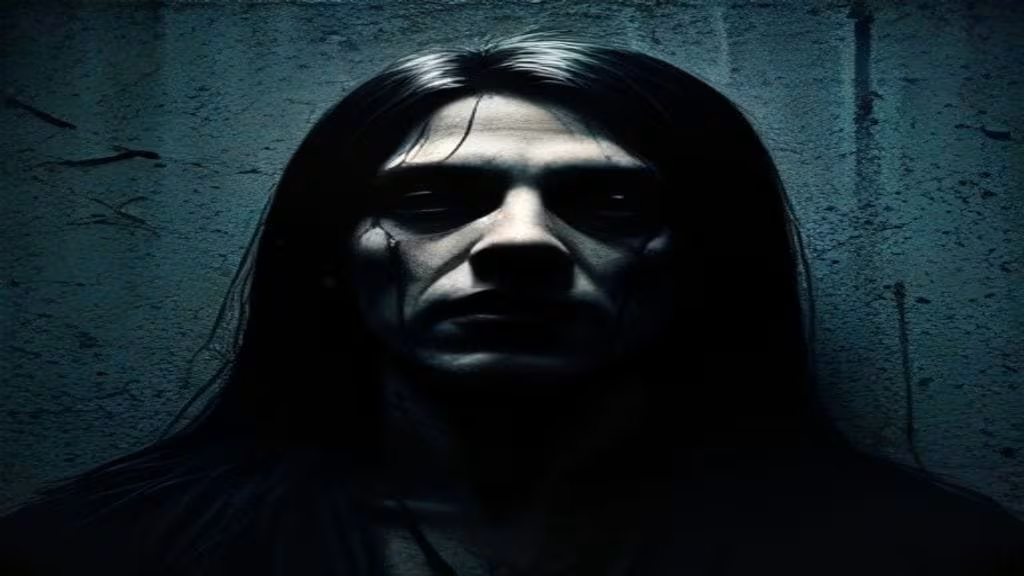
Driven by a morbid fascination that had completely displaced common sense, I began to examine the wall with the flashlight of my mobile phone. I discovered that the area adjoining my workbench had shifted in tone. The yellowish white of the distemper now bore a greenish patina, a circular dampness some thirty centimeters in diameter that emanated a subtle yet unmistakable stench: the very same fragrance of decay and rancid ink that had flooded the landing three months prior.
I brought my ear close to the epicenter of the stain. I pressed the diaphragm of the stethoscope directly against the damp effluvium of the plaster.
What I heard was not a knock. It was a friction. The sound of something soft, heavy, and desiccated dragging itself centimeter by centimeter across the parquet flooring of apartment B, creeping from the spot where the walnut desk once stood until it pressed flat against the reverse side of my wall.
I heard a respiration as well. Not a pulmonary breath, but an asthmatic wheeze, air forcing its way through a dry, cartilage-devoid throat, a murmur of vocal cords stiffened by rigor mortis. And amid that putrid air, a voice that used no words, but instead the phonetic mimicry of my plastic computer mouse.
«Click… click… click…", the murmur articulated behind the partition. It was a funereal, rasping voice that welled up from the depths of the plaster as though the wall itself were trying to speak.
I remembered then the final days of Don Eusebio. I recalled how the neighbors whispered that the old calligrapher spent his nights awake, methodically striking the wall with his bronze inkwells, complaining that the space in the adjacent apartment—my own living room—was not empty, but instead harbored "a frequency begging for entry."
Don Eusebio had not died of natural causes. He had let himself waste away while transcribing the knocks he heard echoing from his wall. And now, with his flesh consumed, the duty was vacant.
Chapter V: The Terminal Function
Tonight, the damp has swallowed half the parlor. The wallpaper peels in blackened strips, shedding onto the floor like dead skin. The stench of a rotting carcass and wet plaster is so dense it burns my nostrils and forces tears to my eyes, yet I am entirely unable to rise from the chair.
The monitor no longer displays code. The screen has flattened into a dull gray, slashed by static interference that beats in exact time with the sound bleeding from the wall. I no longer need to touch the mouse. My right hand, stiff and cold as marble, moves across the pad of its own accord. My fingers rise and fall in involuntary spasms, executing a code I never wrote, dictated instead by the thing dwelling just beyond.
The lath-and-plaster partition is solid no longer. Under my left hand, the wall gives way like the skin of a rotting fruit. I can feel the curved timber of Room B. I can feel the tips of dry fingers, hard as oak splinters, pushing through the crumbling mortar from the other side, searching for mine.
They graze my knuckles. They feel like cold wax and smell of damp earth and dried ink. The voice is no longer a distant murmur; it rings now inside my own skull, echoing with the cruel clarity of a loudspeaker in an empty chapel.
It dictates the final function to me. It asks me to extinguish the light, to abandon the keyboard, and to sit waiting at the edge of the shattered partition, because the person who will inherit this apartment once I am fully consumed needs to hear the very first knock.
And my hand, obedient, has already begun to strike against the bone.
📜Investigation • Frequently Asked Questions
Documentary Archive and Analysis of the Occult • Relatando.com
In what manner do the urban environment and modern architecture act as catalysts for the supernatural in Carlos Nieto's narrative?
The work reveals how isolation within the inner apartments of sprawling cities strips the individual of their humanity, reducing them to a solitary cog. The soot-stained lightwells and thin plaster walls are not mere sets, but porous membranes allowing for the transmutation of matter and psyche, enabling the latent horror of the adjoining space to poison the protagonist's sanity.
What anthropological symbolism does the figure of Don Eusebio, the retired calligrapher, embody within the story's symbolic economy?
Don Eusebio represents the remnant of a methodical, artisanal trade that clashes violently with the cold abstraction of the systems programmer. His solitary death—literally fusing with the paper and dissolving into a blackened fluid—evokes a dark metaphor for human obsolescence in the modern age, where ink and thought decay into a forgotten, claustrophobic organic matter.
How does the concept of 'latency of matter' manifest in the transition from urban silence to the irruption of the phenomenon paranormal?
Latency operates as a state of gestation where the energy of a traumatic event—Don Eusebio's unattended passing—remains imprisoned within a stagnant atmosphere. The unventilated air and the sealed apartment act as a physical and metaphysical breeding ground which, stimulated by the simple, mechanical click of a mouse, finds in the vibration of the partition wall the perfect channel to manifest.
What role does the protagonist's extreme technification (systems architecture programming) play in his vulnerability to the mystery of the partition wall?
The protagonist's hyper-rationality and digital confinement, surrounded by screens and algorithms, isolate him so entirely from the outside world that his perceptual defenses fray. Searching for redundancies across massive databases, his mind involuntarily tunes into repetitive, spectral patterns, rendering him acutely receptive to the symmetrical echo of the 'tap' bleeding through from the other side of the wall.
Don't extinguish the light just yet...
If you have had the courage to make it this far, we have other dossiers that will test the limits of your sanity.

Terms and Figures of this Tale
To delve deeper into the legends, creatures, and dark concepts that inspire this account, consult their entries in our dictionary of the uncanny:





Tu correo no se publica ni se comparte con terceros: solo sirve para notificar la respuesta.