I am Carlos Nieto. Throughout my years investigating the darkest recesses of the inexplicable at Relatando.com, I have stumbled upon countless enigmas, but few prove as disturbing, universal, and elusive as the phenomenon phenomenon of the 'Shadow People' or the Night Shadows. Imagine waking in the dead of night, your body completely paralyzed by Horror, and glimpsing at the foot of your bed a humanoid silhouette of absolute blackness, devoid of facial features yet oozing a tangible malevolence. This is neither a dream nor a simple hypnagogic hallucination; it is a real encounter with entities that seem to inhabit the invisible folds of our own dimensional reality. Delving into this mystery demands stripping away skeptical prejudices and plunging into rigorous research where parapsychology, theoretical physics, and the most ancient folklore converge to shape one of the most thoroughly documented and least understood modern terrors in human history.
Classified File
- Origin: Universal folklore, modern parapsychology, and the experiences of sleep paralysis.
- Nature: Interdimensional entities, energetic projections, or collective psychic constructs.
- Hazard Level: Moderate to High (Capacity to induce psychological terror extremities, asphyxia, and physical oppression).
- Weaknesses: Direct light, conscious willpower, the elevation of energetic vibration, and the interruption of the sleep cycle dread.
Origin and Etymology
The term 'Shadow People'—translated into Spanish as *gente sombra* or *sombras de la noche*—began to gain popularity in the late 1990s through late-night radio programs in the United States, especially via Art Bell's broadcasts on *Coast to Coast AM*. However, reducing this phenomenon to a mere digital-age fad would be a grave historical error. If we examine the anthropological chronicles of ancient civilizations, we find identical descriptions of these dark silhouettes under different names and cultural contexts. From the 'Jinn' of the Mythology Islamic lore—smoky entities born without fire, dwelling in the dark recesses of homes—to the European folklore of the 'Old Hag,' the ancient witch who presses down upon the chests of sleepers, humanity has always coexisted with the presence of these nocturnal watchers. Etymologically, the concept alludes to the primordial quality of their manifestation: an anthropomorphic shape composed not of solid matter, but of a darkness that seems to swallow ambient light, defying the elementary laws of optics and casting a profound sense of existential void upon those unfortunate enough to cross their path.
With the advent of the internet, research communities paranormal began to compile global testimonies, standardizing criteria and uncovering a disconcerting pattern. Individuals who had never heard of 'Shadow People' described the exact same physical and behavioral characteristics. This suggests we are not dealing with a product of mass hysteria spawned by pop culture, but rather an objective manifestation that has endured across the centuries, linguistically adapting to different eras while keeping its terrifying, elusive essence entirely intact. The rigorous investigation of this millenary origin forces us to rethink our position at the apex of the evolutionary chain and to accept that we share our living space with invisible denizens operating on frequencies we are only just beginning to glimpse.

Anatomy and Appearance
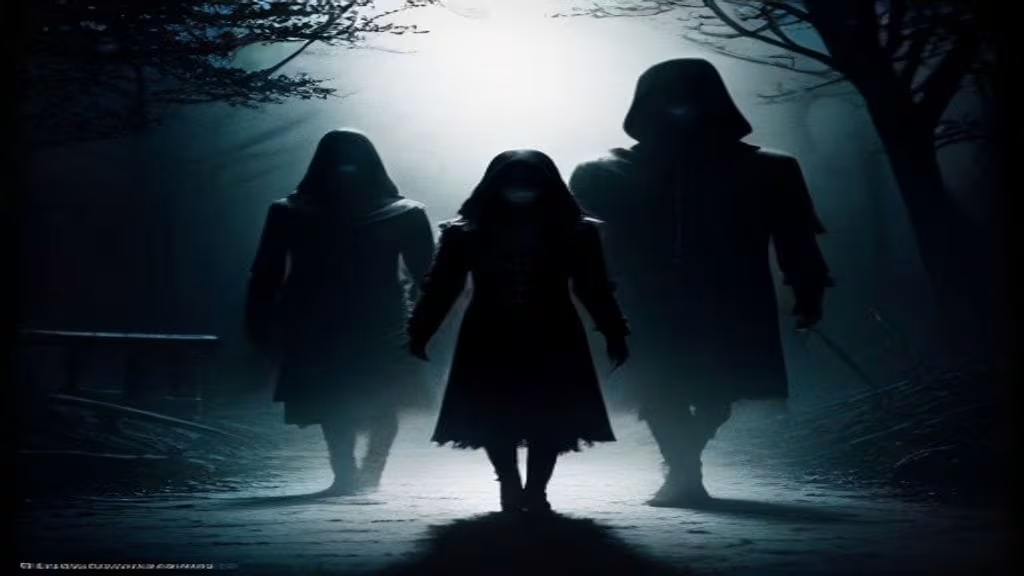
To describe the anatomy of a night shadow is to confront the absolute limits of human perception and descriptive language. Witnesses generally agree that these entities possess a humanoid shape, though notable variations exist in stature, heft, and extraneous detail. They typically manifest as masculine or androgyne silhouettes, ranging in height from that of a small child to towering goliaths well over eight feet tall that seem to bend or shrink to fit within conventional rooms. They are entirely devoid of defined facial features—there are no eyes, no nose, no mouth, only a dense, light-swallowing mass of blackness. Yet, numerous observers report an unbearable sensation of being pinned by an unseen gaze, a cold, calculating scrutiny emanating directly from the region where the entity's face ought to be.
One of the most terrifying aspects of their anatomy is the visual texture of their outline. Unlike a shadow cast by an illuminated physical object—which tends to be diffuse at the edges and transparent—the shadow of the night possesses an unnatural opacity. It is a blackness blacker than the nocturnal darkness itself, a three-dimensional void cut out against the wall or floating freely in the middle of the room. In certain cases documented by field researchers, these entities wear distinct accessories, the most celebrated archetype being the 'Shadow Man with a Hat,' frequently described as a Victorian or 1930s gentleman topped with a wide-brimmed hat or fedora. Other witnesses have observed billowing capes, hooded silhouettes resembling medieval monks, or amorphous shapes that shift in consistency at will, passing from apparent solidity to a volatile mist capable of passing through locked doors and reinforced concrete walls.
Modus Operandi and Powers
The 'modus operandi' of the Shadow People follows a systematic pattern that repeats across thousands of testimonies gathered around the globe. As a rule, their apparition is preceded by a drastic drop in ambient temperature and a sepulchral silence, a sudden cessation of everyday sounds such as the chirping of crickets or distant traffic. The witness typically awakens abruptly, experiencing a total muscular paralysis known as sleep paralysis, where the mind remains fully conscious yet the body refuses to obey commands of movement. It is in this state of extreme vulnerability that the entity manifests, emerging from a dark corner, stepping through the bedroom wall, or looming menacingly at the foot of the bed. Its primary objective does not appear to be direct physical attack, but rather the harvest of emotional energy, feeding upon the fear, despair, and paralyzing anguish they inflict upon their victim.
Among their most unsettling traits is the manipulation of space and perceived time. Those who have survived a close encounter report that the entity can warp a room's acoustics, trapping desperate screams soundlessly in the throat, or inflict a temporal distortion where a few seconds of confrontation stretch into an endless, suffocating eternity. They also possess the ability to traverse impossible distances in the blink of an eye, dissolving into the shadows the moment the observer blinks or claws back a shred of control over their paralyzed limbs. Some researchers suggest these entities operate within the infrared or ultraviolet spectrum, and that their capacity to bleed into our dimension relies on ambient electromagnetic energy—which would explain why they so frequently haunt homes with faulty wiring, high electromagnetic fields, or rooms soaked in the residue of human violence and suffering.
Weaknesses and Protective Rituals
Despite the apparent invulnerability of these entities and the paralyzing dread they instill in those they visit, the Shadow People are not omnipotent gods; they possess specific vulnerabilities that can be exploited to neutralize their presence and banish them from one's living space. The first and most potent weakness of these beings is light. Though they can cloak themselves in the dead of night, the sudden activation of an intense light source—such as clicking on a bedside lamp or a mobile phone's flashlight—frequently triggers their instantaneous dissolution or a hasty retreat back into the darkest corners where illumination fails to pierce. Photonic energy acts as a solvent upon their fragile, low-vibration structure, forcing them to recoil back into the primordial dimension from which they crawl.
On a mental and spiritual plane, the most potent weapon against the Shadow People is the conscious disruption of the cycle of fear. These entities are energetic parasites that feed directly upon the adrenaline and panic of their hosts; therefore, once a person manages to steady their racing heart, project an attitude of mental defiance, or invoke a higher spiritual force with absolute conviction, the entity's sustenance vanishes, forcing an immediate retreat born of energetic starvation. Within the realm of environmental warding, ancient practitioners of the occult and defensive arts recommended high-vibration crystals such as black tourmaline or smoky quartz strategically placed in the corners of bedrooms, alongside the ritual burning of purifying incenses crafted from white sage or rue. Maintaining a healthy sleep routine, curbing chronic stress, and avoiding prolonged exposure to elevated electromagnetic fields within the sleeping quarters are likewise vital hygienic measures for slamming shut the dimensional thresholds through which these shadows manage to seep into our world.
Documented Cases and Famous Legends
The literature surrounding encounters with the Shadow People is fraught with chilling cases that defy any attempt at conventional rational explanation. One of the most celebrated files in the annals of modern parapsidology is that documented by paranormal researcher and author Heidi Hollis in the early 2000s, who popularized the specific figure of the 'Shadow Man with a Hat.' In her research, Hollis gathered hundreds of testimonies from completely unrelated individuals who claimed to have seen a tall man, dressed in black and wearing a classic hat, staring fixedly at them from the threshold of their doorways before vanishing into thin air. Most disturbing about these accounts is that this specific hat-wearing entity often preceded streaks of personal misfortune, sudden illness, or states of profound depression within the affected families, suggesting it acted as a hierarchical observer or an emissary of calamity.
Another paradigmatic case unfolded in rural Texas, where a young couple began experiencing strange thermal and acoustic shifts in the attic of their newly acquired Victorian home. It was not long before the apparitions migrated to the master bedroom, where a silhouette of absolute, light-devouring blackness hovered night after night over their newborn's crib. Field-recording equipment captured electronic voice phenomena—a guttural, whispered cadence demanding absolute dominion over the space. This forced the family to abandon the property for good, even after an informal exorcism performed by a local priest failed entirely to purge the presence. These harrowing accounts stand as proof that the nocturnal shadows are not mere optical illusions born of fatigue, but permanent tenants of an unseen ecosystem that actively bleeds into our daily reality, leaving an indelible brand of terror upon anyone reckless enough to bear witness to them.
Comparative Analysis
To fully comprehend the true nature of the Shadow People, it is indispensable to establish a rigorous comparative analysis with other entities and phenomena across the vast spectrum of the paranormal, distinguishing them from beings with whom they are frequently and erroneously confused in the popular imagination. First and foremost, it is crucial to separate them from classic ghosts or apparitions of the deceased. While a Phantom traditional phantom usually retains vestiges of a human personality, wears the garments of a specific era, and projects a translucent or ethereal luminescence, the Shadow People completely lack recognizable humanity; their blackness is opaque and dense, and their aura exudes a cold hostility devoid of any emotional empathy. They seek neither to communicate nor to resolve unfinished business; their purpose is purely observational or parasitic.
Likewise, it is necessary to separate them from the demons and entities of traditional demonology cataloged within medieval grimoires. Although the oppressive dread and malice projected by the Shadow People can mirror the harrowing weight of a demonic assault, these shapes of the night do not yield to dogmatic religious exorcisms in the same predictable manner, nor do they typically manifest prolonged physical possessions or phenomena of —which are usually bound to a geographic location— the Dybbuk is bound to a person. It is a form of 'personalized' possession that challenges the notion of evil as an external force, reminding us that the deepest horror sometimes springs from our unfinished humanity and the debts we leave unpaid upon death. large-scale violence, such as the levitation of heavy objects or the desiccation of rooms. The Shadow People operate in a more subtle borderland, a dimensional limbo where quantum physics and parapsychology intersect. They are the silent guardians of the nocturnal thresholds, a permanent warning that the reality our physical eyes manage to perceive is merely a minuscule fraction of a cosmos infinitely more complex, dark, and inhabited than we dare to imagine in our worst nightmares.
📜Investigation • Frequently Asked Questions
Documentary Archive and Analysis of the Occult • Relatando.com
What exactly are the Shadow People?
They are humanoid entities composed of absolute blackness that manifest in the dark, frequently associated with episodes of sleep paralysis and sightings in bedrooms.
Are they dangerous to humans?
They rarely inflict direct physical harm, yet they generate an extreme psychological terror, feeding off the energy of fear and the anguish of their witnesses.
How can their presence be avoided?
Switching on the light immediately, maintaining a resolute mental stance to dispel fear, and utilizing purifying elements helps to banish their presence.
Are they related to traditional ghosts?
No. Unlike ghosts, the Shadow People lack human features, do not seek to communicate, and their blackness is utterly opaque and absorbent.
Don't extinguish the light just yet...
If you have had the courage to make it this far, we have other dossiers that will test the limits of your sanity.

Terms and Figures of this Tale
To delve deeper into the legends, creatures, and dark concepts that inspire this account, consult their entries in our dictionary of the uncanny:



Tu correo no se publica ni se comparte con terceros: solo sirve para notificar la respuesta.