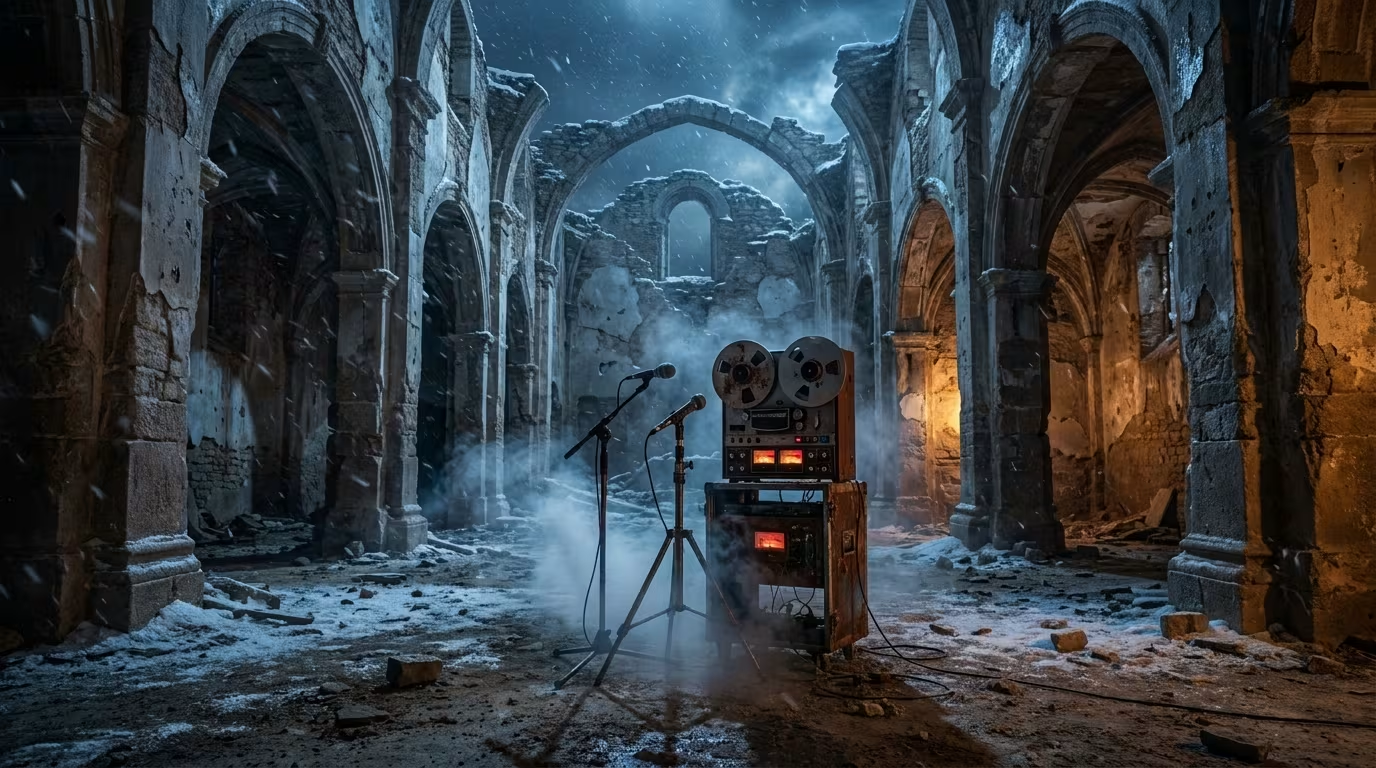
The metal of the tripod clung to the earth with the stubbornness of a withered root. Julián adjusted the final XLR connector while his breath escaped in gray wisps, dense as the smoke from a poorly extinguished stove. Outside, the Aragonese night was not a mere absence of light, but a compact mass, an icy volume that gnawed at the ears and numbed the knuckles until they felt like wax. They stood in the dead heart of Old Belchite. The tower of the church of San Martín silhouetted against the overcast sky like a fractured tibia, a gigantic femur pointing toward nothingness. No one spoke. The multi-track recorder, a heavy beast of mechanical buttons and phosphorescent screens, blinked with a hypnotic cadence. The VU meters registered the absolute muteness of the stones. Grave silence, Julián thought, though the phrase struck him as insufferably trite. Graves, at least, keep something beneath them. Here, there was only crumbling lime mortar, dust from bricks shattered by thirty-seven shrapnel, and the unmistakable odor of stale dampness mixed with dried pigeon droppings.
I. The Frequency of Rust
Three in the morning is not a time; it is a temperature. The equipment thermometer hit three below zero just as the needles on channels three and four began to shudder. There was no preceding crackle, nor the classic static hiss of the nocturnal atmosphere that sound engineers learn to dismiss out of professional habit. It was a mute emergence, a low-frequency vibration rising from the crypt's foundations, permeating the limestone slabs with the patience of a thick, viscous liquid. Julián felt the impact in the soles of his feet before he registered it in his headphones. He tore the muffs off for a second, with the clumsy motion of one seeking to confirm if the outside world remained intact, but the air within the ruin vibrated with a physical density. He pressed the foam padding back against his ears, and the sound struck his eardrums like a blow.
They were sirens. Not the modern wail of city ambulances, but the metallic, strident, unsynchronized roar of Civil War anti-aircraft devices. A mechanical scream forged from poorly greased gears and strained iron that seemed to tear the sky right above the ruined vault. Mateo, checking levels in the opposite corner of the presbytery, dropped his headlamp. The impact against the rubble echoed dryly, but neither of them bent to retrieve it. Their eyes were locked on the oscilloscope screen, where the waves traced violent peaks, sharp as butcher's knives. The frequency was not coming from the outside. The parabolic microphones, aimed with pinpoint precision at the transverse arches of the nave, were capturing something rising from the subsoil, directly beneath the steps leading to the old ossuary.

The sound was not a recording. It possessed weight. It smelled of cold sulfur and wet wool.
The cold ceased to be an aesthetic problem and hardened into a muscular contraction. Julián swallowed hard and tasted old coinage in his throat—pure copper. He looked at Mateo. His partner's mouth hung open, his lips chapped by the steppe wind, a thin line of clear saliva slipping down his chin without him making the slightest move to wipe it away. The main channel's VU meters spiked past the red zone with a furious, continuous flicker, like an epileptic eye refusing to close its lid. And then, beneath the metallic howling of the sirens, the human fabric emerged.
II. The Whisper of Quicklime
First came the rhythm. A dull, rhythmic tapping, like tiny knuckles rapping against the rotting wood of a chest buried six feet deep. KNOCK, KNOCK, KNOCK. Steady, relentless. To that pulse joined a confused chorus, the whisper of garments dragging over pebbles, the harsh friction of coarse burlap against bare stone. They were sobs. Not the theatrical weeping found in the movies of Horror, but the raw, guttural asphyxiation of small children swallowing brick dust as oak beams collapse upon their skulls. A truncated wail, choked by dry coughs, punctuated by silences too prolonged, broken only by the hiss of wind slipping through artillery craters.
Julián tried to move his hand toward the emergency stop button, but his fingers refused to respond. They denied obedience to the commands sent from his brain, paralyzed by an icy current coursing through his forearms. Mateo began to whimper in a corner, huddled against the wall of the high altar, his hands clamped to the sides of his head as if trying to keep his skull from splitting in two. The recorder kept devouring tape, registering the unheard-of. And from amid the cluster of infantile laments, the frequency stabilized into a single voice. An aged voice, cracked, raw as the bottom of a throat full of sand, articulating words in a thick, archaic Aragonese, nearly unintelligible to a modern ear.
The phrase was burned into the memory of the headphones before the circuits began to melt with a bluish crackle:
«Do not step on the quicklime; it still burns.»
The smell shifted abruptly. The stench of basement damp vanished, replaced by the acrid, piercing, unmistakable foulness of quicklime reacting with the moisture of flesh. Heat surged upward from the floor with an unaccustomed violence for the middle of an Aragonese January. Julián's boots began to warm through their rubber soles. Looking down in terror, he saw that the dust accumulated between the paving stones was no longer gray, but a milky, smoking white, giving off tiny bubbles that dissolved in the darkness of the church. Mateo no longer screamed; he had fallen mute, his glazed white eyes fixed on the nonexistent ceiling, while the chemical vapor burned his eyelashes and stripped the skin from his lips in thin, dry strips like parchment.
III. The Silence of the Remains
At six in the morning, the Civil Guard found the recording equipment fused into a shapeless mass of black plastic and twisted copper. Julián was perched on the lintel of the ruined doorway, the soles of his boots utterly disintegrated, reduced to a black sludge that reeked of burnt petroleum. He made no sound, staring fixedly at his own fingers—now blackened and rigid as dead coals—incapable of uttering a word. A few meters away, Mateo lay face down in the white dust, his face pressed into the earth, his lungs filled with lime that had long since grown cold, sealing his mouth in an eternal grimace that no one dared to photograph.
📜Investigation • Frequently Asked Questions
Documentary Archive and Analysis of the Occult • Relatando.com
On what myth or dread reality is this tale based?
Inspired by the tragedies of the Spanish Civil War in Belchite and the atavistic dread of echoes trapped within the sites of slaughter.
Are there documented real cases similar to this story?
Numerous urban legends and electronic voice phenomena supposedly captured by paranormal researchers within the actual ruins of the abandoned village.
What does the ending of the story mean?
It represents the absolute encroachment of the past upon the present, where historical phantoms are not merely heard, but physically destroy.
Don't turn off the light just yet...
If you have had the courage to make it this far, we have other dossiers that will test the limits of your sanity.

Terms and Figures of this Tale
To delve deeper into the legends, creatures, and dark concepts that inspire this account, consult their entries in our dictionary of the uncanny:

Tu correo no se publica ni se comparte con terceros: solo sirve para notificar la respuesta.