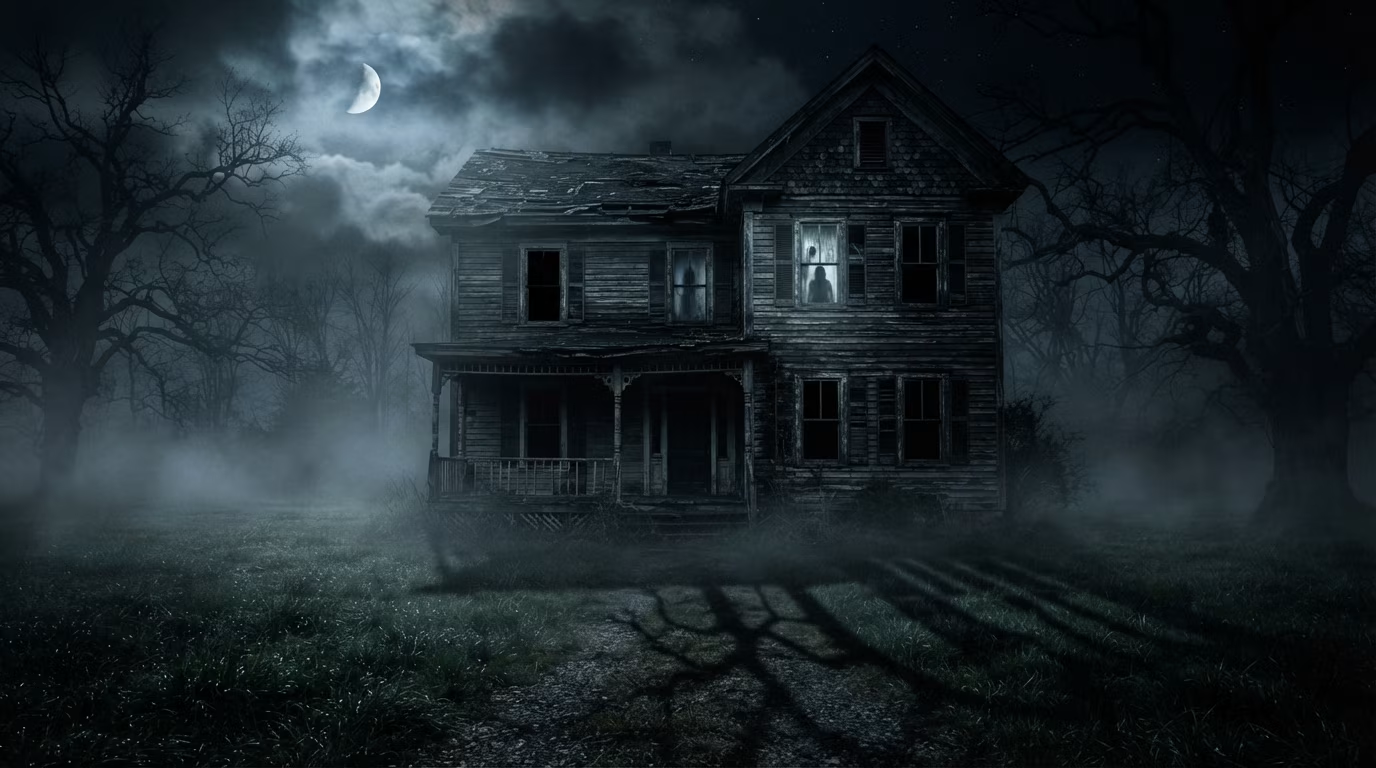
The cold at 112 Ocean Avenue was not simply a matter of autumn meteorology; it possessed a dense, oily consistency that seemed to cling to the temples like dry-ice vapor, slipping into the nostrils with the metallic stench of an abandoned railway track. Ronald DeFeo Jr. —’Butch’, as he was called by the few who believed they knew him before the November night swallowed him whole— felt that dull thud deep within his skull, the frantic ticking of an unhinged clock competing with the constant hum of the central heating, an archaic boiler coughing up soot and smothered screams in the cellars of memory. It was a quarter past three in the morning. The hands of the old clock with its phosphorescent dial crossed with surgical precision, marking the exact moment the house’s timber began to contract, groaning not from the laws of physics, but with the deliberate cadence of gnarled knuckles scraping against the plaster of the load-bearing walls. The flannel sheets were soaked in a cold, rancid sweat, the physical residue of a nightmare that refused to dissolve upon opening the eyes. In the greenish gloom filtered through the poorly shut blinds, the shadows in the master bedroom did not merely cast themselves; they breathed. They constricted and dilated with a viscous slowness, seeking out the contours of the bodies sleeping in the other rooms, completely oblivious to the invisible storm brewing in Butch’s frontal lobe. His right index finger was cramped, unnaturally hooked over the invisible trigger of a headache drilling into his temples with the persistence of a carpenter’s auger. There was no peace in that Dutch colonial house with its dark shingles and rectangular windows staring out toward the river like empty eye sockets. There was a presence, a mass of dense, hostile air occupying the hallways in silence, sealing the doors shut with the sheer force of its will, forcing him to breathe the breath of something ancient, ravenous, and desperately cold.
I. The First Sign in the Darkness
The sound did not enter through the ears; it resonated directly at the base of the brain, like a metallic echo rebounding inside a bronze bell submerged in oil. ‘Kill. Wake the demons sleeping in their beds and purge them. No one must be left’. The voice had neither gender nor face, yet it possessed a rough texture, like dry leaves crushed under boots caked with mud and salt. Butch rose with a mechanical motion, the muscles of his neck rigid as rods of rusted iron, feeling that his own arms no longer belonged to him, that someone else had slid their hands into the sleeves of his pajamas and was working his joints from an infinite distance. The house lay steeped in a sepulchral silence, broken only by his father's distant, muffled snoring on the ground floor and the barely perceptible whisper of wind beating against the oak shutters. He walked barefoot down the carpeted hallway, noticing how the wooden floor gave way beneath his feet with creaks that seemed to him like pistol shots in the dead of night. The air smelled of stagnant damp and withered gardenias, a sweetish, putrid stench emanating from the corners where moonlight dared not penetrate. As he passed his younger siblings' room, he felt a pang in his stomach, a nauseating void that forced him to stop for an instant, holding his breath to keep from vomiting. The doors stood ajar, letting escape a thread of darkness thicker than that of the corridor. In his mind, the voices swelled, transforming into a chorus of overlapping whispers that ordered him to hurry, reminding him that time was running out and that the souls sleeping beneath those feather quilts needed to be liberated by fire and lead. His fingers instinctively sought the latch of the cabinet where he kept the Marlin .35 Remington, feeling the metallic, gelid contact of the steel like an electric shock running through his forearm. There was no hesitation, no trace remained of the clumsy, self-conscious boy who ate dinner with his family on Sunday evenings; only the blind, imperative urgency remained, to fulfill a command that came from beyond the walls, from a dimension where time did not flow but stagnated like rotten water in a dung heap.
The rifle barrel was so cold it seemed to burn the skin, an icy bite that heralded the end of all excuses.
The weapon's preparation took place in such absolute gloom that Butch's hands were guided by pure tactile memory. Every movement was part of an ancient ritual, a macabre choreography rehearsed in dreams for weeks. As he slid the shells into the tubular magazine, the metallic click rang through the quiet of the night like the bolt of a tomb sealing from within. He stopped before the hallway mirror. His own reflection returned a strange grimace; his eyes, usually dull and bovine, burned with a feverish intensity—feverishly dilated, swallowing the meager moonlight until they became two bottomless black wells. He did not recognize himself. Behind his figure, upon the breath-fogged glass, he thought he glimpsed for a fraction of a second the blurred silhouette of a shadow with disproportionate shoulders and a head tilted to one side, as though observing the trembling of his fingers with scientific curiosity. When he snapped his head around to face the threat, the hallway was entirely empty, inhabited only by specks of dust floating lazily in the draft of cold air. His heart hammered against his ribs with the force of a battering ram, but the dread was no longer a paralyzing emotion; it had transformed into an engine, a dark fuel feeding every single one of his cells. He took the first step toward the master bedroom, where his father snored with a heaviness unbefitting a healthy man, unaware that the world he knew was about to dissolve into a pool of gunpowder and absolute silence.

II. The Breaking of Reason and the Silence of 3:15 AM
The first shot did not roll like thunder; it was a dry crack, deafening in the cramped confines of the bedroom, tearing shreds of plaster from the ceiling and filling the air with a dense, acrid smoke that stung the throat and blurred the vision. Ronald DeFeo senior did not even have time to shape a moan; his body jerked with a dry spasm against the white sheets before falling still, his gaze lost in the plaster moldings. Butch advanced with a steady stride, the smoking barrel still aimed at the inert bulk, while in his head the voices applauded, a murmur of collective approval that hissed unintelligible praise between stifled laughter. The smell of burnt powder mingled with the metallic tang of fresh blood beginning to seep through the mattress, dripping with a monotonous, thick rhythm onto the carpet. Without pausing to reflect, he spun on his heels and made his way down the hallway toward the adjoining bedroom, where his mother slept clutching a pillow. The shots came one after another, mechanical, cold, impersonal, as if he were chopping wood in the backyard on a winter morning. None of the siblings, scattered across the upstairs rooms, woke to offer resistance or exchange a single word; they died in the gloom of their beds, trapped in a deep sleep from which they were torn without transition. The entire house seemed to hold its breath, as if the walls themselves absorbed the sound and the tragedy, swallowing the echoes of the gunshots and transforming them into a dull vibration that made the oak foundations and the windowpanes tremble. At three-fifteen on the dot, when the last casing fell to the floor with a metallic tinkle on the parquet, silence settled once more over 112 Ocean Avenue, a silence so heavy and dense it seemed to carry its own weight, pressing the ceilings downward and smothering any trace of life within those four cursed walls.
Hours later, when the gray, listless light of dawn began to seep through the tall windows, Butch wandered the house like an automaton with hands stained in caked blackness. He no longer heard the voices with the same clarity; they had retreated to the deepest recesses of his mind, leaving behind a dull void, a persistent tinnitus humming in his ears with the frequency of a detuned radio station. He changed his clothes with slow, methodical gestures, stepping out into the street in a clean shirt and with an expressionless face, ready to play the role of the grief-stricken son discovering the unthinkable. Yet upon crossing the threshold and feeling the crisp morning air against his face, he understood that the true Horror he was not done with the gunfire. The house's windows, viewed from the outside, seemed to watch him with a subtle malice, like half-closed eyelids guarding a secret terrible thing. Neighbors walked the opposite sidewalk in their dark coats, oblivious to the feast of blood that had just taken place mere yards from their morning coffee. And deep within his conscience, beneath the shell of the alibi he rehearsed mentally for the police, an ice-cold certainty told him the voices had not left; they had simply moved down to the cellar, waiting patiently for the next unsuspecting family to cross the front threshold so they could stoke the boiler once more and feed the fire.
III. The Judgment of Shadows
Throughout the legal proceedings, the Suffolk courtroom smelled of polished wood, aged paper, and the accumulated sweat of scores of gapeseed onlookers packing the pine benches. Ronald DeFeo Jr., sitting at the defense table in a gray suit far too loose for his slumping shoulders, kept his gaze fixed on his hands clasped before him, studying the small scars and the grit lodged beneath his fingernails that neither wire brushes nor bleach had managed to scour away entirely. His defense attorney, William Weber, attempted to build a case around temporary insanity and paranoid delusions, submitting psychiatric reports that spoke of unruly voices, commanding imperatives, and severe schizophrenia that had entirely stripped the accused of his free will. But the district attorney rebuffed the testimony with cold forensic efficiency, dismissing it as the desperate gambit of a calculating killer seeking to cheat the electric chair by conjuring ghosts where there was only gunpowder and greed. The trial transcripts are rife with uneasy silences, drawn-out pauses during which Butch would lift his eyes toward the bench and answer the judge's probing questions in monosyllables, insisting he had never meant to do it, that someone else was holding the rifle, that the walls of the house spoke to him at night and forced him to pull the trigger to keep the demons from seizing his soul. Not a soul in the room believed him; the jurors, men and women of stern countenance and unyielding morality, saw in him only a monster cold, an unrepentant parricide who deserved the harshest punishment New York law could inflict. Yet, whenever the courtroom lights flickered from faults in the building's archaic wiring and a freezing draft slipped through the cracks of the heavy front doors, those present felt an inexplicable shiver trace their spines—a fleeting, intense sensation that perhaps, within that grim history, lay dark truths no criminal code was ever built to judge.
The weeks of deliberation unfolded amid sensationalist headlines in the local press and clusters of onlookers who thronged the courthouse doors with placards and rosaries. Butch spoke with his lawyer during interviews in the visiting room, repeating over and over that the house on Ocean Avenue had a life of its own, that the rooms changed temperature according to the hour of the day and that the corridors smelled of sulfur when no one was breathing in them. Weber recorded every word in his black leather notebook, fascinated by the consistency of the delusion or by the chilling possibility that something existed beyond medical understanding. But justice knows nothing of atmospheres or invisible presences; it knows of material evidence, of bullet trajectories and confessions signed under artificial light. The guilty verdict arrived one December dusk, dry and blunt as a hammer blow on an anvil. Six consecutive life sentences. Six condemnations for a single soul that no longer inhabited its own body, but rather the dark corner of a cell where the walls, no matter how much they were painted white, still creaked with the same rhythm at a quarter past three in the morning.
IV. The Legacy of Ocean Avenue
Years passed, and the Amityville house became a beacon for the curious, myth-hunters, and devotees of urban dread, yet its true foundations kept sinking into the silence of a night that never quite broke. Those who inhabited the place after the massacre—the Lutz family and subsequent investigators who tried to scratch at the surface of the mystery—always spoke of the same oppressive atmosphere, the same scent of damp rot and withered gardenias, of the same unseen footsteps pacing the oak corridors when the moon reached its zenith. Ronald DeFeo Jr. grew old within the walls of Green Haven prison, carrying the dead weight of murders his memory shifted between unbearable guilt and the hallucinated certainty of having been merely the obedient instrument of a higher will. He never fully revealed whether the hell lived inside his own mind or within the very timber of the Dutch colonial, and with his death in 2021, the secret was sealed under lock and key in the Suffolk County court archives. What remains are the yellowing files, the police photographs of empty beds with rust-stained sheets, and the question suspended in the cold November air: can a house possess enough will to steal a man's soul and force him to fire in the gloom, or is the human mind the only architect capable of constructing monsters so flawless that they ultimately become the only possible reality?
📜Investigation • Frequently Asked Questions
Documentary Archive and Analysis of the Occult • Relatando.com
What true origin or documented testimony inspired this enigma?
The case is built on police archives, the transcripts of Ronald DeFeo Jr.'s 1975 trial, and the forensic testimonies of the DeFeo family massacre at 112 Ocean Avenue, Amityville.
What are the telltale signs or anomalies that precede this phenomenon?
Witnesses and the accused himself recounted drastic temperature shifts, inexplicable odors of sulfur and withered gardenias, and muffled noises from within the walls at 3:15 AM.
Is there any documented psychological or scientific explanation?
Forensic psychiatrists pointed to episodes of paranoid schizophrenia and delusions induced by isolation and substance use, though the atmospheric elements of the case exceed traditional clinical logic.
How do folklore and tradition react to this case?
Amityville has established itself as the modern archetype of the haunted house in Western folklore, inspiring a vast Mythology concerning possessory entities and the porous boundary between the criminal psyche and supernatural terror.
Do not extinguish the light yet...
If you have had the courage to make it this far, we have other dossiers that will test the limits of your sanity.

Terms and Figures of this Tale
To delve deeper into the legends, creatures, and dark concepts that inspire this account, consult their entries in our dictionary of the uncanny:


Tu correo no se publica ni se comparte con terceros: solo sirve para notificar la respuesta.