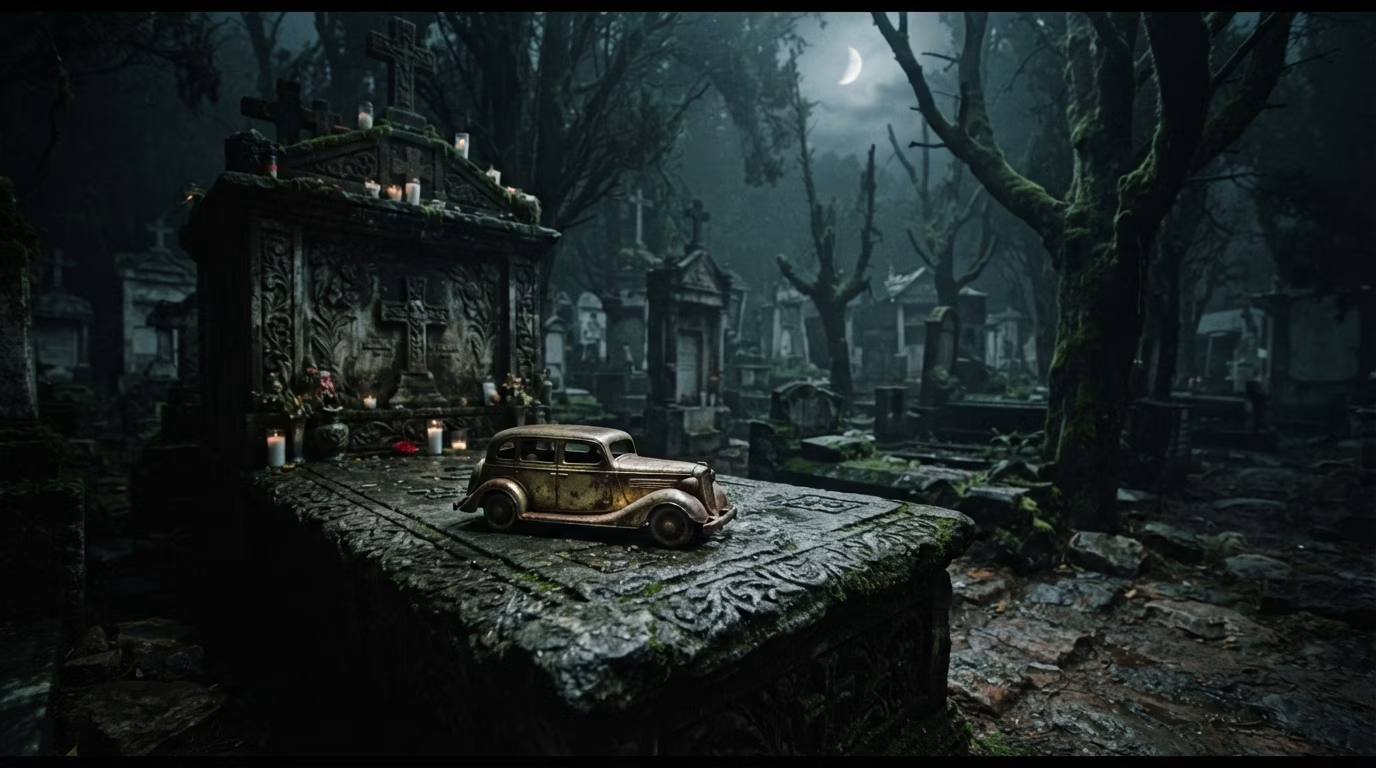
The metal of the little brass carriage scraped the rough surface of the grey quarry stone with a dry, almost imperceptible screech that nonetheless spread like a metallic lash through the absolute muteness of the graveyard. Don Eustaquio withdrew his fingers slowly, as if he feared the cold stone might return his touch with a live shock, and he stayed there, crouched on his knees, spine curved under the weight of his sixty years and the viscous dampness descending from the crowns of the century-old cypresses. The hand lantern, an old iron dynamo with a dented glass, cast a beam of dying light, a dirty amber tone, that barely reached the inscription chiselled into the sepulchral block: Ignacio Torres Altamirano. There were no crypt walls sealed shut with lime and stone, nor wrought-iron crosses to guard the sleep of the just; the grave lay entirely open to the sky, exposed to the inclemencies of the Guadalajara heavens and to the unfathomable blackness that, at three in the morning, seemed to swallow the alleys and niches of the Panteón de Belén.
Eustaquio straightened up slowly, stretching his joints with a grimace of dull pain that ran along his back. The night wind, which always came down laden with a sickly-sweet smell of wet earth and rotting flowers in tin vases, blew against the nape of his neck, making him shudder with a cold that pierced his bones, beyond the thick wool jacket he wore buttoned to his chin. He looked at the little fire engine, a miniature painted bright red that contrasted grotesquely with the gloom of the carved stone. It was the unwritten rule, the fragile truce he had kept for months with the oppressive atmosphere of the place: if the toys were not renewed, if the child were left in absolute darkness and without his favorite distraction, the stillness of the small hours would break in a way his old mind refused to fully process. He knew, from the stories passed by word of mouth among the old watchers, that Ignacio —Nachito, as they called him with a mixture of affection and reverential dread— had died from an atrocious phobia of the dark, a panic so visceral that his parents, in a desperate attempt to ease his eternal torment underground, had ordered the tomb built without a vault, allowing moonlight and starlight to bathe his open grave. But the stars did not always shine, and the night, when it grew overcast, brought with it something more than simple shadows.
I. The First Sign
The nightly rounds through the Panteón de Belén demanded a leaden patience and an absolute indifference to one's own senses. For five years Eustaquio had walked the corridors flanked by neoclassical mausoleums and crypts crumbling from damp, an architectural labyrinth where every corner seemed to conceal a presence crouched in the half-light. Yet nothing had prepared him for the night the little brass carriage appeared three meters from the tomb, propped against the base of an ahuehuete, its front wheels twisted as though it had suffered a violent impact. That time, Eustaquio's logic had tried to cling to any sensible explanation: a wildcat, a blast of hurricane wind sweeping down from the Barranca de Huentitán, or perhaps some irresponsible prankster who had vaulted the perimeter fence and slipped past security. But the wrought-iron gates had been bolted with double-turn locks since dusk, and the perimeter walls stood more than four meters high, crowned with rusted spearheads that no intruder would dare scale in pitch darkness without leaving behind shreds of cloth or flesh.

"It isn't the wind, Eustaquio. The wind pushes forward—it doesn't spin wheels in perfect circles on the ground."
The thought struck him with the raw force of a physical blow as he walked back toward his guard post beside the main entrance. He stopped dead, the flashlight trembling in his calloused hand. The silence of the pantheon was not an empty silence; it was thronged with a dense amalgam of subtle creakings: the settling of the old quarry, the sporadic drip of nighttime condensation onto the palm fronds, and the distant murmur of city traffic that seemed to belong to another universe entirely, utterly foreign to that underworld of illustrious and forgotten dead. But amid those customary sounds, another frequency began to bleed through, a sonic nuance that froze the blood: a rhythmic tapping, quick and light, like the drumming of porcelain fingers on polished wood, or better still, the unmistakable sound of small feet—tiny, bare—running in desperation across the dry gravel of the central path.
II. The Fracture of Reason
Eustaquio clicked off his flashlight. It was a reflex, a primitive defense mechanism whispering that if one could not see the approaching horror, perhaps the danger would cease to exist. The darkness swallowed him instantly, like a thick, unbroken black tide where the silhouettes of the crypts melted into a single, formless mass of looming menace. The sound of footsteps halted abruptly, directly at his back, less than five paces away. The air around the old man grew dense, heavy, charged with a static electricity that raised the hair on his arms and instantly parched his throat. He could feel it: a small, weightless presence radiating no body heat whatsoever, yet exuding a loneliness so profound, so infinitely desolate, that the dread initial terror in Eustaquio's chest began to slowly dissolve, giving way to a heartbreaking empathy, a visceral pity that wrenched his very gut.
"Who's there?" he whispered, his voice shattered, hoarse from disuse and by the Horror fear tightening like a vise around his throat. There was no coherent reply, merely a faint sigh, a breath of freezing air that grazed his right cheek with the delicacy of an invisible feather, followed instantly by a crystalline laugh—sharp and brief, like the chime of a silver bell submerged in water. The laughter held no malice; it was, paradoxically, the expression of a childish game cut far too short, a spark of pure joy trapped in a temporal loop of eternal abandonment. Eustaquio spun on his heel, his heart hammering against his ribs like a runaway piston, and snapped the flashlight back on. The beam of light violently slashed through the blackness, sweeping the alley from side to side. There was no one. Only the path of white gravel, the motionless cypresses silhouetted against the starry sky, and, in the distance atop Nachito's tomb, the brass toy car now pointing in the exact opposite direction from the one he had left it in mere minutes before.
III. The Weight of the Quarry
The following weeks became an exercise in psychological and physical attrition for the old watchman. His hours of sleep dwindled to intermittent fragments, peopled by recurring nightmares in which he himself was the child buried under tons of stone, unable to scream because of the earth filling his mouth. Each night, before beginning his rounds, Eustaquio scrupulously performed the ritual: he wiped the surface of the quarry with a cotton cloth, cleared away the dust that had gathered during the day, and placed a new toy upon the coffin. A wooden cup-and-ball, an oak top with its rusted nail tip, a lead soldier with its bayonet bent. And every night, without exception, the objects shifted position, appeared overturned, or were displaced toward the edges of the grave, as if someone—or something—had been manipulating them during the dead hours of the early morning, searching for the perfect combination to soothe a restlessness that not even eternity could placate.
His companions on the morning shift began to notice the change in Eustaquio. His eyes, once alert and lively, had sunk into dark sockets, ringed by violet halos of chronic exhaustion. He had stopped speaking of his family and barely touched a morsel during the long hours of his watch. Instead, he spent long stretches sitting on a stone bench before the grave of Ignacio Torres Altamirano, staring fixedly at the imperceptible motion of the shadows cast by the trees under the waning moon. He knew the visitors spoke of him with unease, murmuring that the solitude of the graveyard had at last softened his reason, that he was going senile and mistaking the nighttime scurrying of animals for visitations from beyond. But Eustaquio kept silent. He could not explain to them that one night, approaching the grave stealthily, drawn by the sound of a stifled weeping, he had seen a small hand with translucent outlines, pale as nacre, come to rest hesitantly on the surface of the wooden top before vanishing like smoke into the air.
IV. The Question Without an Ending
On the final night Eustaquio walked the shadowy corridors of the Panteón de Belén before requesting early retirement and vanishing without a destiny backward glance, the air was uncommonly dense, steeped in a low-hanging fog that trailed heavily among the mausoleums, blanketing the stone plinths in a milky, freezing shroud. He carried no flashlight that night; the illumination of the full moon sufficed to carve out the cemetery's contours with a ghostly, silver clarity. He approached Nachito's tomb holding a small wind-up toy car, identical to the one he recalled possessing in his own distant childhood. Reaching the sepulcher, he stopped short, startled to discover that the space was not empty: resting upon the cold stone were already half a dozen dusty playthings, some gnawed away by dampness and the passing years, left there by the anonymous hands of mourners or daytime curiosity seekers.
Eustaquio bent forward with an infinite slowness, laying his offering at the exact center of the stone block. In that precise instant, the wind ceased entirely. The distant murmur of the city faded, and the whole pantheon seemed to hold its breath in an absolute silence—heavy and solemn. Small hands, cold as the ice of a mountain stream, came to rest gently upon his stooped shoulders. There was no fear in that moment, no startle, no urge to flee. Only an immense, overwhelming sense of companionship in the midst of nothingness. Eustaquio closed his eyes, feeling the faint brush of a breath that did not exist against his ear, while a child's voice—faint as a dry leaf skimming over a tomb—whispered a question that hung suspended in the small hours' mist, beyond any possible answer, poised forever on the threshold between life and memory.
Why does the night never end for those afraid of losing the light?
📜Investigation • Frequently Asked Questions
Documentary Archive and Analysis of the Occult • Relatando.com
What true origin or documented testimony inspired this enigma?
The Legend concerning Ignacio Torres Altamirano (Nachito) at the Panteón de Belén in Guadalajara rest upon oral histories and the testimonies of night watchmen who, across decades, have reported anomalous activity and toys mysteriously shifted atop his open-air grave.
What are the telltale signs or anomalies that precede this phenomenon?
Night watchmen and caretakers often report a sudden plunge in the local temperature, the sound of bare feet on gravel, crystalline peals of children's laughter, and the inexplicable movement of toys left upon the quarry floor.
Is there any documented psychological or scientific explanation?
From a psychological standpoint, nocturnal isolation in a historic graveyard intensifies pareidolia and sensory hypersensitivity—yet the recurring accounts of multiple independent watchers defy any simple hallucination.
How do folklore and tradition react to this case?
Popular tradition keeps alive the custom of bringing new toys to the grave—to entertain the child's soul and soothe its ancestral fear of the dark, transforming dread into a collective ritual of empathy.
Do not extinguish the light just yet...
If you have had the courage to make it this far, we have other dossiers that will test the limits of your sanity.

Terms and Figures of this Tale
To delve deeper into the legends, creatures, and dark concepts that inspire this account, consult their entries in our dictionary of the uncanny:

Tu correo no se publica ni se comparte con terceros: solo sirve para notificar la respuesta.