The metallic screech of the last commuter train's wheels against the tarnished steel of Shinagawa Station had faded more than twenty minutes ago, leaving behind a dense, heavy silence broken only by the steady drip of a rusted pipe on the opposite platform. Mateo adjusted the lapels of his coat, feeling the chill of that Tokyo small hours seep into his bones, down to the marrow. He had lingered too long in that underground cocktail bar in the Minato district, discussing publishing contracts that now seemed absurdly futile against the raw solitude of the wet asphalt. He decided to cut through the side alleys that run parallel to the Yamanote line, a labyrinth of grey concrete walls, high-tension cables hanging like black viscera, and flickering bulbs of dying light that barely kept the densest shadows at bay.
The asphalt was covered by a thin layer of persistent drizzle, a cold mist that seemed to cling to the skin like a living substance. Mateo walked with a steady stride, trying to keep his mind occupied with the manuscript corrections he had to deliver the next day. Yet in the atmosphere hung that strange quality, an acoustic void where every footstep on the wet ground resonated with a hollow echo, as if he were walking on a hollow surface, on an immense metallic sounding box. It was then, just as he turned the corner that connected to the underground passage of the train tracks, that the sound began. At first it was a dull murmur, a rhythmic and hurried tapping against the pavement. Tac-tac-tac-tac-tac. A dry, frantic sound, implacable in nature.
I. The First Sign in the Gloom
Mateo stopped dead. His breath unfurled a dense white plume in the gelid air. He thought, with that desperate need of human reason to cling to logic, that it was a stray dog, a large animal running in terror beneath the storm. But the rhythm did not match the trot of a quadruped; it was too heavy, too mechanical, and above all, too swift. The sound rebounded against the reinforced concrete walls with disconcerting precision, closing the distance between the darkness of the alley and the amber cone of the streetlamp beneath which he stood petrified.

"Who goes there?" Mateo shouted, trying to imbue his voice with an authority that his parched throat utterly belied.
The echo returned his words distorted. The metallic tapping did not slow; on the contrary, it seemed to intensify, now accompanied by a secondary sound—a dull, viscous drag, like thick canvas or flayed flesh scraping against the coarse asphalt of the street. The smell of pure rust, dried blood, and stagnant dampness suddenly flooded his nostrils, triggering an instant nausea that made his knees buckle slightly. The streetlamps flickered in unison, as if an immense electromagnetic field were sweeping low along the alley floor.
The human mind is a fragile architecture that prefers madness to the acceptance of the impossible.
Clinging to his leather briefcase as if it were a medieval shield, Mateo slowly pivoted on his heels. His eyes took a moment to focus on the absolute blackness of the sloping stretch rising from the railway maintenance yards. What the streetlamp's light revealed next destroyed in a tenth of a second any rational foundation of his existence. It was not an animal. It was not a macabre prank by Tokyo's nocturnal youth.
II. The Breaking of Reason and Metal
Low to the ground, propelling itself with frenzied violence on its raw-boned forearms, a human figure advanced, cleanly severed at the waist. The elbows struck the wet asphalt with a demented cadence, producing that metallic, rhythmic sound that had terrified Mateo from a distance. The torso wore a white shirt reduced to tatters and soaked in a blackish fluid, and long, lank hair completely covered its face, concealing features that intuition screamed were no longer human. But the worst of it, that which froze time and paralyzed the beat in Mateo's chest, was the ashen, deadly gleam protruding between its lips: a farmer's sickle with a curved, sharpened blade, held firmly between bloodied teeth, glinting under the flickering light.
The horror did not arrive as a slow revelation, but as a physical blow to the pit of the stomach. Mateo tried to run, but his legs felt heavy, as if forged from solid lead. His initial denial—the desperate conviction that this was merely a feverish nightmare born of exhaustion—shattered upon hearing the sound of breathing coming from the creature: a harsh, guttural, profoundly human hiss that exhaled freezing vapor just a few yards away. It advanced at sixty kilometers an hour, eating away the distance with the precision of a mechanical predator, driven by an atavistic hatred and a velocity impossible for a mutilated frame.
—*Teke… teke…* —the entity murmured through the steel blade it bit with rabid fury, an onomatopoeic sound mimicking the frantic slamming of its elbows against the rails where, decades before, a high-speed train had violently severed its life.
III. Flight Through the Urban Labyrinth
A strangled scream escaped Mateo's throat as the creature raised its torso slightly, revealing the clean cut of its hip: a mass of exposed bone, dried tendons, and necrotic flesh that left a gleaming, viscous trail on the pavement. Raw, animal survival instinct replaced paralyzing panic. Mateo hurled the briefcase to the ground—a useless decoy—and sprinted down the alley, blindly turning at the first intersection toward the residential district of Shinagawa.
His footsteps splashed desperately through the puddles. Behind him, he heard the metallic echo multiplying against the narrow walls, rebounding in a macabre symphony that seemed to surround him completely. *Clack-clack-clack-clack*. Closer each time. He could feel the entity's icy breath grazing the backs of his heels, the fetid stench of iron and death seeping into his clothes. The doors of the traditional Japanese houses remained shut fast, mute and indifferent to his agony. No one lit a light; no one came to his call.
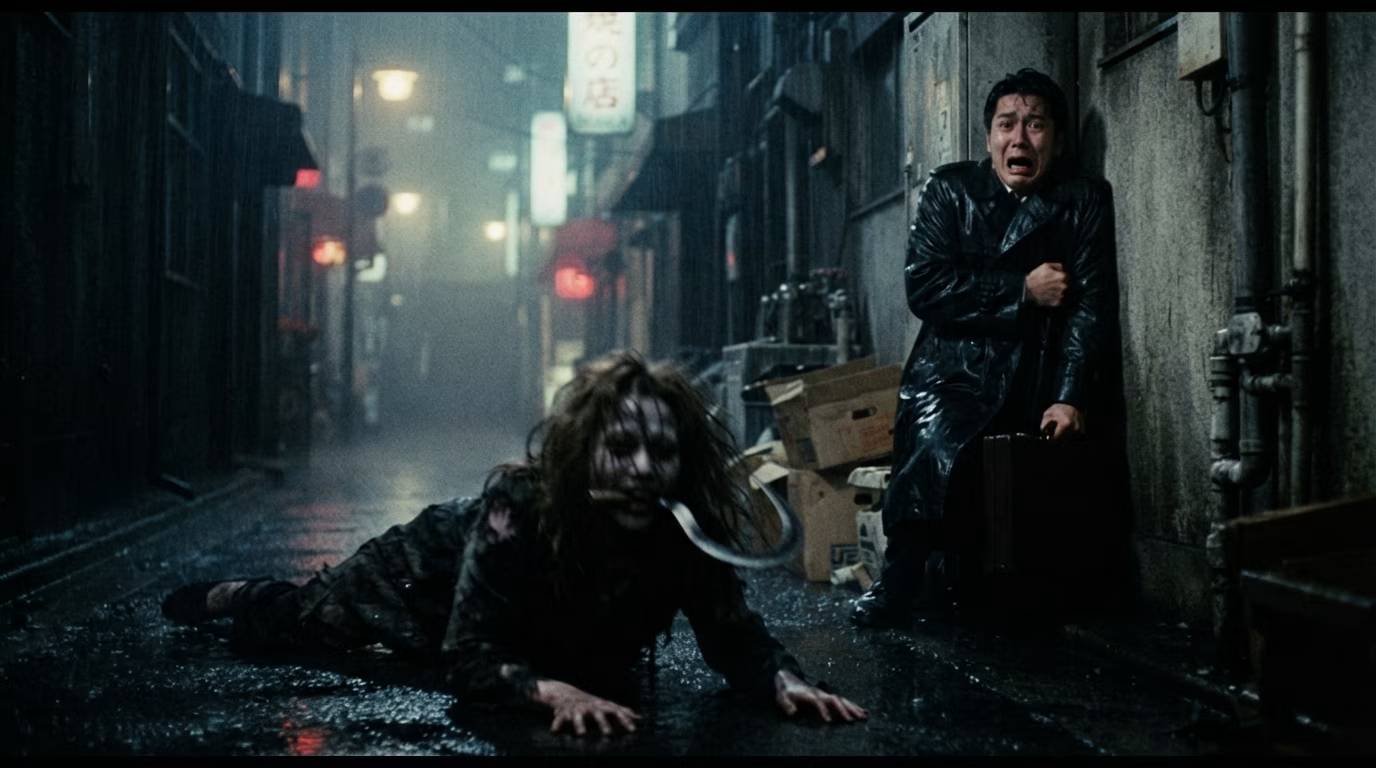
He turned one last corner into a dead-end alley, a blind alley flanked by high concrete walls crowned with barbed wire. He stopped, gasping, lungs aflame and heart hammering against his ribs like a hydraulic hammer. He spun around with his back pressed to the cold wall, trembling from head to toe, awaiting the inevitable. The metallic sound ceased abruptly. Silence returned to the alley, denser and more sepulchral than before.
Before him, in the gloom of the last blown streetlamp, the silhouetted torso waited motionless. The sickle gleamed with a silver sheen. And from the darkness, a hoarse whisper, cloying and near, asked directly into his mind:
—Where are my legs?
📜Investigation • Frequently Asked Questions
Documentary Archive and Analysis of the Occult • Relatando.com
What true origin or documented testimony inspired this enigma?
What are the telltale signs or anomalies that precede this phenomenon?
Witnesses agree on a sudden, sepulchral silence in nighttime urban areas, followed by a distinctive rhythmic, metallic sound ('teke-teke') produced by the impact of elbows against the ground at superhuman speeds.
Is there any documented psychological or scientific explanation?
From an urban psychology perspective, these myths mirror the profound isolation of the individual in modern Asian megalopolises, nocturnal dread, and the dread visceral terror of mutilation within overcrowded railway environments.
How do folklore and tradition react to this case?
Oral tradition holds that should one encounter the Teke Teke, there are but seconds to answer correctly a treacherous question concerning the whereabouts of her legs; otherwise, one will be cleaved in half with a scythe.
Do not extinguish the light yet...
If you have had the courage to make it this far, we have other dossiers that will test the limits of your sanity.

Terms and Figures of this Tale
To delve deeper into the legends, creatures, and dark concepts that inspire this account, consult their entries in our dictionary of the uncanny:


Tu correo no se publica ni se comparte con terceros: solo sirve para notificar la respuesta.