The saliva in Eustaquio's mouth tasted of rust and sour pulque, a viscous residue that caught against his uvula each time he forced himself to swallow. Outside, the Zacatecas night fell like a slab of lead over the steep alleys, drowning the amber glow of the kerosene lanterns beneath a dense fog that smelled of dampened stone and mule dung. His boots were caked with dried mud; the worn soles barely clinging to the fragments of pink quarry tile he clumsily trod upon. For three hours he had been waiting by the cliff's fissure, right where the sheer wall of La Bufa seemed to part with a sigh of ancient rock. The wind hissed through the scrubby huizaches with a sharp, almost human pitch—a relentless grievance that wormed its way into his ear canals and drilled into his temples with a dull, insistent rhythm.
No one climbed La Bufa at that hour. The old miners kept their terror buried at the bottom of the cantinas, their mezcal glasses trembling between calloused fingers as they warned the young men that St. John's midnight tore open portals where the shadowless dead walked. But Eustaquio had nothing left to lose. Tuberculosis was eating away at his lungs from the inside, wringing out dark coughs that stained the grimy handkerchiefs in his pouch with blackish blood. He needed the gold. The veins of the San Bernabé mine had collapsed, entombing his compadres in a sepulchral silence, and destitution was tightening around his throat with more force than a hemp rope. Then the rock gave way.
I. The Quarry Fissure
The sound was no thunderous crash, but a dry crack, like the bone of a kneecap snapping beneath a mule's weight. The stone slid inward, revealing a darkness so thick it seemed to possess a liquid consistency. A dense vapor billowed from the void—a reek of primordial dampness mixed with rotting tuberoses and sweetish meat, a cloying stench that coated the back of the throat and induced instant nausea. Eustaquio drew a pine-torch remnant from his waistcoat pocket and struck a match. The flame flickered, bluish and fragile, half-devoured by the foul air exhaled from the mountain's guts. He took his first step into the dark, feeling the subterranean cold gnaw at his ankles through the threadbare cotton of his trousers.

The tunnel descended in a steep, slick spiral. The walls had been hewn by hand, though by no human tool; the gouges in the stone bore the shape of monstrous talons, deep grooves that seemed to ooze a greasy lubricant. The torchlight barely illuminated a couple of yards ahead, forcing him to divine the path through the soles of his boots. Each footfall echoed hollowly, as though he were treading across the hollowed skull of a giant. Halfway down, the air shifted abruptly. It no longer smelled of stagnant damp; it smelled of a woman. Expensive perfume mingled with fresh sweat and clean hair—a contrast so violent against the filth of the mine that Eustaquio halted dead in his tracks, his heart hammering against his ribs like a bird trapped inside a shoebox.
—Come for what is yours, miner? —a voice murmured from the depths of the gloom, soft as the brush of silk against raw skin.
Eustaquio raised the torch. The muscles in his arms were rigid, locked tight, and a fine film of cold sweat pearled across his forehead, trickling down the bridge of his nose to strike the stone floor. There, seated upon an old iron-banded oak chest, was she. She wore a black satin underskirt that caught greenish sheens beneath the foul light of the resinous wood. Her face possessed an atrocious beauty, features so delicate and faultless they inspired mistrust, paired with dark, fathomless eyes that seemed to swallow the scant light around them. There was no shadow behind her. The stone wall was clean, barren of any silhouette save that of her slender frame.
II. The Sanctuary of Open Arms
La mujer se puso de pie con un movimiento lánguido, felino, y se acercó a Eustaquio sin que sus zapatos hicieran ruido alguno sobre la piedra. El olor a nardos podridos se volvió insoportable, casi metálico, recordándole el aroma de los ramos que se dejan sobre las tumbas de los niños pobres en el panteón municipal. Estiró los brazos hacia él, con las palmas abiertas y blancas como la cuajada, invitándole a tomarla en peso. Eustaquio tragó saliva, sintiendo la boca reseca por la fiebre. Recordaba las advertencias de los abuelos, los fragmentos sueltos de una Legend que nadie se atrevía a repetir completa por dread a invocar la desgracia: «Entras por el oro, cargas con la dama, y caminas hacia la catedral sin mirar atrás, por más que el mundo se te caiga en la espalda».
—Lévame —susurró ella al oído, y su aliento helado le congeló el lóbulo, haciéndole estremecer de pies a cabeza con un espasmo violento en los muslos—. Lévame hasta las puertas del templo de la Virgen, minero. El oro del arca será tuyo cuando pises las gradas de cantera. Pero si te atreves a girar la cabeza… si tan solo dejas que tus ojos busquen mi cara… te quedarás aquí para siempre, sirviendo de alimento a la piedra.
Eustaquio crouched awkwardly, wincing at the sharp crunch of his lower vertebrae, and lifted her into his arms. At first she weighed very little, scarce more than a village girl on a feast day; her body was soft, yielding, settling against the miner's chest with a deceitful docility. Eustaquio pivoted and began the ascent up the dark tunnel, gripping the torch in his right hand while his left supported the woman's thighs. The flame sputtered, burning down in great leaps, threatening to plunge him into blindness at any second.
Within minutes of marching, his burden began to shift. It was no gradual increase, but a sudden leap in the density of the matter resting in his arms. The woman's legs, which had seemed slender and delicate moments before, thickened beneath the fabric of her skirt, growing as heavy as freshly felled oak trunks. Eustaquio exhaled a hot wheeze, arching his back to compensate for the imbalance as his boots slipped across the muddy floor. The scent of perfume evaporated, supplanted by a nauseating reek of warm mire, carrion exposed to the desert sun, and pooled bile.
III. The Beast Upon the Spine
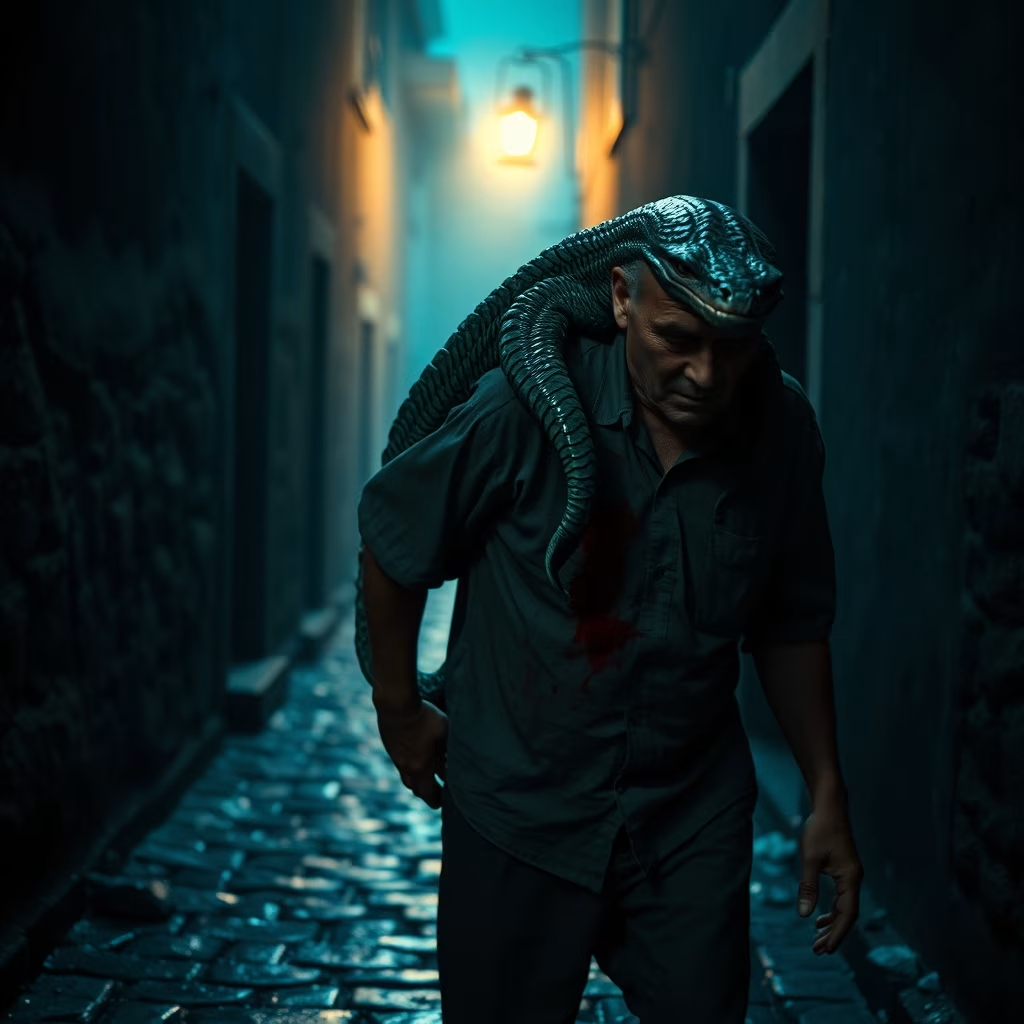
He staggered out of the cave just as the moon finished crossing its zenith, casting a greenish, ghostly light over the cobblestone alleys of Zacatecas. Before him stretched the steep path descending toward the Plaza de Armas and, beyond, the monumental towers of the cathedral silhouetted against the black sky like stakes driven into the night. Eustaquio pressed forward in stumbles, his knees trembling from sheer physical exertion. The weight upon his back was no longer that of a person; it was a formless, cartilaginous, ice-cold mass driving his shoulders down until his collarbones all but dislocated.
—¡Señor… santísima virgen…! —balbuceó con la voz rota, escupiendo un hilo de sangre espesa que le manchó la barbilla y la camisa.
The creature que cargaba se había ensanchado de manera monstruosa. Los brazos que rodeaban su cuello ya no eran delgados y blancos, sino extremidades escamosas, cubiertas de una baba viscosa que le empapaba la nuca y se le metía por el cuello de la camisa, quemándole la piel como ácido diluido. Eustaquio sentía las costillas a punto de estallar hacia adentro, comprimidas por el volumen descomunal de aquel cuerpo que crecía con cada cuadra recorrida. El peso le obligaba a caminar encorvado casi hasta el suelo, con la columna vertebral doblada en un ángulo imposible, los ojos inyectados en sangre y fijos en las baldosas irregulares que pisaba con desesperación.
In the distance, the cathedral bells began tolling three in the morning. Each bronze stroke reverberated through the night air like a hammer blow against a sheet of zinc, piercing his eardrums. Barely fifty yards remained to reach the atrium. The grey quarry steps loomed directly ahead, illuminated by the ash-pale light of false dawn. Eustaquio felt his legs melting beneath him; his thighs shuddered with uncontrollable spasms, and a sharp, piercing pain stabbed through his groin with every forward stride.
And then he heard the sound.
It did not come from outside, but from his own back, pressed flush against his ear. It was a long, wet hiss, accompanied by the dry click of scales scraping against scales. Something began to slither across his shoulders, stretching a neck of impossible length, heavy and cold as mountain ice. A fetid breath, thick with the stench of dead flesh and sulfur, blew directly against his left cheek. The urge to turn his head was a blind, imperious force—a command born from the deepest recesses of his brain that his will could no longer contain. The muscles in his neck tightened like harp strings about to snap.
—Mira el oro, Eustaquio… —siseó la voz, pero ya no era la de la mujer; era un coro de voces superpuestas, graves y metálicas, raspando el fondo de una caverna vacía—. Ya casi llegamos. Voltea a ver tu pago.
Eustaquio contuvo el aliento. Sus ojos, fijos en las baldosas, comenzaron a desviarse por puro Horror mecánico. Sintió el borde de la mandíbula girando hacia la izquierda, milímetro a milímetro, empujado por una curiosidad enfermiza que superaba al instinto de supervivencia. Vio de reojo el inicio de una escama verdosa, el brillo húmedo de un ojo amarillo y vertical que lo miraba desde arriba con una malicia infinita. El cuerpo entero se le paralizó en el instante exacto en que sus pupilas intentaron alcanzar el perfil de aquella abominación.
He never reached the cathedral. The neighbors who unlatched their doors at dawn found only a pool of blackish slime upon the atrium steps and, cast among the hillside brush, a completely contorted human skeleton, its spine snapped into three pieces and its head twisted at an impossible one-hundred-and-eighty-degree angle, staring fixedly into the darkness of La Bufa.
📜Investigation • Frequently Asked Questions
Documentary Archive and Analysis of the Occult • Relatando.com
¿Qué simboliza la medianoche de San Juan en el imaginario minero de Zacatecas y cómo se vincula con la búsqueda de tesoros ocultos en el Cerro de la Bufa?
In the oral tradition of the Mexican highlands, Saint John's Eve represents a liminal temporal hinge where the profane order is suspended and cthonic forces break through to the surface. For the miners of Zacatecas, this inverted solstice marks not only the tearing open of portals to the underworld, but the sole opportunity to bargain with the guardian spirits or 'encantamientos' that shield buried wealth. Eustaquio embodies the desperate archetype who defies the sacred taboo, risking his tubercular soul in exchange for material transmutation.
¿De qué manera el realismo sucio y sensorial del relato (óxido, pulque agrio, nardos podridos) subvierte la estética clásica de las legends coloniales de plata?
Carlos Nieto abandona el tono academicista y distante del cronista tradicional para sumergir al lector en una experiencia visceral donde la decadencia física de Eustaquio se funde con la podredumbre del entorno. La saliva oxidada, la tuberculosis y el hedor a carne dulzona actúan como anclajes de un naturalismo descarnado. Este recurso literario transforma el myth del tesoro en una tragedia claustrofóbica, donde la miseria humana resulta ser el verdadero monster que habita las entrañas del cerro.
¿Qué implicaciones antropológicas tiene la transición olfativa dentro del túnel, pasando del olor a humedad ancestral al perfume femenino?
Desde la perspectiva del análisis folklorístico, la apparition súbita de notas asociadas a la feminidad —perfume caro, sudor y cabello limpio— en un espacio geológico hostil y marcado por garras bestiales, evoca la figura mítica de la tentadora, la sirena subterránea o la clásica 'Llorona' transmutada en duende de mina. Este contraste sensorial no es fortuito: anuncia el inicio de una prueba de carácter fáustico donde el deseo y la perdición comparten la misma fragancia embriagadora.
¿Cómo se entrelazan la tragedia histórica de la mina San Bernabé y la desesperación individual de Eustaquio en la construcción de este relato documental?
The mention of the San Bernabé mine and the cave-in that entombed his comrades places the fiction firmly within the painful historical ledger of New Spanish and post-independence mining, scarred by exploitation and precarious labor. Eustaquio seeks no bourgeois greed, but an urgent restitution against a system that has condemned him to pulmonary suffocation and starvation. His venture into La Bufa is, ultimately, an act of desperate defiance against anonymous death.
Do not turn off the light yet...
If you have had the courage to make it this far, we have other dossiers that will test the limits of your sanity.

Terms and Figures of this Tale
To delve deeper into the legends, creatures, and dark concepts that inspire this account, consult their entries in our dictionary of the uncanny:

Tu correo no se publica ni se comparte con terceros: solo sirve para notificar la respuesta.