Chapter I: The Arithmetic of Silence
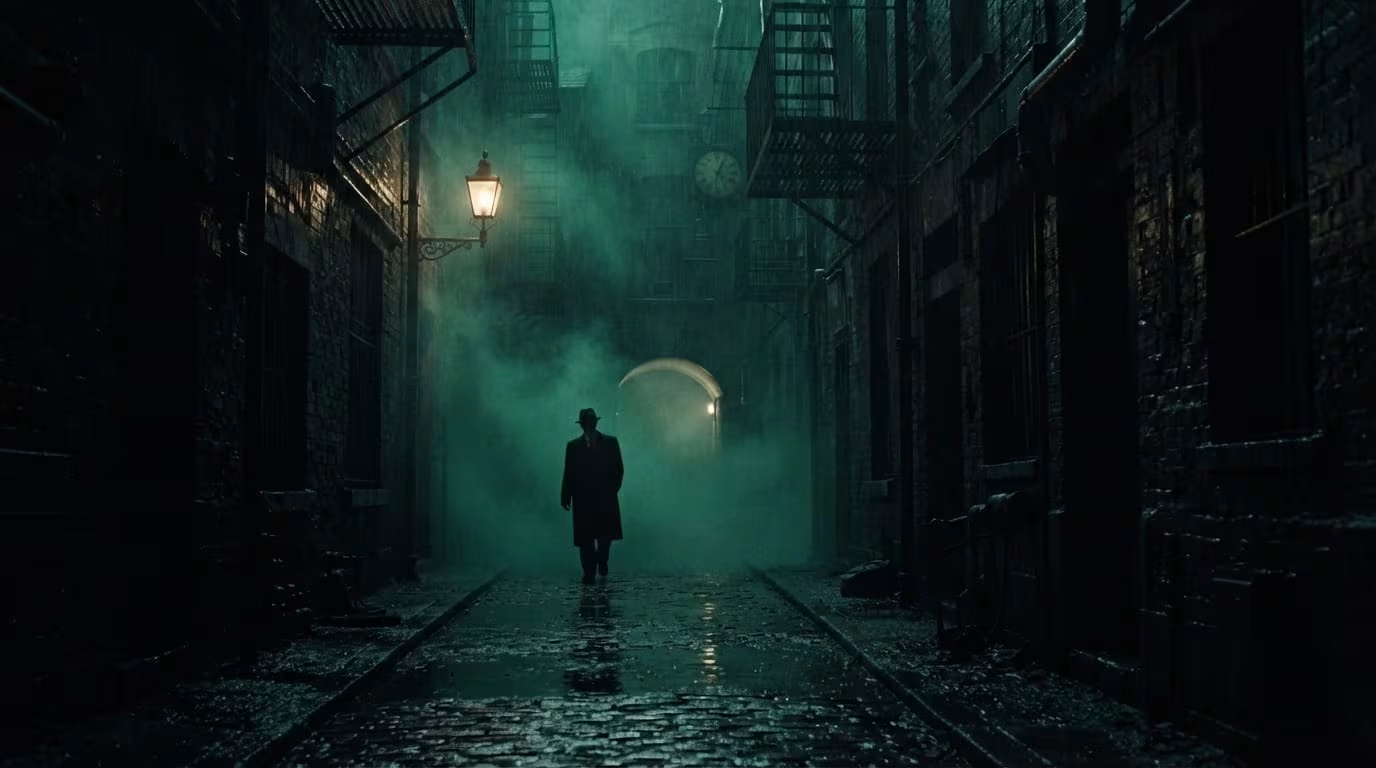
Don Julián Ormazábal was not a man given to fantasies. His life, built with the rigor of an iron beam, was measured in columns of debit and credit, in folios of laid paper, and in the dense shadow of India ink that stained his fingertips. For thirty-four years he had served as chief accountant for the trading house Valladares Sons & Co., a century-old firm nestled in a shadowed corner of Madrid's Barrio de las Letras, where the dust seemed to possess a density all its own and the sun entered only at a slant, as if asking forgiveness.
To Julián, the universe was a ledger that sooner or later had to balance. If reality showed any crack, it was due solely to an erratum in the sum, never to an aberration of the natural world. That is why, when he first heard the metallic tapping, he attributed it to the aging of his own body or to the dry click of woodworm devouring the mahogany shelves.
It happened on a slack Tuesday in November. An oily rain filed against the office windows when Julián set himself to validate the quarterly balance. It was a routine operation, but it carried a delicate decision: to authorize the seizure of the properties of a delinquent widow, Mrs. Carvajal, whose late husband had been his childhood friend. Julián held the pen above the box of the official seal. His hand, steady for decades, experienced a microscopic tremor.

Then it sounded.
Tick. Tock. Tick. Tock.
It did not come from the wall. Nor from the pocket of his waistcoat, where his old pocket watch lay inert and unwound for months. The sound emerged from the temporal bone, just behind his left ear, with the clean, dry sharpness of a freshly greased anchor escapement. It was a tiny click, yet of an overwhelming presence, as if a minuscule tailor were driving steel pins into his eardrum.
Julián lifted the pen from the document. Instinctively, the cadence of his inner heartbeat slowed. Tick… tock… tick… tock… until they dissolved into the hiss of water against the glass. The accountant drew a deep breath, removed his tortoiseshell-rimmed glasses, and massaged the bridge of his nose. "It's the tension," he told himself in a dry whisper. "The liver. Or the poor digestion of the stew." He brought the nib of the pen to the paper once more. He pressed the red wax onto the sheet. He decided to stamp the embargo.
The crack burst inside his skull like the snapping of some primordial spring.
TICK-TOCK-TICK-TOCK-TICK-TOCK.
The frequency multiplied tenfold. It was no longer a distant wall clock; it was the runaway gallop of a Swiss precision chronometer accelerating toward an invisible abyss. The sound was not vibrating air; it was a direct friction against his meninges, a toothed saw of brass and steel scraping the sensitive tissue of his consciousness.
Chapter II: The Vibration of Doubt
During the first week, Julián believed he could master the phenomenon through the sheer discipline of intellect. He kept a meticulous record in a lambskin ledger locked away in his desk, noting down the hours, the minutes, and the rate of acceleration within his cranial machinery relative to the gravity of the decisions he was forced to make.
If the choice was trivial—selecting between noodle soup or vegetable purée for dinner—his internal clock maintained a sluggish pulse, a drowsy, almost biological rhythm of forty beats per minute. Yet whenever a dilemma grazed his moral core or the destiny of his estate, the apparatus transformed into an infernal engine.
One Thursday afternoon, at the café in San Ginés, his partner, Señor Donoso, proposed a shady deal: to divert a shipment of Philippine tobacco by declaring it damaged by seawater, then sell it on the black market to the tobacconists of the south. It was a simple fraud, clean, with hardly any risk of detection.
While Donoso laid out the particulars in a confidential voice, smoothing his pumice-stone-dyed mustache, Julián felt the temperature in his left ear surge violently. The chronometer didn't merely accelerate; it changed pitch. The metallic tick-tock it became a guttural scraping, the sound of hundreds of tiny gears whose teeth did not quite mesh, filing against one another and shedding an invisible filigree of metal deep inside his brain.
"Are you all right, Julián? You're as white as a grave shroud," said Donoso, halting his spoon in midair.
Julián tried to articulate a response, to decline the offer. But as he weighed the possibility of accepting—the extra money, the security of his old age—the rhythm turned frenetic, a whirlwind of mechanical parts spinning at thousands of revolutions per minute. TICK-TOCK-TICK-TOCK-TICK-TOCK. The noise smothered the pianist's music, the murmurs of the patrons, and the clatter of the dishes. He felt a warm thread sliding through his nasal cavity. He brought the handkerchief to his nose: the silk was stained a dark, dense red.
—I have to… I must leave—he stammered, leaping to his feet with a violence that knocked his chair to the floor.
He fled into the street. He ran through the narrow alleys, shivering beneath his threadbare overcoat. He verified with horror that the more he hesitated over which direction to take to return to his flat on Calle de Huertas, the more savage grew the acceleration of his internal machinery. If he stopped at a corner, undecided between turning left or right, the hammering became a rhythmic thunder that doubled him over in pain against the damp masonry of the facades.
To silence the martyrdom, he had to renounce free will: he stopped choosing. He walked blind, turning on mere automaton impulse, becoming himself an inert piece dragged by the inertia of the cobblestones.
Chapter III: The Anatomy of the Heartbeat
By December, the accountant was a shadow of a man. He had lost twelve kilos. His eyes, sunken into violet, wrinkled sockets, reflected the terror of animals cornered by a pack whose baying only they can hear. He had requested an indefinite leave of absence from the firm, withdrawing into his home of high ceilings and wallpaper with floral motifs already faded by mold.
His apartment became a trap of self-imposed silence. He had every clock in the house removed. The two pendulum clocks in the sitting room, the alarm clock on the nightstand, and the cuckoo clock in the hallway were wrapped in blankets and banished to the basement. He needed absolute acoustic emptiness to be certain the aberration was strictly endogenous.
He visited in secret Dr. Albarracín, a preeminent authority on nervous disorders at the Central University. His consulting room was a lugubrious study, infested with jars containing deformed fetuses and anatomical plates of sliced brains.
The doctor pressed a brass stethoscope to his temples, examined his pupils by candlelight, and sank silver needles into his arms to measure his reflex response.
"Physiologically, Don Julián, you are a millpond," the alienist pronounced as he washed his hands in a porcelain basin. "No trace of apoplexy, no detectable tumors. What you have is an obsessive-compulsive transference neurosis. Your moral conscience, hypertrophied by years of tallying other men's numbers, has projected the concept of punishment in the form of an auditory hallucination."
"It's not a hallucination, doctor," Julián said, his voice worn ragged by confinement. "I beg you. Put your ear here. Right over the mastoid process."
Albarracín sighed with the condescension of scientific men and acquiesced. He inclined his gleaming bald pate and pressed his ear to the left side of the accountant's skull.
Ten seconds passed. Fifteen.
The doctor's face changed by degrees. The smug smile froze. His complexion turned the color of rancid lard. He recoiled at once, stumbling against the examination table, setting the scalpels clinking.
—What… what manner of monstrosity are you carrying in there?—whispered the physician, bringing a trembling hand to his own ear.—That is no vascular murmur. That is… there is metal in there. There is the friction of bronze against steel.
—He speeds up when I have to make a decision —Julián confessed, on the verge of sobbing—. If I try to decide whether I should heal myself or let myself die, the pain paralyzes me.
Dr. Albarracín, terrified by what reason forbade him to admit, retreated toward the door of his study.
—Go, Don Julián. I cannot treat you. This does not belong to the realm of medicine. Go to the asylum in Ciempozuelos… or to a church. But leave this office at once.
Chapter IV: The Rot of the Chronometer
In the weeks that followed, Julián discovered the most terrible truth: the mechanism was not a mere spectator of his thoughts, but a parasite that fed on indecision. Each time he postponed a resolution, the clock did not return to its normal rhythm, but retained a percentage of the excess speed. The baseline of the ticking had risen. Now, in the most absolute state of rest, his mind roared at ninety metallic beats per minute.
He could no longer read: the doubt over whether to turn the page or reread a paragraph made his skull toll like a boilermaker's works. Nor could he scarcely eat: deciding whether to chew a slab of salt cod or leave it on the plate brought on terrible vertigo and vomitings of black bile.
On January 5th, the eve of Epiphany, the city woke draped in a heavy layer of filthy snow. Julián sat in his wingback chair, wrapped in three wool blankets, staring fixedly at the bare wall. He had reached a state of near-catatonic immobility. He discovered that if he kept his mind in a voluntary void, surrendering all will, the clock steadied into a monotonous and bearable click-clack.
Yet life persists in demanding choices.
At four in the afternoon, two sharp knocks sounded at the street door. Julián did not move. The bell rang again, this time with insistence. He heard the voice of his maid, the faithful and elderly Tomasa, who had returned from doing the shopping.
"Don Julián! Open up, for God's sake! I've left the key inside and the cold is seeping into my bones. I've brought the coal for the stove!"
Julián closed his eyes. He felt the cold seeping through the cracks of the gallery. If he didn't open, the old woman would have to spend the night on the stair landing, below zero; pneumonia would likely kill her before dawn. If he got up and opened the door, he would have to decide whether to let the coalman in as well, whether to pay his bill, whether to continue with the comedy of existence.
Doubt struck the spark.
TICK-TOCK-TICK-TOCK-TICK-TOCK-TICK-TOCK.
The inner mechanism burst with an unfamiliar fury. This time it was not mere friction; he began to catch a sulfurous odor, the stench of burnt machine oil escaping through his nostrils and his auditory canals. The pain was so savage that he dropped to his knees on the rug, clutching his head in both hands, shrieking in the gloom of the room.
"Don Julián! For the love of the Blessed Virgin, open up!" the woman pleaded from the other side of the thick wood.
Within the accountant's skeletal structure, something snapped. Feeling on the verge of syncope, he grasped the source of the sound. It was not divine punishment, nor disease. It was a abominable temporal parasite, a creature forged of pure time and forgotten mechanics that settled within the minds of scrupulous men, consuming the energy released by the torment of doubt until it completely devoured their will.
The clock accelerated to such a degree that its vibrations began to fracture his own teeth. He tasted shattered ivory and blood in his mouth. The ticking grew so piercing that his vision started to darken; he saw the room distorted by a haze of black lines crisscrossing like the teeth of a gigantic gear crown enwrapping the entire world.
Chapter V: Absolute Zero
At six in the evening, the door gave way. The estate's porter, roused by the maid's screams, had brought the lock down with an iron crowbar.
They found Don Julián Ormazábal curled up in the darkest corner of the room, behind the cold iron stove. He did not move. His face was a mask of cadaveric fixation, but his eyes, bloodshot, remained open and fixed on the void.
—Young master! Don Julián! —the maid sobbed, bringing a candle close to his face.
The accountant did not blink. From his left ear streamed a steady thread of thick, greyish liquid, gleaming like mercury, mingled with tiny metallic splinters that hissed and spat as they met the carpet.
Julián was alive, but the accounting of his soul had come to an end. He had made the only decision left to silence the torment: absolute surrender. He had decided, in a supreme and suicidal act of will, never again to decide anything, ever.
The on-call court physician who examined the body two hours later determined that the subject was suffering from an irreversible psychic paralysis. But while the doctor drafted his report at the office desk, using the very pen Julián had always employed for his ledgers, the maid approached her master's lifeless body to place a blanket over his shoulders.
As she leaned over him, in the frozen stillness of the cabinet, Tomasa turned to stone.
From the depths of Don Julián's motionless chest, there where the heart should have marked the soft pulse of life, a new sound emerged. It was no longer disordered. It was no longer rapid. It was a grave, colossal ticking, the perfect motion of a gigantic pendulum marking the seconds of the universe with mathematical and merciless precision.
TICK… (a one-second pause). TOCK…
Julián no longer heard the machine. The accountant had become the pendulum. The parasite had finished devouring the flesh of doubt to inhabit, definitively, the empty shell of his certainty.
📜Investigation • Frequently Asked Questions
Documentary Archive and Analysis of the Occult • Relatando.com
What does the figure of Don Julián Ormazábal symbolize within the tradition of urban fantastic tales set in nineteenth-century Madrid?
Don Julián embodies the collision between bourgeois rationalism and atavistic mystery. His profession as head accountant in the Barrio de las Letras is no accident; it represents the human urge to frame reality through debits and credits. When confronted with an inexplicable acoustic anomaly, Carlos Nieto uses his mental rigidity to amplify the psychological horror, proving that the strictest order is always the most vulnerable before the fissure of the supernatural.
What folkloric and literary significance does the motif of the internal 'tick-tock' hold in mystery narrative?
The sound of the clock within the temporal bone subverts the classic 'memento mori' trope. Here, time is not contemplated passively in an external object; rather, it installs itself parasitically within the protagonist's consciousness. This mechanical heartbeat acts as a relentless tribunal judging his moral decisions—specifically the foreclosure against the widow of his childhood friend—fusing ethical guilt with temporal fatality.
In what way does the atmospheric and spatial context of Madrid influence the development of the protagonist's psychological conflict?
The November atmosphere of Madrid — characterized by an 'oily rain' and an office where the sun enters timidly — functions as an extension of Julián's constricted soul. The Barrio de las Letras, heavy with history and shadows, lends the tale an almost gothic texture. This claustrophobic environment isolates the accountant within his own mental labyrinth, making it inevitable that the world's outer echo fades away to give way to the relentless noise of his interior.
What function does Mrs. Carvajal's seizure dilemma serve as the catalyst for the fantastic experience in the tale?
The act of signing the embargo marks the breaking point between Julián's humanity and his cold mechanization as a worker. The tremor in his hand and the subsequent acceleration of the invisible clock suggest that the supernatural does not intrude by chance, but as a direct response to a moral transgression. The runaway ticking is the physical manifestation of remorse, an acoustic reminder that there are human debts impossible to settle in the accounting books.
Do not extinguish the light just yet...
If you have had the courage to make it this far, we have other dossiers that will test the limits of your sanity.

Terms and Figures of this Tale
To delve deeper into the legends, creatures, and dark concepts that inspire this account, consult their entries in our dictionary of the uncanny:






Tu correo no se publica ni se comparte con terceros: solo sirve para notificar la respuesta.