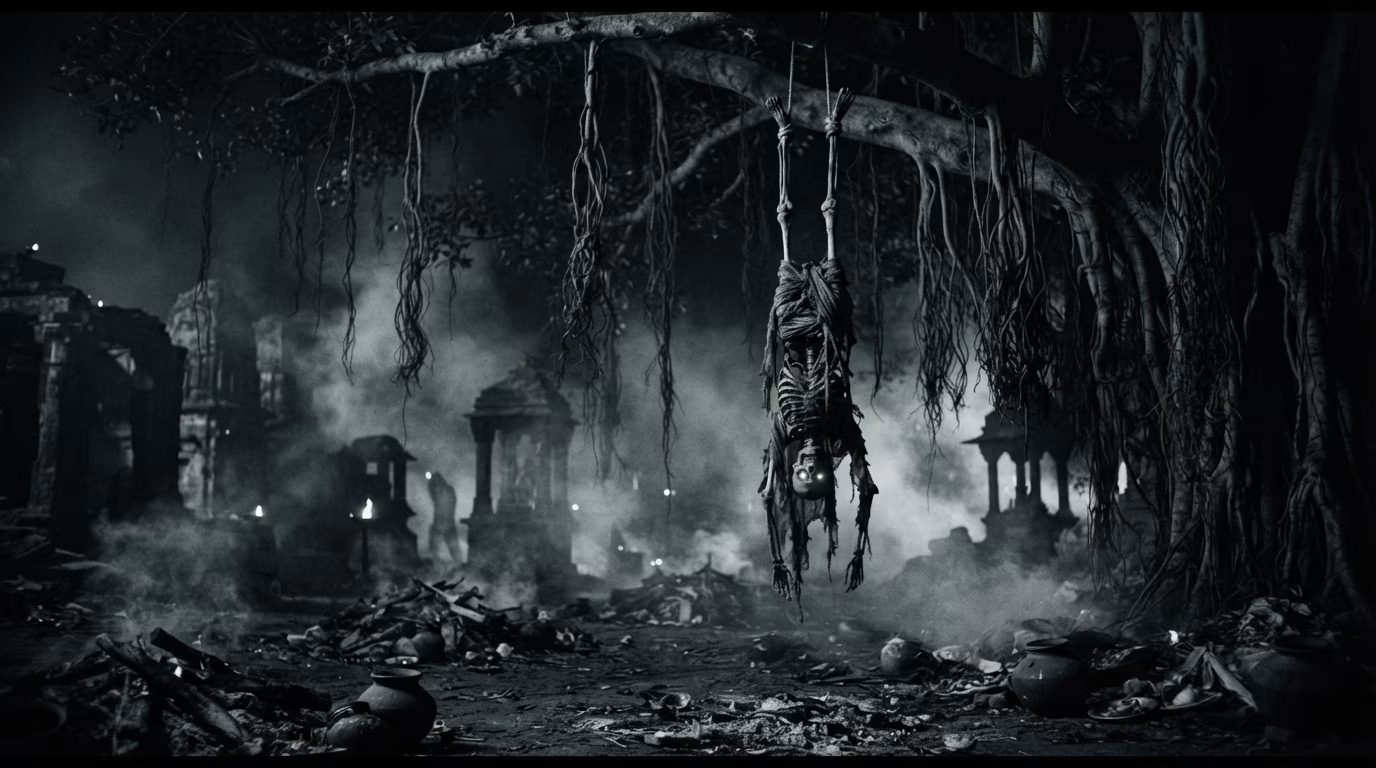
Welcome to a new tour through the abyss of the unknown. As an occult researcher and director of Relatando.com, today we delve into the most remote necropolises of the Indian subcontinent to unravel one of the darkest and most fascinating myths of Eastern demonology: the Vetāla. Imagine the scene: midnight drapes an open‑air crematorium in a cloak of shadows, the air smells of burnt sandalwood and rotting flesh, and from the gnarled branch of a banyan tree hangs a human corpse, swaying mechanically, inhabited by a hunger for chaos, twisted wisdom, and cadaveric possession. This is not a simple Legend urban legend; it is an ancestral reality that defies the boundaries between life, death, and the astral plane.
Classified File
- Origin: Mythology and Vedic tradition of India.
- Nature: Vampiric spirit, demon necrophage, or dweller of corpses.
- Hazard Level: Extreme. Capable of manipulating the mind, possessing bodies, and tormenting the living with deadly enigmas.
- Weaknesses: The recitation of sacred Vedic mantras, purifying fire, the severing of the threads that bind it to the corpse, and the intellectual cunning to solve its riddles.
Origin and Etymology
To comprehend the true magnitude of the Vetala, we must trace back to the most ancient Sanskrit sources of the Hindu tradition. The word 'Vetala' (वेताल in Devanagari) finds its etymological roots in Vedic terms referring to wandering spirits associated with decay and the realm of the dead. In Hindu cosmology, Vetalas are not born as primordial demons; rather, they are souls trapped in an existential limbo—often those who suffered violent, premature deaths or whose funerary rites were not properly completed according to the dharma.
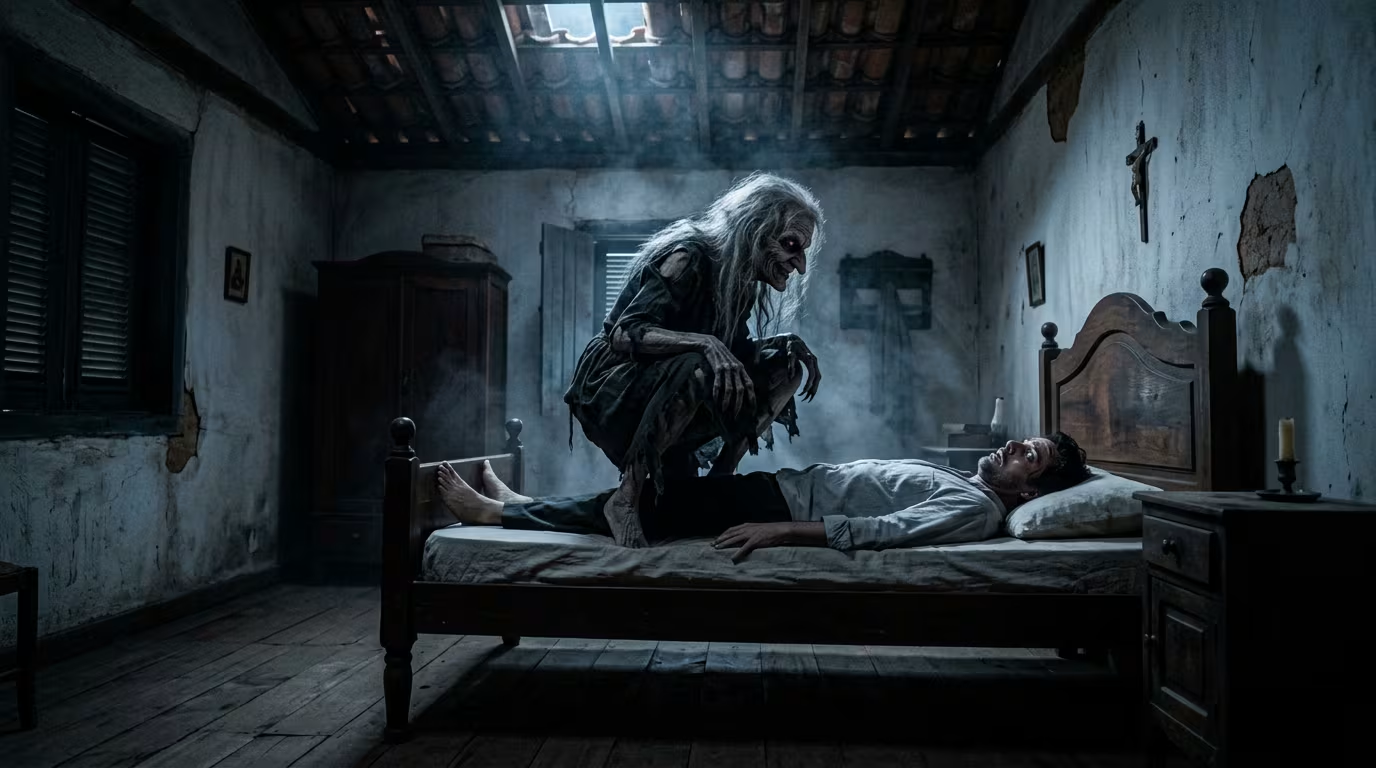
These entities drift along the border between this world and the next, incapable of reincarnating or finding eternal peace. Their nature—starved for physical sensation—drives them to seek a material vessel through which to interact with the world of the living. It is here that cemeteries (shmashana) and cremation grounds become their favored hunting grounds. The Vetala seeps into fresh or far-advanced corpses, using them as biological marionettes. Upon possessing a body, the Vetala gains superhuman strength, agility, and the ability to defy the laws of physics and gravity, hanging upside down or swaying in the dark.

Over the centuries, the figure of the Vetala evolved from religious texts into classical Sanskrit literature, cementing its place as one of the most enigmatic creatures in world folklore. Ancient sages and ascetics (Tantrics) regarded the Vetala not merely as a threat but as a supreme trial of spiritual discipline. To master a Vetala granted unimaginable arcane knowledge, yet the slightest error in the ritual meant instant madness or a horrifying death—devoured by the very entity itself.
Anatomy and Appearance
The physical description of a Vetala is twofold, for we must separate its ethereal essence from the physical shell it inhabits. As pure energy or spirit, the Vetala is invisible to the common human eye, perceptible only as a frozen breeze carrying the stench of the grave, or as a fleeting shadow dancing at the edges of a ritual fire's light. Yet when it manifests through a corpse, its anatomy becomes a visual nightmare.
The vessel utilized by the Vetala exhibits an advanced state of rigor mortis and decomposition, yet remains strangely pliable due to the demonic energy animating it. The skin takes on a sallow, grayish, or blackened hue, stretched over prominent bones like those of a living skeleton. The eyes, though sunken and often devoid of moisture, burn with a supernatural, malevolent light charged with a millennia-old intelligence. The jaw is frequently dislocated or agape in an eternal grimace of Horror, revealing razor-sharp teeth stained with the fluids of its macabre transgressions.
One of the most terrifying features of its appearance is its posture when hanging from the trees in cemeteries. Like bats, with which they are often said to share a mystic lineage, Vetalas suspend their corpses head-down, held by the ankles or the neck with dried tendons or twisted roots. This inversion of the human body symbolizes the perversion of natural law, the world turned upside down where death rules over life and darkness supplants the light.
Modus Operandi and Powers
The Vetala is no common predator driven to sate a mere physical hunger for blood or flesh, though the myths speak of its penchant for necrophagy. Its true quarry is psychological manipulation, mental torment, and the acquisition of control over those unwary souls who dare disturb its rest in the witching hours of the night.
Among its most terrifying powers is the capacity for levitation and the manipulation of space. A Vetala can make the surrounding forest seem an endless labyrinth, warping its victim's perception of reality. It likewise possesses the faculty to abandon the corpse it inhabits, to travel at vertiginous speeds, to temporarily possess other living beings, or to conjure illusions so vivid they can drag a man into madness within seconds.
Its most celebrated method of attack manifests when a brave man, a legendary king, or an ascetic approaches the tree where the corpse hangs in order to capture it. The Vetala, wielding an insuperable cunning, begins to tell stories or to pose complex moral and philosophical riddles. The bargain is simple: the seeker must carry the corpse in complete silence to a designated place. If the seeker utters a single word, the Vetala flies back to its original tree, forcing the search to begin anew. Through these enigmas, the demon tests the patience, the morality, and the sanity of its bearer, time and again laying bare the hypocrisy and the frailty of human nature.
Weaknesses and Protective Rituals
Despite its formidable power and terrifying nature, the Vetala is not invincible. Vedic tradition and tantric mysticism have established precise methods to repel, contain, or destroy these entities, shielding the living from their necrophagous claws.
First, sacred mantras and the recitation of divine names act as an impenetrable shield. An advanced practitioner who recites the Vedic texts with devotion and mental focus can dissipate a Vetala's energy instantly. Fire, especially the sacred fire of rituals (agni) and purified funeral pyres, is another of its great weaknesses; flames destroy the demon's physical vehicle, leaving it vulnerable and stripped of its capacity for material manifestation.
Another fundamental method to neutralize a Vetala trapped within a corpse is to sever the physical and magical ties binding it to its host. This entails dismembering the body, scattering blessed ashes, or driving sandalwood stakes impregnated with sacred oils into the corpse's vital points. Tantric ascetics who sought to subjugate a Vetala to win its favors were required to maintain absolute silence, bear ritual swords inscribed with protective wards, and employ protective circles drawn from ash and consecrated bone dust, all while avoiding the dialectical traps woven by the creature as it carried the body through the dead of night.
Documented Cases and Famous Legends
The most celebrated and monumental tale in which the Vetala takes the principal role is the famous Sanskrit story cycle titled *Vetala Panchavimshati* (The Twenty-Five Tales of the Vetala), later woven into larger works such as the eleventh-century *Kathasaritsagara*.
The legend recounts the trials of King Vikramaditya (Vikrama), a monarch of renown famed for his courage and his sense of justice. To fulfill a promise made to a mendicant ascetic, the king must journey to a dark and lonely cemetery, cut down a corpse possessed by a Vetala, and bear it upon his shoulders through the blackness of the night without uttering a single word. Along the way, the Vetala entertains the king by telling him an intricate and fascinating story that always concludes with a cunning question concerning morality, law, or human duty.
At the end of each tale, the Vetala challenges the king to answer the riddle, threatening to shatter his head if he knows the answer and remains silent, or escaping back to its tree if the king speaks. With flawless wisdom, Vikramaditya answers each of the twenty-five riddles correctly, proving his intellectual and moral worth. Each time the king speaks, the corpse slips from his back and returns to the tree, forcing Vikramaditya to begin the journey anew, again and again. This mythological cycle not only illustrates the Vetala's modus operandi but delves into the philosophy of justice, karma, and the complex nature of human decisions.
Comparative Analysis
When analyzing the Vetala within the vast tapestry of global supernatural folklore, it becomes inevitable to draw parallels and crucial distinctions with other entities of comparative mythology, especially with Western vampires and the necrophagous demons of other Asian traditions.
Unlike the Western European vampire popularized in the Victorian era—an aristocratic, seductive creature strictly dependent on fresh blood to sustain its immortality—the Vetala does not seek blood as its primary sustenance, nor does it possess the beauty or tragic romanticism of the Western undead. The Vetala is primarily an entity of possession and decomposition, an inhabitant of rotting flesh that uses the corpse as a mere mechanical tool to interact with the physical world.
Furthermore, when compared to the necrophagous demons of Mesopotamian mythology or the Jiangshi (hopping vampires) of Chinese folklore, the Vetala stands out for its superior intellect, its inclination toward dialectics, and its philosophical riddles. While the Jiangshi hops along with outstretched arms driven by pure predatory instinct, the Vetala is a master of psychological manipulation and a harsh judge of human morality. Its uniqueness lies precisely in that duality: being both a monster grotesque thing suspended from the trees of a cremation ground and, simultaneously, a dark philosopher who tests the integrity of kings and sages through insoluble enigmas.
📜Investigation • Frequently Asked Questions
Documentary Archive and Analysis of the Occult • Relatando.com
What exactly is a Vetala?
It is a spirit or demon from Hindu mythology that inhabits and possesses human corpses, using them as physical vessels to torment the living.
Why are the corpses hung from trees?
The Vetalas suspend bodies head-down in cemeteries and crematoriums to symbolize the perversion of natural law and to ease their possession.
How can a Vetala be defeated or stopped?
They are repelled by sacred Vedic mantras, purifying fire, by destroying the host corpse, or by successfully solving the riddles they pose.
Do not extinguish the light yet...
If you have had the courage to make it this far, we have other dossiers that will test the limits of your sanity.

Terms and Figures of this Tale
To delve deeper into the legends, creatures, and dark concepts that inspire this account, consult their entries in our dictionary of the uncanny:


Tu correo no se publica ni se comparte con terceros: solo sirve para notificar la respuesta.