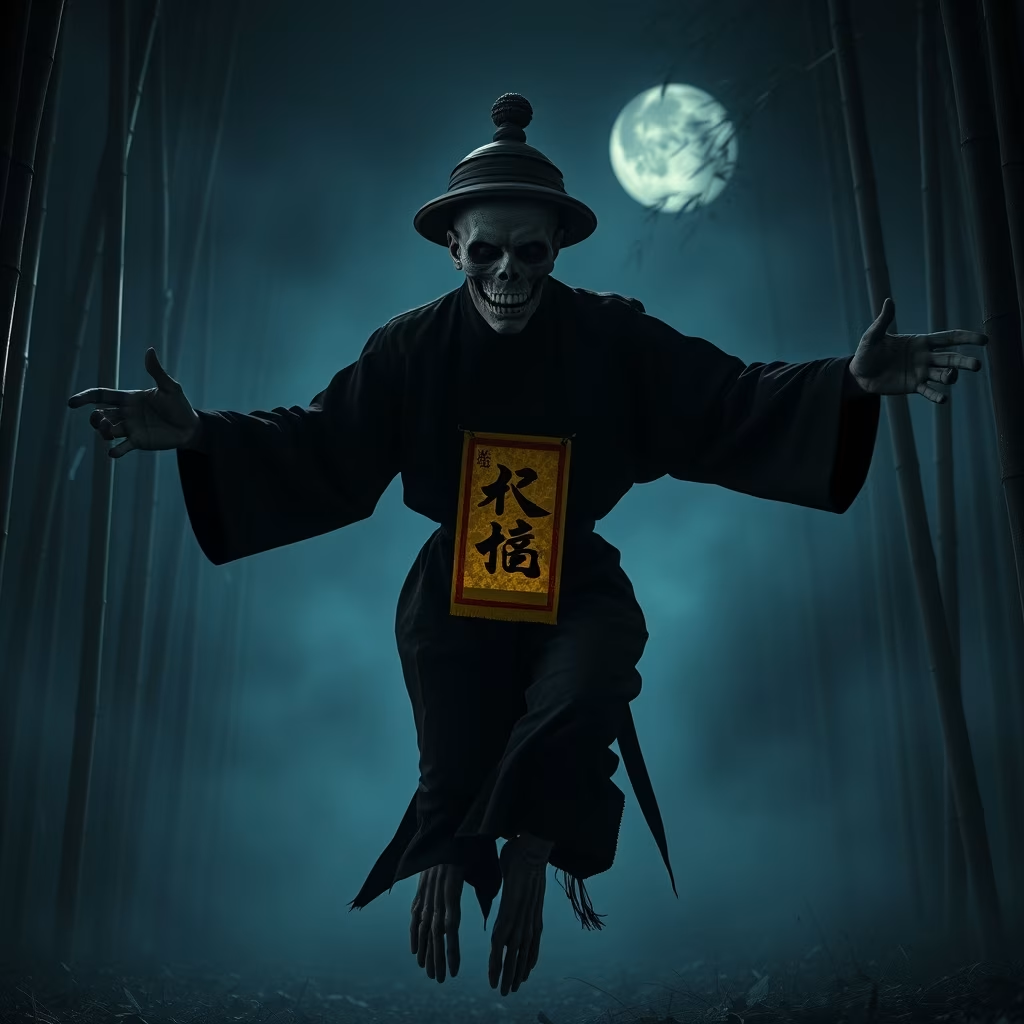
In the misty, ancestral rural regions of imperial China, where the damp earth exhales the secrets of the dead and the silence of the night is broken only by the creaking of old timber, lurks a Horror that defies the boundaries between life and eternal rest. I am Carlos Nieto, and in my investigations through the darkest corners of world folklore, few specters have fascinated and terrified me quite like the Jiangshi. This is no simple Western undead; it is a rigid corpse, uncorrupted by the malice of yin energy, advancing in mechanical leaps with outstretched arms and a terrifying strip of yellow paper soaked in blood-red calligraphy plastered across its forehead. Its mere presence evokes the dread of an era when dying far from one's native home condemned both soul and body to an destiny unnatural state, turning the deceased into a machine for hunting qi—the life force of the living—beneath the pale glare of the moon.
Classified File
- Origin: Traditional Chinese folklore and legends of the Qing Dynasty.
- Nature: Corpse reanimated by an excess of yin energy or demonic possession.
- Hazard Level: High. Capable of tracking prey by breath and devastating entire villages.
- Weaknesses: Mirrors, glutinous rice, rooster blood, peaches, fire, and above all, the yellow paper talisman upon its forehead.
Origin and Etymology
To comprehend the genesis of the Jiangshi, we must descend into the annals of the Qing Dynasty and the dark depths of Chinese folklore regarding death and the soul. The word ‘Jiangshi’ (僵屍) translates literally as ‘stiff corpse’ or ‘wracked body.’ In traditional Chinese culture, reverence for one's ancestors and native soil is an unyielding, sacred law. To perish far from home was considered a spiritual tragedy of staggering proportions—a curse ensuring the soul could find neither peace nor rest in the underworld, leaving the physical shell exposed to the malevolent pull of subterranean forces. During the nineteenth century and eras of profound social upheaval, countless peasants and laborers migrated hundreds of leagues to eke out a living, only to meet their end far from their hearths. To remedy this grim dilemma and fulfill families' desperate wishes to bury their kin in native earth, mysterious Daoist priests known as ‘corpse-drivers’ or ‘Ganshiqiye’ arose. These men conducted clandestine rituals deep in the suffocating black of night, moving columns of corpses in rigid formation through rhythmic, bell-synced hops. Yet if a cadaver's passage was disturbed—struck by lightning, brushed by the leap of a black cat, or poisoned by an unfathomable grudge clenched within the dying soul—the flesh would gorge itself on an unnatural surplus of yin energy. Rigor mortis would refuse its grip on the meat, the muscle hardening to stone as the dead stirred, not as a Phantom mere phantom, but as a monster corporeal predator starved of the living's vital breath. This monstrosity took root because the lower soul, the ‘Po,’ refused to relinquish its vessel, bloated on rage and unfinished business, rotting the flesh into a puppet strung by death itself. Superstition bled seamlessly into the reality of those nocturnal corpse-caravans, forging a Legend urban legend that haunts the collective Asian and global imagination to this very day.
Anatomy and Appearance
The physical description of a Jiangshi is as grotesque as it is anthropologically fascinating within the realm of classic horror. Unlike Western zombies—depicted in contemporary pop culture as shambling heaps of decay, putrid flesh, and missing limbs—the Jiangshi displays an unsettling state of preservation. Chilled by death and saturated with yin energy, the flesh does not rot in the traditional manner; instead, it desiccates, hardening like seasoned oak and acquiring a greyish, greenish, or deathly ivory hue akin to aged bone. Its skin is so hideously dense and resilient that conventional weapons—such as standard iron swords or blades—rebound without leaving the faintest scratch, demanding specialized or consecrated implements to pierce it. Its limbs remain entirely outstretched and rigid at a perpendicular angle to the torso, rendering natural walking an impossibility. This absolute stiffness dictates its signature method of locomotion: it travels in synchronized hops, propelling itself with both legs simultaneously while keeping its arms parallel to the ground, palms thrust forward, poised to snatch its next victim. Its face is a frozen mask of terror: sunken eyes that burn with a greenish or reddish phosphorescence in the dark; a mouth half-open to reveal canine teeth distended into true vampiric fangs; and fingernails that continue their anomalous growth into razor-sharp, blackened talons dripping with necrotic venom. The attire of the Jiangshi is another of its most iconic hallmarks: it unfailingly wears the traditional vestments of Qing Dynasty bureaucracy, consisting of a dark tunic—often midnight blue or obsidian black—a mandarin official's hat topped with a red button, and a long, braided queue trailing down its back. Above all else, dominating its forehead, rests the defining instrument of its restraint: a rectangular strip of deep yellow rice paper upon which a Daoist priest has traced intricate, esoteric characters using cinnabar, a blood-red mineral stone serving as a divine seal to keep the fury of the dead at bay.

Modus Operandi and Powers
The predatory behavior of the Jiangshi follows strict patterns dictated by its undead nature and its absolute dependence on vital energy. Bereft of the traditional senses of the living, the Jiangshi is blind and deaf in the conventional sense; it can neither see colors nor hear footfalls. Its primary method for tracking and locating prey is scent, and above all, the perception of 'qi'—the vital energy emanating from any creature living thing. It can sniff out human breath across vast distances. For this reason, one of the most famous survival tactics passed down from generation to generation in rural Chinese villages was to hold one's breath entirely upon hearing the sound of hopping approaching in the dark. If a person suspends their breath, the Jiangshi loses the trail and drifts past, mistaking them for an inert object. Once it locates its prey and confirms their presence through breath, the strike is swift and mechanical. It lunges forward with startling speed despite its rigor, driving its long fangs into the victim’s jugular or chest, sucking not only the blood but completely draining their vital energy until they are left dry, pale, and cold. Yet the most terrifying aspect of the Jiangshi's modus operandi is its capacity for propagation: any human being attacked by a Jiangshi who survives the encounter, or those who perish from their wounds, finds no peaceful rest. The necrotic venom transmitted through claws and fangs, combined with the corrupting influence of the yin, initiates an irreversible transformation. Within hours, the victim begins to lose all color, the body grows rigid, and come the following night, it will rise in turn as a new Jiangshi, bound to join the nocturnal hunt for its former loved ones. Beyond its superhuman strength and ballistic resilience, certain classical texts attribute to it the capacity to levitate short distances, pass through thin walls, and absorb the energy of the full moon to amplify its destructive power, making it a truly formidable adversary for any novice exorcist.
Weaknesses and Protective Rituals
Fortunately for humanity, Taoist folklore and folk traditions have meticulously documented the vulnerabilities of the Jiangshi, allowing for the development of highly specific and effective methods of defense. The supreme weakness—the Achilles' heel of this entity—is the yellow paper talisman affixed to its forehead. Inscribed in pure cinnabar by a Taoist monk of proper spiritual authority, this talisman acts as an invisible cell that traps the 'Po' soul within the body and severs its connection to outside malefic energy. If the talisman falls away by accident, is blown off by the wind, or is carelessly removed, the creature instantly reclaims its mobility and murderous fury. Protecting that talisman, therefore, remains the absolute priority in any confrontation. Beyond this fundamental containment, numerous physical and ritual elements are capable of repelling, confounding, or destroying a Jiangshi. Glutinous rice is a classic weapon: hurled in handfuls across the entity's path, the Jiangshi is forced to halt and count every single grain, or else suffer instant burns upon contact with the rice's pure energy. Rooster's blood—specifically from a red rooster charged with potent yang energy—acts as a corrosive poison to its necrotic flesh; dousing the monster with it severely degrades its physical integrity. Bronze-rimmed or highly polished mirrors serve to induce profound visual confusion; forced to reflect its own monstrous, hollow visage, the Jiangshi suffers a spiritual short circuit that momentarily paralyzes it. Peach trees and their branches likewise possess purifying properties capable of keeping the entity away from the thresholds and windows of human dwellings. And, naturally, the sacred fire: should a priest manage to corner the hopping corpse and hurl it onto a funeral pyre prepared with incense, sacred herbs, and peachwood, the flames will utterly consume the cursed flesh, reducing it to harmless ash and at last releasing the trapped soul back into the cycle of reincarnation.
Documented Cases and Famous Legends
The myth of the Jiangshi is not confined exclusively to children's storybooks or the horror films of Hong Kong cinema; it is deeply rooted in local chronicles, travelers' journals, and folklore passed down orally for centuries across the provinces of Hunan, Guizhou, and Guangdong. One of the most celebrated accounts hails from the informal archives of the Qing Dynasty, compiled by scholars such as Ji Yun in his ‘Notes of the Thatched Cottage of Observations’. It tells of a caravan of corpse-transporters operating in the forested mountains of Hunan on a night of relentless electric storm. Seven bodies moved in single file, bound by hemp ropes and led by an aging, seasoned priest. A lightning strike hit agonizingly close to their makeshift camp, generating an energy field so intense it shattered the yellow paper talismans on three of the corpses. Within seconds, the bodies tore free from their tethers and began to leap with unnatural, feral violence toward the local villagers who had taken refuge in a nearby inn. Legend has it that the priest was forced to sacrifice his own life force—wielding an ancestral mirror and a bowl of rooster blood—to drive new seals into the creatures' foreheads before they could slaughter every soul in the valley. Another infamous myth centers around the ‘Jiangshi of the Forgotten Village’, a tale of a powerful official who died in disgrace far from home, whose body, while being escorted back by his corrupt subordinates, absorbed the bitter malice of a cursed graveyard. This particular entity allegedly developed a malignant intellect, capable of orchestrating nocturnal ambushes and bypassing traditional sticky-rice traps, ultimately requiring the intervention of an entire order of Taoist monks from the Wudang Mountains to achieve its absolute annihilation through a three-day-and-night ritual of sacred fire and mantras.
Comparative Analysis
To grasp the true anthropological dimension of the Jiangshi, it is imperative to establish a rigorous comparative analysis with other creatures of the Mythology global, occupying similar ecological and spiritual niches, such as the Western zombie and the traditional European vampire. At first glance, the Jiangshi shares obvious similarities with the modern zombie popularized by Hollywood horror cinema: both are reanimated corpses stripped of free will, driven solely by an insatiable hunger for the living. Yet the philosophical and structural gulfs between them are absolute. While the Western zombie is typically the byproduct of viral infection, parasitic fungus, radiation, or a botched scientific experiment—stripping the monster of all mysticism and reducing it to a metaphor for the dehumanized masses or societal collapse—the Jiangshi's roots strike deep into Daoist metaphysics, ancestor worship, and the sacred geography of China. As for the European vampire, archetypally embodied by Draculas, it shares with the Jiangshi an imperative thirst for the life force or blood of the living, along with vulnerabilities to specific religious or natural elements. Yet the Western creature is aristocratic, cunning, gifted with a profound capacity for seduction, metamorphosis, and a decadent elegance that acts with premeditation and intellect. The Jiangshi, by contrast, is a blind, rigid force trapped within its own physical torment, moving in a mechanical, rhythmic cadence without a spoken word, relying entirely on scent and *qi*. Another crucial divergence lies in methods of defense: whereas the European vampire recoils from garlic, Christian crucifixes, and direct sunlight, the Jiangshi remains utterly immune to Western symbols, demanding strictly Eastern mystical technology—such as cinnabar-inscribed yellow paper, glutinous rice, and Daoist martial arts. This comparison reveals that the Jiangshi is no mere Asian variant of global vampirism, but a singular cultural manifestation reflecting China's deep-seated anxieties regarding social order, filial piety, and the destiny of the soul after the final breath.
📜Investigation • Frequently Asked Questions
Documentary Archive and Analysis of the Occult • Relatando.com
How does one escape a Jiangshi should it strike?
The most effective tactic is to hold your breath entirely. The Jiangshi is blind and deaf, tracking its prey exclusively through scent and the perception of breath. If you cease to breathe, it will lose your trail at once.
Why does the Jiangshi bound rather than walk?
Under the influence of *yin* energy and extreme rigor mortis, the corpse's flesh and muscle petrify into wood-like stiffness, rendering it incapable of bending its knees and forcing it to traverse the gloom in synchronized leaps.
What is the exact purpose of the yellow paper affixed to its forehead?
The yellow paper is a Daoist talisman brushed in red cinnabar. It acts as a divine seal, pinning the 'Po' soul within the flesh and severing its tether to malevolent forces, holding the corpse in absolute paralysis.
Do not extinguish the light yet...
If you have had the courage to make it this far, we have other dossiers that will test the limits of your sanity.

Terms and Figures of this Tale
To delve deeper into the legends, creatures, and dark concepts that inspire this account, consult their entries in our dictionary of the uncanny:



Tu correo no se publica ni se comparte con terceros: solo sirve para notificar la respuesta.