Chapter I: The Shadow over the Moor
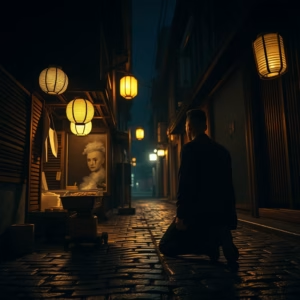
There are places in the geography of Ávila where the granite does not seem sculpted by time, but frozen by a primordial dread. San Martín de las Agujas is one of those hamlets forgotten by the hand of God, wedged into a gloomy crevice of the Sierra de Gredos where winters are not measured in months, but by the thickness of the ice that coats the stables and the vacant stare of its few remaining inhabitants. There, the air reeks of rotted pine, of damp straw smoke, and of a stale mould that seeps from the entrails of the earth.
At the heart of that desolation stands the parish of Nuestra Señora de la Soledad, a Romanesque temple of blackened ashlars, devoured by moss and crowned by a square tower that looms over the valley like a one-eyed watchman. It was in the final days of that frozen November when Don Mateo arrived in the village to take charge of the curacy. The bishopric had assigned him there following the sudden and inexplicable retirement of Father Faustino, who had ended his days confined in the asylum at Fontenebro, babbling incoherencies about "tongues of metal" and "beads that never come out wrong."
Don Mateo was a man in his thirties, gaunt, of pallid complexion and faltering faith, who sought in the peace of rural seclusion a cure for the theological doubts gnawing at his spirit. Yet the first night he spent in the rectory —a rambling manse annexed to the church, its wooden floorboards groaning under the weight of the wind— he understood that peace did not dwell in San Martín de las Agujas.

The silence of the moor was near absolute, a dense void that muffled even the howl of the wolf in the distance. But just as midnight struck, when the belfry clock —stopped for decades— ought to have remained mute, a thunderous sound tore through the gloom.
CLANG!
The blow resounded not in the air, but in Mateo's very marrow. It was a dull, grave toll, steeped in a metallic vibration so dreadful it set the wooden doors and windowpanes trembling. The priest bolted upright in bed, his heart hammering against his ribs. That was no call to joy, no festive peal; it was the death knell, the mournful note that announces a life's candle is about to be snuffed out.
The metal sang again. Once, twice, three times... Each strike was followed by an agonizing pause, an exact three-second interval where the echo seemed to crawl through the cobbled alleys like a bronze serpent.
Mateo counted in the dark, breaking into a cold sweat despite the freezing chill of the bedroom. Twelve... thirteen... fourteen... And upon reaching the nineteenth toll, the bronze emitted a dry snap, a dead resonance, and silence returned.
The next day, when the first light of dawn stained the ridges of the sierra violet, a woman's harrowing scream woke the village. Lucía, the miller's daughter, a buxom girl of barely nineteen, had been found dead in her bunk. Her face showed no signs of violence or disease; only a mask of absolute terror frozen on her purple lips and her eyes open, fixed on the ceiling, as if she had witnessed the arrival of something unutterable from the gloom.
Chapter II: The Tongue Without Rope
Desolation took hold of San Martín. During the wake, Mateo tried to console the family, but met a barrier of averted eyes and sealed lips. No one spoke of the death as a chance misfortune. The locals huddled in the corners of the square, conversing in a harsh whisper, casting glances full of dread toward the bell tower.
Only Uncle Braulio, the old sacristan with a face tanned like the sole of a boot and hands deformed by arthritis, dared to break the pact of silence when Mateo cornered him in the sacristy.
—Don't go looking for medical reasons, Don Mateo —murmured the old man, as he wiped the brass candelabras with a filthy rag—. The one who knocked tonight was The Dead Woman. And when she speaks, the grave answers.
"What nonsense are you talking about, Braulio?" the priest rebuked him, trying to summon a firmness he did not feel. "Bells do not ring on their own. Someone must have climbed the bell tower to play a macabre joke or stir up panic."
The sacristan let out a dry laugh, rasping like the crunch of dead leaves under a boot.
—A joke? Father, that bell hasn't had a rope since forty-seven. My own father cut it down with an axe when the lord bishop forbade it ever to be rung again. And the tower stairs... the access door up there is locked with a wrought-iron padlock, the only key to which I've worn hung around my neck for forty years. Look at the key, Father. It is rusted. No one has gone up there.
Mateo took the aged iron key the old man held out to him. It was freezing, coated in a layer of undisturbed grime. Yet the priest's stubbornness, shielded by a desperate empiricism, drove him to climb the tower that very afternoon.
The spiral staircase was a suffocating granite passage where the air reeked of bat guano and rancid sulfur. When he reached the final flight, he confirmed that the solid oak door was, in fact, blocked by the heavy padlock. The chains showed no signs of tampering. With a trembling hand, using the sacristan's key, he forced the mechanism, which gave way with a shrill click.
When he opened the door, the icy mountain wind lashed his face. The vaulted chamber housed three bells. Two of them, small and green with copper verdigris, remained inert, lashed to their wooden yokes. But in the center, suspended from a black oak beam that seemed fossilized, hung the third bell.
It was a monstrous piece, cast in a bronze of so dark a hue that it seemed to swallow the afternoon light. Its surface bore no inscriptions of saints, no bas-reliefs of crosses. In their place, the metal displayed grotesque engravings of agonized faces, deformed figures that appeared to writhe as if struggling to escape the alloy itself. Mateo grazed the surface with his fingertips and recoiled at once in a surge of nausea: the metal was not cold like its surroundings; it throbbed with a subtle, greasy warmth, like the skin of a feverish animal.
And worst of all: the bell rope was conspicuously absent. The iron clapper, as large as a child's head, hung in the center of the void, inert... yet dripping a thick, blackened substance that was neither oil, nor water, nor rust.
Chapter III: The Counting of the Days
Confirmation of the horror was not long in coming. Two nights later, the phenomenon occurred once more. The parish priest, unable to find sleep, kept vigil by the rectory window with a Bible in his hands and his rosary clutched until his knuckles turned white.
At the stroke of twelve, the silence was blown to pieces.
CLANG!
The sound enveloped the village. Mateo counted each toll like someone listening to the hammer blows driving nails into their own coffin. The bronze resonated once, ten, thirty, fifty, sixty times... The agony of the sound dragged on through the night like an inexorable countdown. Sixty-four. Sixty-five. And the bell fell mute.
The next morning, the victim was Don Gonzalo, the village apothecary, a robust man of sixty-five who had never suffered from his heart. He was found on the floor of his shop, collapsed across the counter, his eyes shot through with blood and his hands clawed tight against his chest.
Panic broke loose in San Martín de las Agujas. The people began to flee. Carts heaped with blankets and household goods abandoned the village along the steep roads, preferring to freeze in the hills rather than linger a single second more beneath the yoke of the accursed tower. The village was reduced to a dozen old men, the sacristan, and the priest himself, who refused to abandon the church, possessed by a destructive blend of priestly duty and morbid obsession.
Mateo spent the following days searching the parish archives, prying apart moth-eaten bundles of documents that dated back to the seventeenth century. There, among tight-scripted entries of tithes and baptismal records, he uncovered the truth about the bell.
It was cast in 1612 by a renegade monk named Fray Bartolomé de la Cruz, expelled from the Franciscan order for practicing dark arts and necromancy. It was said that to mold the bronze, the friar used not only copper and tin, but poured into the crucible the ashes of several executed by the Inquisition and the blood spilled in blasphemous pacts. The bell was never blessed; it was baptized with the name of The Tongue of the Abyss.
The text of an old volume marked in a trembling stroke: "It tolls not for the glory of the Lord, but for the debt of the flesh. Count the years of the one the Shadow claims, and before the sun rises over the peaks, the debt is paid."
Chapter IV: The Shepherd's Toll
On the night of December third, a ferocious blizzard descended upon Gredos. The wind howled through the cracks in the houses like a choir of damned souls. Mateo, alone in the rectory, felt that the atmosphere of the village had grown so heavy it was difficult to breathe. The smell of damp earth and sulfur seeped through the granite walls.
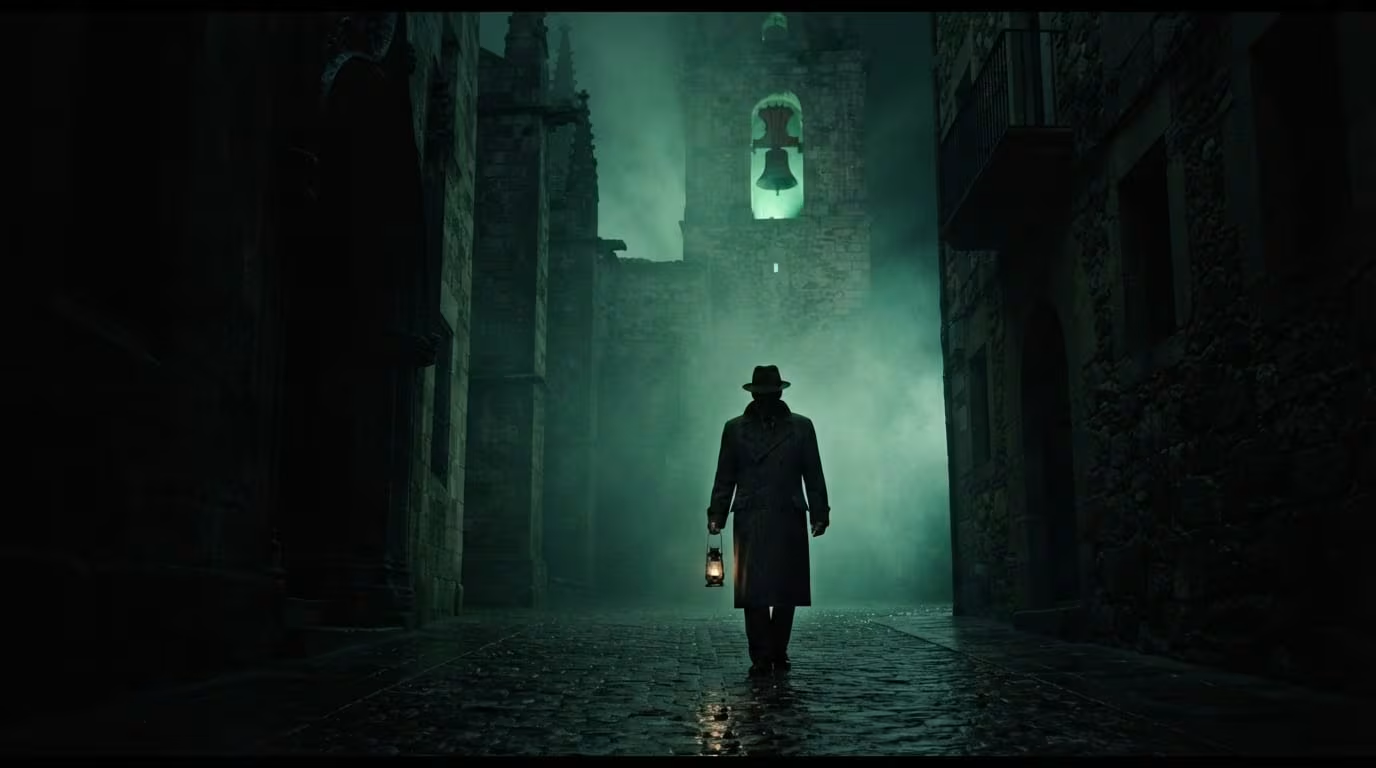
It was half past eleven. Driven by a holy madness—or perhaps by the irrational despair that precedes damnation—the priest took a silver crucifix, a vial of holy water, and the oil lantern. He decided he would not wait for the tolling in his bed. He would wait for the demon within its very lair.
He climbed the tower as the storm battered the outer walls. Each stone step seemed steeper than the last. The cold was unbearable, a mystic cold that seared the skin and froze the breath into dense vapour. He reached the wooden door, opened it, and stepped into the sanctuary of bronze.
The bell hung at the centre of the belfry, swayed subtly by an invisible breeze that did not come from outside. In the faltering lantern light, the figures carved into the metal seemed to move, writhing in a macabre dance. The stench of rancid blood and sulphur was suffocating.
Mateo drew out the flask of holy water and began to recite the exorcism ritual, his voice breaking:
—Exorcizo te, creatura metalli, in nomine Patris et Filii et Spiritus Sancti...
Before he could finish the sentence, an invisible, icy force seized his throat, crushing his windpipe. The flask of holy water fell to the stone floor and shattered into a thousand pieces. The flashlight died, leaving the room steeped in the night's gloom, lit only by the lightning that tore across the sky of Ávila.
His pocket watch struck twelve.
A sepulchral silence seized the tower. Mateo, on his knees, fighting for breath, raised his eyes. The iron clapper began to move. There was no wind. There was no rope. A black mist, dense as soot, poured from the bell's inner cavity, taking the shape of long, fleshless hands that pushed the iron's weight against the bronze lip.
CLANG!
The first strike was a shockwave of pain that pierced his eardrums. Mateo clapped his hands to his ears; blood began to well between his fingers.
CLANG!
Two.
CLANG!
Three.
In that instant, the parish priest understood the dreadful truth. The bell was not summoning any villager. The few who remained had either gone or were safe for the night. The bell was tolling for The.
Four... five... six...
Mateo tried to crawl toward the door, but the floor seemed to turn liquid, a mass of black mud that trapped his limbs. The figures sculpted in bronze began to emit a collective whisper, a murmur of a thousand dead voices repeating his sins, his doubts, his faltering faith, and his darkest secrets.
Ten... fifteen... twenty...
"My God, have mercy on me!" Mateo cried out, but his voice was swallowed whole by the metallic thunder. The sky gave no answer in the tower of San Martín de las Agujas. There, only blind metal reigned.
Thirty... thirty-one... thirty-two...
Each toll made an organ collapse inside his body. He felt his lungs filling with a thick liquid, felt the veins in his eyes bursting under the immense pressure of the vibration.
Thirty-four... thirty-five...
Mateo was thirty-four years old.
The clapper rose for the thirty-fifth stroke, the blow that would mark the end of his existence. But the bell did not emit a clean sound. The clapper hung suspended in the air, millimeters from the metal, surrounded by the mass of shadows that seemed to savor the priest's Horror agonizing terror.
The priest lay on his back, chest heaving, his gaze blurred by blood, mouth agape in a rictus of silent prayer. The first ray of dawn pierced the arrow slit of the belfry, cutting through the gloom like a silver sword.
The metal never chimed for the thirty-fifth time. The shadows dissolved with a hiss of rage, and the bell fell inert, cold and dead as a tombstone.
When Uncle Braulio climbed the tower at noon, puzzled by the priest's absence from morning mass, he found Don Mateo sprawled beside the bell. He was not dead. His eyes, utterly white from the cataract of fright, stared fixedly at the ceiling. His hair had turned white as the snow of Gredos.
The priest never uttered another intelligible word. He spent the rest of his days in the asylum at Ávila, perched small beside the window, rocking himself rhythmically in his armchair. And the few who dare draw near to him swear that, whenever the cathedral clock strikes twelve, Mateo begins to count under his breath, waiting for the thirty-fifth toll that, he knows full well, will come sooner or later to settle the debt.
📜Investigation • Frequently Asked Questions
Documentary Archive and Analysis of the Occult • Relatando.com
What do the figure of Don Mateo and his predecessor, Father Faustino, symbolize literarily and psychologically in this prologue of the work?
Don Mateo embodies the hesitant intellectual who seeks rural isolation to heal his fractured faith, becoming the archetype of the epistemological victim. His arrival contrasts tragically with the destiny fate of Faustino, confined to an asylum, babbling about 'tongues of metal.' This transition establishes a cursed lineage within the local clergy, where theological reason is devoured by a physical and acoustic phenomenon of inscrutable nature.
How do the geography of the Sierra de Gredos and the secluded hamlet of San Martín de las Agujas function as an oppressive, breathing presence within the narrative?
Carlos Nieto wields the landscape of Ávila not as a mere backdrop, but as a hostile, chthonic entity. The frozen granite, the reek of rotting pine, the subterranean mould—together they forge a dirty realism that borders on rural gothic. This extreme isolation smothers every hope of outside rescue, turning the moorland into a claustrophobic prison where the laws of nature hang suspended beneath the weight of the ice.
What hidden meaning lies within the numerical cadence of the midnight tolls echoing from the bell tower of Nuestra Señora de la Soledad?
The bell tower, its clock frozen for decades, shatters its silence with a death knell that halts precisely on the nineteenth toll, preceded by agonizing three-second intervals. This metronomic precision suggests a macabre countdown or a ritual synchronized with the human tragedy looming ahead. It is no random sound, but a spectral machinery heralding the consummation of an inescapable condemnation upon the community.
How do the folklore of wandering souls and historical trauma entwine within the suffocating atmosphere of the blackened ashlar Romanesque temple?
The parish church, consumed by damp moss and crowned by a blind watchman, evokes the architecture of dread the sacred unique to the Iberian Peninsula. The text summons the oral tradition of bells that toll of their own accord—a universal motif in horror folklore—harbingers of violent deaths and the awakening of dormant collective guilts. The sanctuary ceases to be a haven of salvation, transforming instead into an epicenter of foreboding where the past and local sin take on a terrifying, resonant corporeality.
Do not extinguish the light yet...
If you have had the courage to make it this far, we have other dossiers that will test the limits of your sanity.

Terms and Figures of this Tale
To delve deeper into the legends, creatures, and dark concepts that inspire this account, consult their entries in our dictionary of the uncanny:

Tu correo no se publica ni se comparte con terceros: solo sirve para notificar la respuesta.