To submerge oneself in the dark, swollen waters of the Amazon basin is to cross the threshold into a territory where the boundary between zoology and cryptozoology dissolves entirely. As a researcher of the uncanny and director of Relatando.com, I have dedicated much of my career to tracking those legends that defy our understanding of reality, and few manage to curdle the blood with such intensity as that of the Amazon River's *Encantado* and its shape-shifting alter ego, the pink river dolphin. We are not dealing with a simple fishermen's tale meant to frighten children away from the water's edge as the sun sinks; we stand before an archetypal entity, an aquatic morpher who commands the art of lethal seduction, crossing the line between the jungle's most charismatic marine mammal and a handsome man dressed in white, capable of stripping the soul and will from any unwary soul. Throughout this definitive encyclopedic article, we will unravel the layers of mystery, history, anthropology, and psychological terror that envelop this dweller of the river depths, analyzing its *modus operandi*, its mythic anatomy, its weaknesses, and the chilling accounts documented over the centuries by the riverbank communities who coexist, in fear and trembling respect, beneath the constant threat of its hypnotic pull.
Classified File
- Origin: Mythology and folklore of the Amazon basin (Brazil, Peru, Colombia, Ecuador).
- Nature: Shape-shifting river spirit, a semi-aquatic entity capable of assuming human form.
- Hazard Level: Moderate to High (Seduction, aquatic abduction, loss of reason, and soul-stealing).
- Weaknesses: Potent cane liquor, dark tobacco, the presence of mirrors, and exposure to direct sunlight in its animal shape.
Origin and Etymology
The term ‘Encantado’ stems directly from Portuguese and colonial Spanish, alluding to those beings who have been ‘enchanted’ or confined to a liminal reality—a mystical limbo from which they cannot escape by conventional means. In the worldview of the indigenous and mestizo populations of the Amazon, the river is not merely a waterway or a source of natural resources; it is a parallel dimension, a vast, turbid green ocean teeming with underwater cities invisible to the eyes of ordinary mortals. These sunken metropolises, known in certain local dialects as the ‘City of the Enchanted’, are ruled by spiritual hierarchies where the pink river dolphin (known scientifically as Inia geoffrensis, and locally as pink river dolphin) holds the highest rank as prince, warrior, and seducer.
The etymological and mythological roots of this creature sink their fangs deep into the cultural syncretism of the region. On one hand, indigenous tribes such as the Ticuna, Tukano, and Omagua already held ancestral myths regarding water spirits capable of assuming the shape of giant fish or amphibious entities to punish those who violated the river's ecological laws, such as overfishing or polluting the sacred oxbow lakes. On the other hand, with the arrival of European colonizers and the subsequent rubber boom, the myth became spiked with Christian and Western nuances, fusing with the European figures of the incubus and succubus: nocturnal demonic entities that prey upon the carnal weakness of human beings. Thus, the Boto transformed into the archetype of the Amazonian dandy, a mysterious gentleman emerging from the gloom of the flooded jungle (the igapó) during traditional village festivities to dance with the most beautiful young women, leaving them with child or dragging them down forever to the bottom of the river abyss.

Anatomy and Appearance
To comprehend the duality of the Encantado, we must analyze its anatomy in both its natural form and its anthropomorphic manifestation. The Amazon pink river dolphin is, by its own right, one of the strangest and most fascinating creatures on the planet. Unlike its marine relatives, the Inia geoffrensis possesses unfused cervical vertebrae, allowing it to turn its head ninety degrees in any direction—a flawless evolutionary adaptation for navigating among the submerged trunks of the flooded forest. Its skin, ranging from a pearl gray in its youth to a deep, nearly scarlet pink in adult males, acquires this coloration due to constant abrasion and a high concentration of blood capillaries close to the cutaneous surface, a trait that Legend popular lore interprets as the flush of passion or the ravages of its feverish nature.
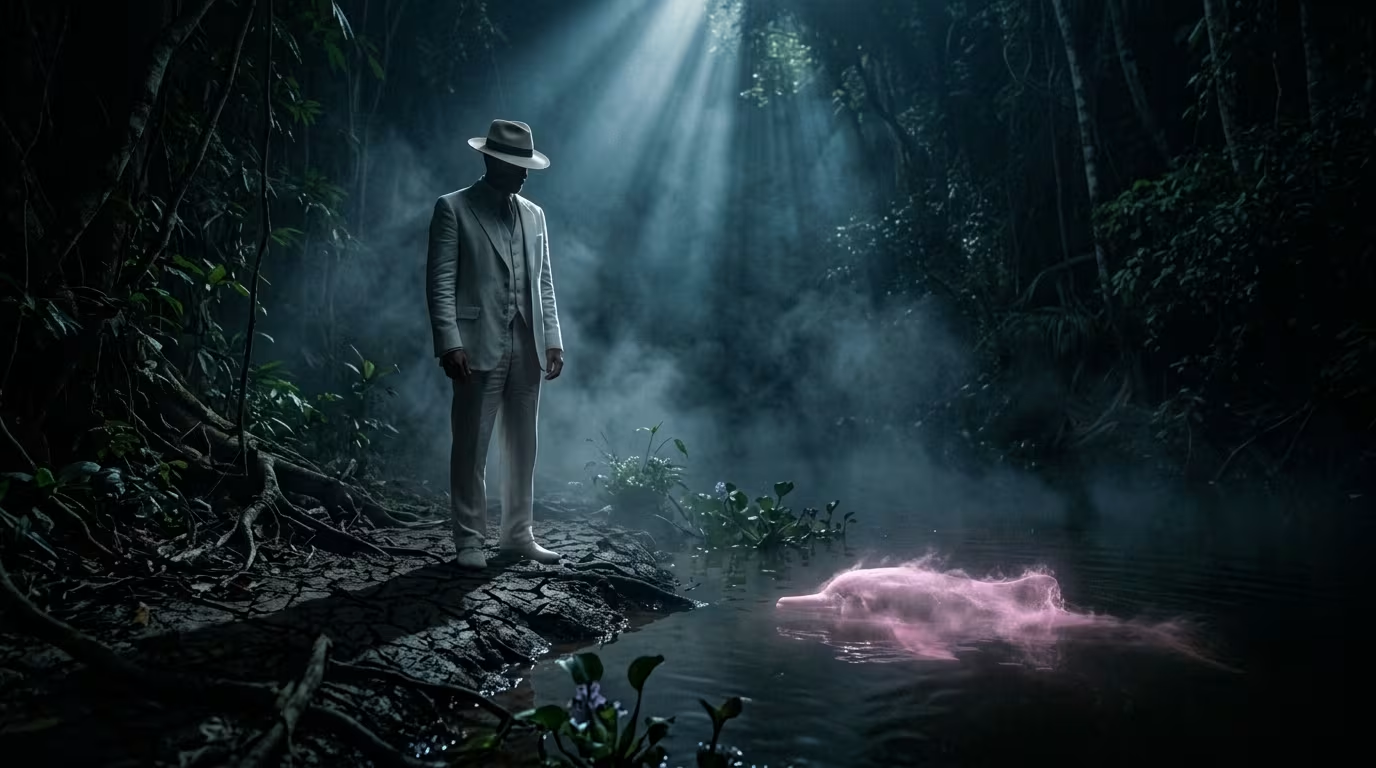
Yet when the Encantado chooses to walk among men, its physical appearance undergoes a metamorphosis as subtle as it is disturbing. It invariably transforms into a tall, slender man with dark skin and a magnetic gaze that seems to hold the secrets and the horrors of the riverbed. The Boto's most telling anatomical feature in human form—and the only foolproof method to identify it before it is too late—lies in its head: incapable of completely hiding its true cetacean nature, the Encantado permanently wears a wide-brimmed hat, a Panama, or a sailor's cap, even at night or within enclosed spaces, for the sole and desperate purpose of concealing its characteristic blowhole or the dolphin's distinct frontal cranial bulge. Likewise, it tends to wear immaculate white linen suits and shoes that subtly conceal feet sometimes described as slightly webbed or deformed.
Modus Operandi and Powers
The *Encantado* is not a monster that attacks through brute force or explicit violence; its *modus operandi* relies upon psychological manipulation, irresistible seduction, and sensory enchantment. The hunting or abduction cycle typically begins on nights of the full moon, coinciding with local festivities, weddings, or patron-saint fairs held along the riverbanks. The Boto sheds its aquatic skin, breaks the surface, and assumes the form of a handsome foreign gentleman. Endowed with a prodigious silver tongue, a velvety voice, and the power to fascinate everyone present through endless dances, the *Encantado* unfailingly seeks out the celebration's most vulnerable maiden: young, solitary women of melancholic spirit or marriageable age who find themselves neglected by their families.
Once the initial connection is forged, the Encantado's seductive power acts as a spiritual narcotic. The victim slips into a hypnotic trance from which she is powerless to break free, blindly obeying the stranger's commands. The Boto leads her slowly toward the dark riverbank, far from the tumult of music and laughter, where it transforms her anew or drags her straight down into the murky depths. It is said that women who fall beneath its spell and manage to return days later come back entirely deranged, babbling unintelligible words about crystal palaces beneath the water, or discover months afterward that they are pregnant by an invisible father who never again shows a sign of life. Beyond seduction, the Encantado possesses powers of weather control, the ability to generate dense fogs over the river to disorient watercraft, and the knack for inflicting temporary madness upon any men who attempt to stand in its path during the courtship.
Weaknesses and Protective Rituals
Despite its semi-divine nature and absolute dominion over the aquatic ecosystem, the Encantado is not invulnerable. Over generations, the riverbank populations of the Amazon have developed a body of empirical and mystical knowledge to repel its attacks and protect their families from the lethal allure of the shape-shifting dolphin. The Boto's first and most obvious weakness lies in its dependence on water and environmental humidity; though it can walk upon the earth, its power wanes drastically the farther it strays from the river's edge. If discovered in human form before the abduction is consummated, highly effective traditional deterrents exist.
Black tobacco and cane aguardiente (the cachaça or local rum) serve as pacifying offerings and magical barriers. Offering a stiff drink or a tobacco leaf to the suspected stranger during a feast will often compel him to reveal his true identity, since the Boto, incapable of resisting human vices, may lose control and exhibit erratic behavior. Another widespread method of defense involves amulets fashioned from the teeth of other aquatic predators, such as the black caiman or piranha, alongside sharpened metals and mirrors. It is believed that if a mirror is shown to the Encantado in his human form, he is horrified upon catching a fleeting glimpse of his true, impossible reflected anatomy—shattering the spell instantly and forcing him to flee in blind terror back toward the river channel, letting out shrieks that mimic the blow of a cetacean.
Documented Cases and Famous Legends
The chronicles of the Amazon are choked with accounts of unexplainable disappearances that local authorities and villagers attribute without a second thought to the Encantado. One of the most notorious and thoroughly documented oral narratives in the Brazilian state of Pará dates back to the 1950s in a small settlement near Santarém, where a young woman named Raimunda, known for her striking, uncommon beauty, vanished into thin air during the feast of St. John. According to eyewitnesses, a tall, impeccably dressed man in pure white had claimed her for every dance throughout the night, speaking to no one else. By dawn, she had failed to return home. For days, her family tore through the suffocating jungle and scoured the riverbanks, finding only her lace handkerchief drifting near a dark whirlpool notorious for harboring pink river dolphins. Months later, Raimunda staggered back into the village in a state of absolute mutism, her eyes hollow and fixed on nothing, her belly distended. In her rare flashes of lucidity, she whispered that she now dwelt in a magnificent mansion of gold and glass at the bottom of the river, bound to her handsome husband.
Another striking record is a report drafted by Jesuit missionaries in the 18th century, who documented with profound unease the deep-seated dread the natives held toward river dolphins, hunting them under pain of eternal damnation. The priests logged numerous instances where men and women, having attempted to slaughter a pink dolphin for threatening their catch, suffered sudden deaths by drowning in impossibly shallow water or succumbed to a violent, wasting fever marked by frenzied delirium, swearing they could hear laughter and singing rising from the riverbed. These accounts, passed down from generation to generation with grim solemnity, prove that the myth of the Encantado is no mere relic of a bygone era, but a living, predatory force that continues to shape the psyche and the fearful reverence the jungle dwellers harbor toward the great waters.
Comparative Analysis
To fully grasp the singular horror of the Amazonian Encantado, one must undertake a rigorous comparative analysis against other folkloric and cryptozoological entities sharing similar traits—such as the European werewolves, the sirens of Western maritime lore, or the malevolent nixies of Germanic myth. Unlike the classic sirens of the Mediterranean or the North Atlantic—half-woman, half-fish monstrosities that lure sailors with sweet, hypnotic songs to shatter their hulls upon jagged reefs—the Encantado boasts a superior, terrifying morphological versatility. It assumes a complete, flawless human form, walking upright among men on dry land, masquerading with chilling ease as a social dandy at communal festivities.
Furthermore, while the European lycanthrope (the werewolf) remains inextricably shackled to the curse of the full moon and a brutal, blood-drenched transformation driven by sheer bestiality, the Boto operates through cold elegance, courtship, seduction, and deep psychological decay. It seeks not the immediate physical annihilation of its prey, but their utter spiritual abduction and absorption into a submerged, unnatural order. Compared to the Scottish Kelpie—a shape-shifting water spirit that adopts the guise of a magnificent horse to lure the unwary to a drowning death—the Amazonian Encantado displays a far more insidious cultural sophistication, mirroring the claustrophobic complexities of survival in a jungle where water is simultaneously the giver of life and the vessel for the abyss of the human psyche.
📜Investigation • Frequently Asked Questions
Documentary Archive and Analysis of the Occult • Relatando.com
Can the real pink river dolphin turn into a human?
Not scientifically. The Inia geoffrensis is a very real aquatic mammal, yet within Amazonian mythology, it commands the unearthly power to assume the guise of a strikingly handsome man for the sole purpose of seduction.
Why does the *Encantado* always wear a hat?
According to popular folklore, the Boto invariably wears a wide-brimmed hat while in its human form, using it to conceal its blowhole or the unnatural cranial bulge native to the river dolphin.
How can a person protect themselves from the *Encantado*?
It is whispered that one must offer it dark tobacco or cane liquor to unmask the beast, bear protective amulets fashioned from the teeth of water-dwelling creatures, or thrust a mirror before its face to shatter the illusion and expose its true, monstrous identity.
Do not extinguish the light yet...
If you have had the courage to make it this far, we have other dossiers that will test the limits of your sanity.

Terms and Figures of this Tale
To delve deeper into the legends, creatures, and dark concepts that inspire this account, consult their entries in our dictionary of the uncanny:






Tu correo no se publica ni se comparte con terceros: solo sirve para notificar la respuesta.