The Pegaso's engine coughed a dense mouthful of soot before settling into a metallic rattle that rattled the fillings in Mateo's teeth. Mateo slammed his right boot onto the handbrake, desperately trying to gain traction against the black ice carpeting the road. Outside, the blizzard on the León slope of the Pajares pass didn't just blow—it howled with the fury of an open throat. Wet, heavy flakes of snow fell, swept by the windshield wipers in a rhythmic, tired sound of old rubber scraping across frosted glass. The cab smelled of burnt diesel, stale black tobacco, and the sour sweat pouring from Mateo's armpits after hours of wrestling with power steering that failed on the hairpin turns.
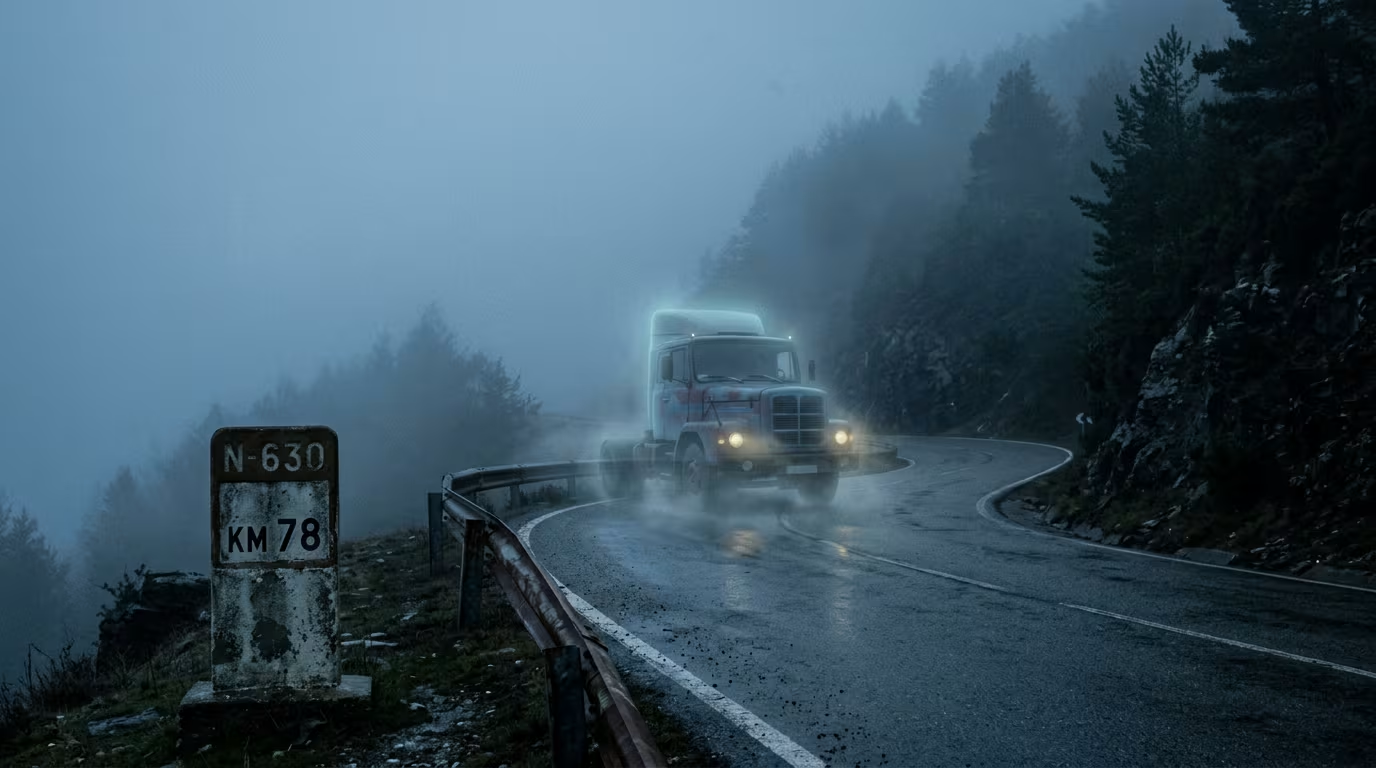
The odometer read seventy-seven. An eternity remained before cresting the pass and descending toward the relative safety of the Asturian valleys. The truck's high beams barely pierced three meters of a mist so thick it felt chewable. Mateo lit a cigarette with clumsy, trembling fingers, letting his fingertips graze the cold metal of the lighter. That was when the lights appeared in the rear-view mirror.
I. The Opaque Mirror
At first, he thought they were the headlights of some lagging coach or the ministry's snowplow. Two beams of jaundiced, greenish, withered light that cast no brightness upon the asphalt, but instead seemed to swallow the darkness around them. The vehicle behind did not announce its presence with the usual roar of a heavy diesel engine; it advanced in absolute silence, defying the laws of physics and common sense, devouring the steep incline with unnatural agility.

Mateo tore his eyes from the road for an eternal second to peer into the exterior side mirror. Accumulated rainwater warped the image, turning the reflection into a bloody smear. The truck pursuing him was a relic from the sixties, an old CAMPSA tanker painted a leaden gray that bled into the fog. It bore no visible license plate. Its rusty, dented front bumper scraped nearly against the asphalt. The headlights were on, but their lenses were cracked, webbed with dry fractures.
Mateo's heart gave a dull lurch in his chest, hammering against his ribs like a caged bird. He tried to accelerate, but the aging Pegaso engine answered with a choked groan. The tachometer needle barely flickered. The monster mass of iron was closing in. Its front grille was mere meters from his rear bumper. Mateo felt the invisible weight of that monstrous rig pressing down upon his spine, a metallic urgency demanding he veer off at once.
If I don't clear a path, it's going to run me over. It's not braking. That mass has no intention of stopping.
He searched desperately for a shoulder, a widening of the road. Kilometer 78 offered a straight stretch of scarcely a hundred meters before the dreaded La Romereda curve. Mateo flipped his right turn signal, downshifted to third, and pressed the passenger-side wheels hard against the sheer rock face, hoping the tanker would pass him and vanish into the storm.
II. The Bandages on the Steering Wheel
The gray truck scraped the side of the Pegaso with a dull groan of metal on metal. Sparks flared briefly, illuminating the curtain of snow with a bluish flash. Mateo held his breath, his knuckles white as he gripped the steering wheel rim, waiting for the definitive blow that would send his truck plummeting into the ravine. But the impact never came.
Instead, the tanker slowly pulled alongside his cab. The two lumbering hulks rolled in tandem, defying the narrowness of the road. Mateo turned his head to the right, drawn by a force both magnetic and repulsive. His eyes locked onto the driver's window of the truck Phantom.
The cab was bathed in a dim, spectral light, an amber hue reminiscent of old filament bulbs. There was no face. There were no eyes to stare back. Through the frosted, oil-smeared glass, Mateo saw with absolute horror the massive black bakelite steering wheel spinning under its own power, violently swinging from side to side in a frantic, mechanical choreography.
And resting upon the rim, holding it with impossible rigidity, were two human forearms. They were swathed from end to end in thick hospital gauze, yellowed by time and stained with brown rings of dried blood and bodily fluids. The bandages ended abruptly in stumps where wrists should have been; there were no hands. Only soaked fabric, loose threads swaying in the draft, and a trail of blackened dampness seeping through the gauze to drip heavily onto the cab's floor mat.
The cold ceased to be an atmospheric condition and became a physical presence inside Mateo's Pegaso. The steam from his own breath froze instantly on the interior windshield in fractal patterns. His lips went completely numb. He tried to scream, but the sound died in his throat, reduced to a thread of thick saliva.
III. The End of the Road
The tanker began to crowd him. The massive front right wheel of the archaic vehicle struck the Pegaso's side fender, lifting Mateo's cab as if it were made of cardboard. The shriek of twisting axles drowned out the howling wind. Gravity ceased to exist for a fraction of a second.
Mateo didn't close his eyes. He watched the bandages on the phantom truck's steering wheel tense, guiding the maneuver with millimeter-precise accuracy toward the abyss. There was no screech of brakes. No cries for help. Only the dry snap of the chassis yielding to the weight of the impossible.
The Pegaso tumbled down the slope, cartwheeling endlessly among pines and boulders, shedding doors, mirrors, and cargo with every impact. When the vehicle finally stopped at the bottom of the ravine, resting on its roof and reduced to a smoking heap of mangled iron, silence reclaimed the Pajares pass. An absolute, heavy silence, broken only by the steady drip of hot oil onto pristine snow.
Up on the kilometer 78 highway, the lights of a grey tanker truck pressed on toward León, the steering wheel turning of its own accord, guided by two stumps wrapped in aged gauze that will never find rest.
📜Investigation • Frequently Asked Questions
Documentary Archive and Analysis of the Occult • Relatando.com
On what myth or dread reality is this tale based?
It draws inspiration from urban legends of truckers regarding apparitions on Spanish mountain passes and the Horror claustrophobia of nighttime highway isolation.
Are there documented real cases similar to this story?
No official records exist, but the crime chronicles of the Spanish postwar era document numerous fatal tanker truck accidents on treacherous passes like Pajares.
What does the ending of the story mean?
It represents the inevitability of death on cursed routes, where the ghosts of the highway endlessly replay their tragic journeys without hope of redemption.
Do not extinguish the light yet...
If you have had the courage to make it this far, we have other dossiers that will test the limits of your sanity.

Terms and Figures of this Tale
To delve deeper into the legends, creatures, and dark concepts that inspire this account, consult their entries in our dictionary of the uncanny:

Tu correo no se publica ni se comparte con terceros: solo sirve para notificar la respuesta.