The coolant no longer smelled of pure glycol; it reeked of rotting fish and old coins boiled in motor oil. Adrián spat out the half-rolled-down window—a thick, dark thread that vanished into the compact blackness of the limestone walls. The gorge of La Hermida was no mere road; it was a throat in earnest, a trachea of stone down which the dampness crawled from the Picos de Europa to slowly suffocate any stranger audacious enough to cross from Cantabria to Asturias past midnight. The Renault 19 coughed—a metallic spasm that shook the cracked dashboard—and then the odometer seemed to suspend its tremor. The needle froze dead at fifty kilometers per hour, refusing to rise or fall, as though the gorge's own dense air weighed tons upon the engine.
To his right, the Deva River roared with a muffled violence, invisible at the bottom of the abyss—a monster of freezing water dragging logs and boulders against unseen slabs. To his left, raw rock oozed a viscous, green slime that the car's low beams could scarcely tear from the shadows. Adrián had been driving for three hours with white knuckles, his fingers dug into the worn plastic of the steering wheel until his nails ached. It was not merely the exhaustion. It was the smell. A heavy stench of rancid candle wax and wet wool permeated the air conditioning ducts, despite the system having been broken since the previous summer. Every time he swallowed, he tasted the metallic tang of bile at the back of his tongue.
I. The Grey Habit in the Void
The curve loomed without warning—a sharp, blind gash in the trace of the N-621 highway that forced him to bite the shoulder. Right there, where the stone parapet stood scarcely a handspan high above the endless abyss, a human shape silhouetted against the mist brought the car to a halt. Adrián slammed his right foot down on the brake with all his might. The pedal offered a mushy resistance, as though he were stepping into a sack of warm entrails; it sank straight to the floor without the slightest hydraulic opposition. The brake pads shrieked for an instant—a high-pitched lament of metal upon metal—but the vehicle did not slow down. It kept sliding by sheer inertia, as if the wheels had lost all contact with the asphalt and were floating across a sheet of ice.

The figure stood perfectly still, right at the precipice's edge. It wore a coarse woolen habit of a greyish hue that seemed to devour the meager light of the halogen headlights. The deep, empty hood concealed every trace of a face, casting a cone of absolute shadow across its chest. Adrián clenched his teeth until he felt his molars crack. He tried to crank the steering wheel to the left, toward the mountain, but the metal rim locked with a sharp click, as though an invisible steel bar had jammed the steering column. The car kept moving—slowly, inevitably—toward the hooded silhouette.
The engine died completely. The battery warning light flickered once—a red eye closing forever. And then, from the blown-out speakers of the radio, entirely disconnected from the power supply, there welled a dense, rasping murmur, uttering syllables in a deep-throated Latin.
The air inside the cabin turned unbreathable. It smelled of flesh roasting with agonizing slowness, of the dampness of a crypt excavated beneath clayey earth. Adrián tried to scream, but only a dry death rattle escaped his throat—a hiss unfit for human lungs. His hands, clamped to the steering wheel, began to shake in a violent, uncoordinated spasm, unable to let go of the plastic. Through the windshield, less than ten centimeters from the fogged glass, the monk raised his right hand. It was no hand of flesh; the skin was parchment-dry, brown like ancient leather exposed to the sun for centuries, with long, yellowish nails curving toward the palms like the talons of a bird of prey. The knotted fingers brushed the glass with a dull scratch: creak, creak, creak.
II. The Mirror of Broken Memory
The cold began in the soles of his feet, climbing relentlessly up his calves, freezing the blood in his veins with the sluggishness of a mud tide. Adrián glanced into the rearview mirror, searching for an exit, any sign of the road he had just left behind. The rear glass showed neither the dark asphalt nor the twisted pines of the ascent; it reflected only the interior of a tiny, damp room, its walls papered with a floral pattern already rotted by moisture. In one corner of that reflection, seated on a rush-bottom chair with a broken seat, a small boy stared at him with white eyes, devoid of corneas, weeping thick, black tears that stained his cheeks.
Recognition struck his stomach with the force of a physical blow. That child was him, thirty years ago, locked in the attic of the old stone house in Potes during the endless winter afternoons when his father drank fiery pomace brandy until he lost his senses. The smell of wet wool did not belong to the monk; it was the smell of his uncle's old coat—the one who had brought him to the gorge that very night, at this exact same hour, before the car plunged into the river and the freezing water filled his mouth with gravel and silt.
The realization brought no relief, only an unbearable nausea. Adrián understood that he had never left that car at the bottom of the Deva. The passing years, the city, the grey job at the bank, the failed marriage—it had all been the feverish delirium of a brain deprived of oxygen during those final minutes of agony beneath three meters of turbid current.
III. The Silence of the Limestone
The monk stepped forward and passed through the Renault's hood with the casual ease of a shadow crossing a wall. The metal offered no resistance; it simply disintegrated into a cloud of grey dust and fine ash that filled the cabin. The cold reached Adrián's chest, stopping his heart dead in an icy grip. The Latin litany ceased abruptly, replaced by the deafening roar of water battering against the rocks—a sound real at last, raw and definitive.
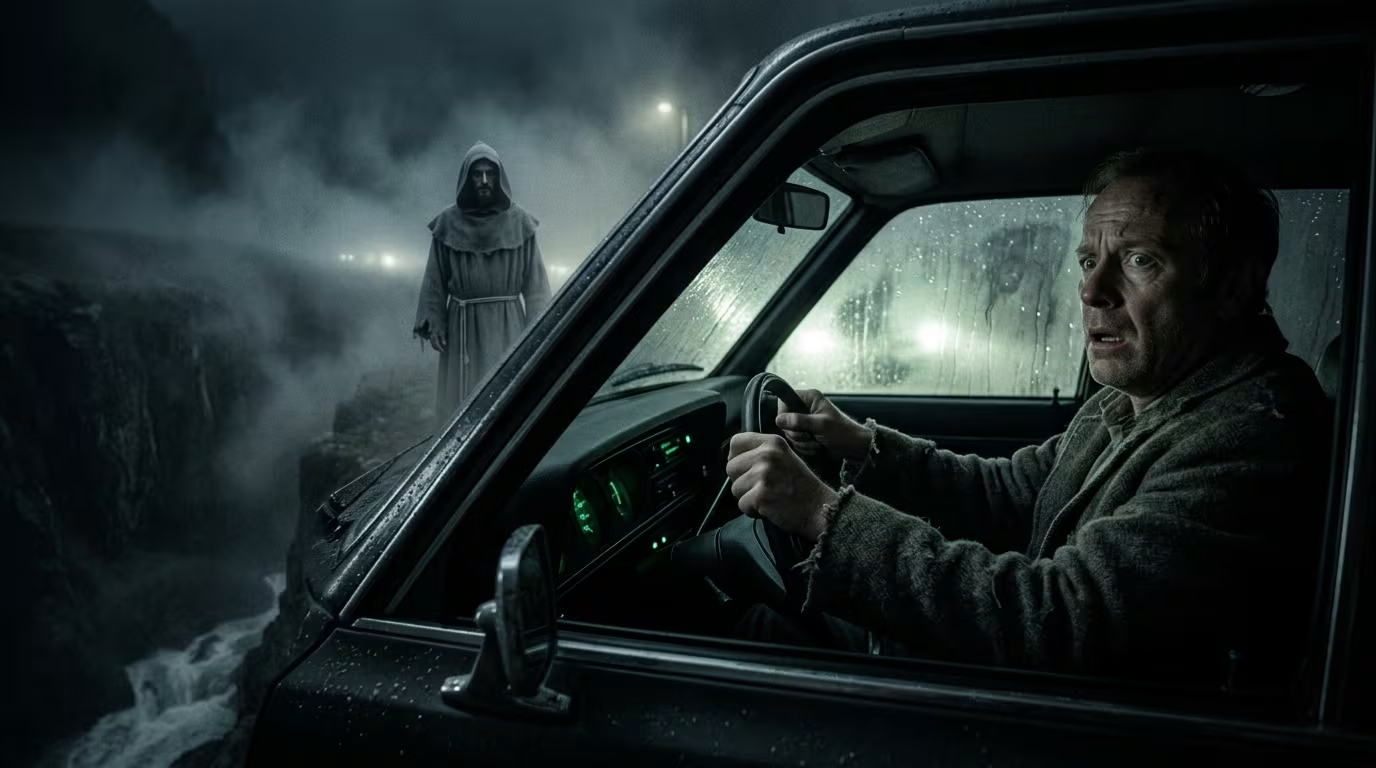
Outside, the fog continued to devour the gorge. At dawn, the highway maintenance crews would find the car wedged against the pillar at kilometer 124, its front end utterly smashed against the bedrock. In the driver's seat, Adrián's body would appear stiff, his hands still clawed upon the cold plastic steering wheel, his eyes blown wide open, reflecting only the grey, oppressive wall of limestone where no light could ever penetrate.
📜Investigation • Frequently Asked Questions
Documentary Archive and Analysis of the Occult • Relatando.com
On what myth or dread reality is this tale based?
It feeds upon the urban legends of the La Hermida gorge in Cantabria, weaving mystical apparitions with the claustrophobic terror of mountain roads.
Are there documented real cases similar to this story?
The stretch is notorious for numerous severe nocturnal accidents caused by rockfalls and dense fog, fueling the local folklore of phantoms.
What does the ending of the story mean?
Proposes that the protagonist has been dead beneath the water for decades, trapped in a temporal loop of his own agony and childhood guilt.
Do not extinguish the light yet...
If you have had the courage to make it this far, we have other dossiers that will test the limits of your sanity.

Terms and Figures of this Tale
To delve deeper into the legends, creatures, and dark concepts that inspire this account, consult their entries in our dictionary of the uncanny:

Tu correo no se publica ni se comparte con terceros: solo sirve para notificar la respuesta.