Chapter I: The Well of Souls
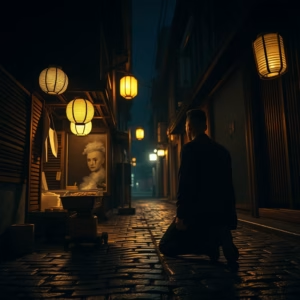
Toledo does not belong to the world of the living when the mist descends from the river gorge and claws its way up through the sewers of the Jewish Quarter. It is a city built upon layers of the dead, a concatenation of Visigothic vaults, Arab cisterns, and forgotten crypts conspiring within the bowels of the granite bedrock. In that subterranean labyrinth, where the air tastes of rancid lime, dampness, and burnt candle wax, Don Mateo de la Torre had decided to take leave of his senses.
Mateo was a historian of architecture, a man of dry, methodical science whom the Archbishopric had commissioned to catalog the cellars of the abbot’s ancient manor, a 17th-century mansion attached to the Capuchin convent. For three weeks, his universe had been reduced to the space illuminated by the sickly yellow glow of his halogen lamps: ashlar walls devoured by saltpeter, floors of fired clay, and an atmospheric density that seemed to compress the lungs with the weight of the centuries.
It was the night of November fourth when the sound began. A dull tapping, rhythmic yet devoid of any urgency. KNOCK. KNOCK. KNOCK. Three sharp strikes, punctuated by an interval of stagnant air, and then, nothing.

Mateo froze, his brush hovering over the alcove’s inscription. The silence in the subterranean depths was absolute—a physical entity ringing in his ears. He told himself the noise came from the pipes on Calle del Ángel, or perhaps the thermal expansion of the oak beams above. Yet, the ancients knew well that beneath the substrate of Toledo, wood does not warp and iron does not vibrate without cause; down there, the stone responds only to the command of that which dwells within its fissures.
He approached the western wall, the oldest mortar partition in the cellar, which in theory bordered the strict enclosure of the convent. He pressed his palm against the frigid surface. The dampness stained his skin with a viscous, mossy slime. He waited. Ten minutes. Thirty. Just as weariness began to cloud his vision, the stone vibrated beneath his fingertips.
KNOCK. KNOCK. KNOCK.
It was not the strike of a tool, nor the shifting of the structure. It was the unmistakable sound of naked bone rapping against brick. A small, desperate sound, infinitely ancient.
Chapter II: Chronicles of Brick and Silence
The hunt for answers tore Mateo from the cellar’s gloom, casting him into the ashen light of the Diocesan Archive. Amidst bundles of parchment ravaged by silverfish and folios blackened by gall ink, he traced the history of the abbot’s house during the reign of Philip IV.
The seminal document emerged from a folio stitched with gut thread, inscribed beneath the seal of the Holy Inquisition of Toledo: Cause and Process against Sister Soraya de la Cruz, formerly Doña Inés de Sandoval (1641-1643).
The pages chronicled a history of perverted devotion. Young Inés, forcibly committed by her kin to smother a lineage scandal, never once accepted her cloistered fate. Her handwritten journals—unearthed beneath the floorboards of her cell—spoke of nocturnal divinities that haunted the subterranean galleries of Toledo long before the cathedral rose, entities of stone and mire that answered the call of young blood. The sentence, handed down by the Holy Office and carried out with the Mother Superior’s cold complicity, offered no formal appeal: Inclusio Perpetua et Muro Obstricto.
Mateo felt a shudder run down his spine as he read the executioner's records. Soraya had not been put to death at the stake. They had opened a vertical niche in the deepest wall of the convent's crypts, beside the cistern; they had placed her inside standing, dressed only in her coarse hemp habit, and had walled off the space with a double row of fired brick and quicklime. Without food. Without water. Without light.
“And so that her sin might not defile the air of the Most High,” the text recited in a trembling hand, “the aforementioned nun shall remain entombed within the living rock, consigned to the patience of the earth until the Final Judgment consumes the masonry.”
What kept Mateo awake that night was not the barbarity of the punishment—so common in Habsburg Spain—but the marginal note added by the scribe two years after the walling-up: «In this present year of 1645, the noises in the cellar wall persist. The damned woman continues to call.» And another note, dated 1701: «The knuckles continue to rap from behind the whitewash.»
Chapter III: The Sound Piercing the Lime
Over the following week, Mateo ceased to emerge to the surface. His breathing grew asthmatic from the accumulated dust, and his eyes took on the feverish glint of the obsessed. He purchased a high-sensitivity plumbing stethoscope and a stonemason's mallet, then barricaded himself within the manor's depths.
At three in the morning, the hour when the shadows of Toledo seem to take on volume and density, the noise mutated. It was no longer an intermittent series of sounds. It became a methodical tearing, a rasping of eroded organic matter against the mortar.
Mateo pressed the receiver against the wall. What he heard did not belong to the realm of natural acoustics. From behind those twelve inches of brick and mortar, he could hear breathing. Not a breath of fresh air, but a dry death rattle—an exhalation of dust and spores that smelled of a sealed vault. And alongside that vegetative breathing, the continuous, rhythmic thumping.
KNOCK. KNOCK. KNOCK.
“Who’s there?” Mateo whispered, pressing his lips against the fissured wall.
The sound ceased instantly. The pause was suffocating, an abyss of silence where only the frantic thrum of his own heart echoed like a hammer. Then, directly on the other side of where his lips had been resting, a violent impact sent a shard of dry paint flying.
KNOCK!
An inarticulate voice, produced without vocal cords through the vibration of a throat petrified by three hundred years of desiccation, pierced the stone. It was a drawn-out syllable, a hiss that sounded like dry leaves being trampled upon a grave:
—Op… en…
Terror paralyzed Mateo, but the morbid fascination of archaeology, mingled with a perverse piety, proved stronger than his self-preservation instinct. Taking up the mallet was not a conscious decision; it was the execution of a destiny charted upon the city's subterranean maps since the seventeenth century.
Chapter IV: The Subterranean Rift
The first sledgehammer blow rang out against the vault with the roar of a cannon shot. The mortar, hard as iron after three centuries, released a cloud of white dust that blinded the historian. Mateo struck again. And again. With each impact, an ancient stench seeped from the fissure: an indecipherable blend of rancid wax, graveyard soil, and something inhumanly sweet, like overripe fruit fermenting in a shroud of ash.
Through the fist-sized hole, he shone his high-intensity flashlight. The beam of light sliced through the darkness of the unhallowed niche.
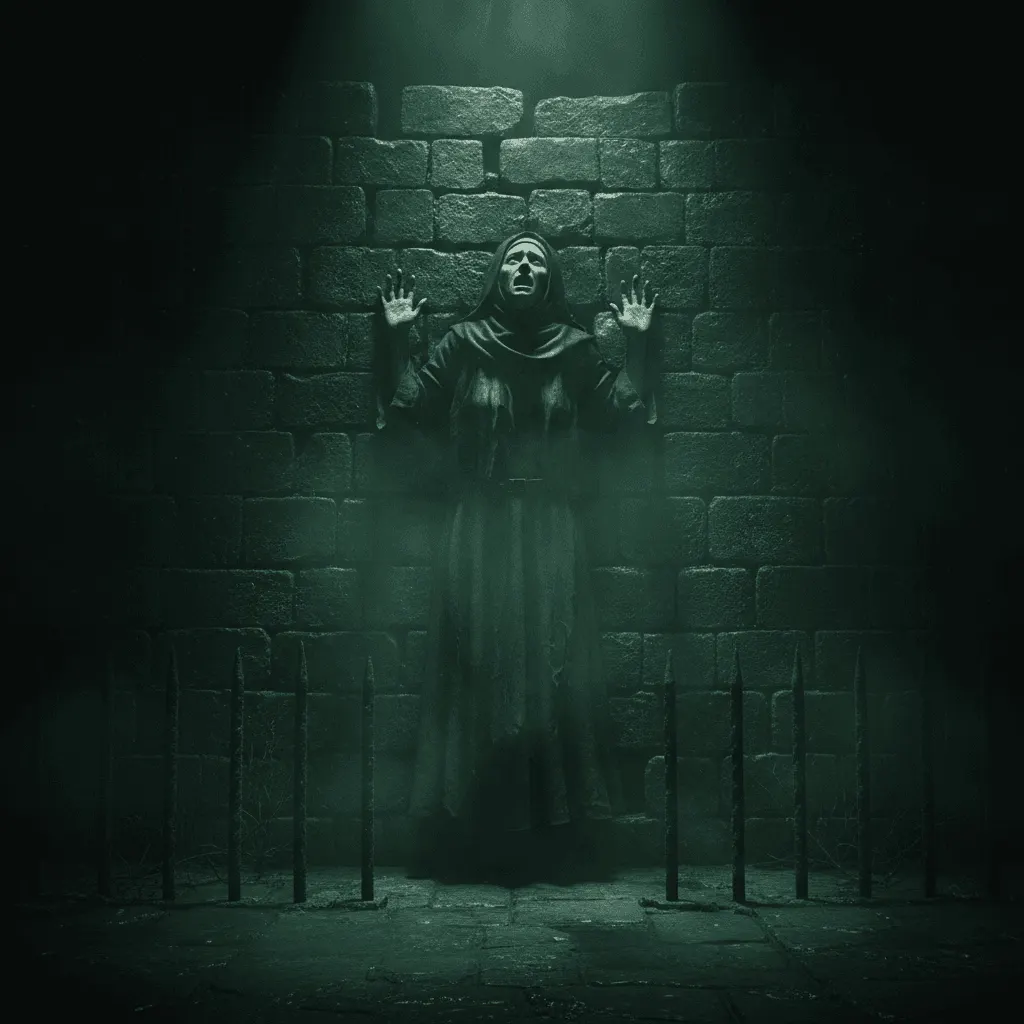
There was no skeleton collapsed on the floor. There were none of the dry remains that forensic science would expect to find.
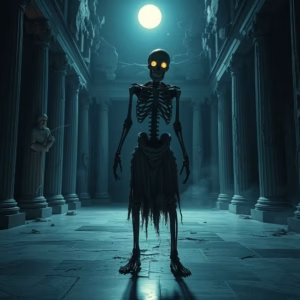
Upright, wedged with claustrophobic precision into the hollow of the wall, stood a figure. The Capuchin habit, undone into dun-colored tatters by damp and time, covered a body that had not rotted; it had calcified. The figure’s skin held the texture of burnt cardboard and the color of fossilized wood. Yet, it was not dead.
The creature slowly, she raised her right arm. The movement was accompanied by the dry snap of synovial-less joints, the cracking of dry twigs on the verge of splintering. Mateo watched in absolute horror the nun's hand: the fingers possessed neither nails, nor pads, nor flesh. What struck the stone were exposed osseous stumps, worn down to spheres of white calcium, abraded by centuries of unceasing friction against the brick.
The creature's eyes were veiled by a layer of grayish mold, but in the center of the parched sockets burned a point of red light, a spark of malignant consciousness sustained by pure hate and a devotion to the dark things that dwell beneath the crust of Toledo.
The nun's mouth unhinged. Her lower jaw dropped with a disjointed snap, tearing the parchment-thin skin of her throat. It was not air that surged from within, but a tide of blind beetles and black loam that spilled through the wall's fissure, pooling at Mateo’s feet.
Chapter V: The Immortal Vein
Mateo tried to recoil, but his legs failed him; the damp chill of the earth seemed to have seeped into his marrow, petrifying his muscles. Sister Soraya’s eroded hand lunged through the gap. Her stripped, calcified knuckles clamped onto the historian’s wrist with the crushing force of a forge press.
The contact brought no chill, but a scorching heat—the dry fire of souls that have burned in their own isolation for eons. Mateo screamed, yet the basement’s acoustics devoured his voice, drowning it within the stone arches that spanned beneath the cathedral, beneath the Alcázar, beneath the entire city.
—The rule… has been… fulfilled… —whispered the mental voice within Mateo's skull. It was not a prayer for forgiveness, but the liturgy of an underground order—. One remains… so another may unearth the lime…
The superhuman strength of the fossilized corpse hauled him toward the breach. The stone groaned as Mateo was dragged face-first against the jagged masonry. He saw the face of horror up close: it was not the victim of a cruel inquisition, but the vessel for a pre-human malice that had found, in being walled alive, the perfect womb for its own immortality. The quicklime had not killed it; it had anchored it in time.
The mallet struck the floor with a metallic snap.
***
The following morning, the laborers hired to restore the manor house descended into the cellar. They found the chamber silent, saturated with a strange scent of burnt incense and fresh plaster. At the back of the room, the western wall appeared flawless, reinforced with a course of ancient bricks and a patch of mortar that still wept moisture.
The foreman ran his hand over the resurfaced wall, unsettled by the quality of the finish, which no one had authorized. He was reaching for his abandoned tools when he froze in his tracks.
From the immeasurable depth of the stone, far beneath the foundations, where the bedrock dissolves into the rivers of the abyssal night, a sound resonated.
KNOCK. KNOCK. KNOCK.
Slow. Patient. Gut-wrenching. The sound of fresh knuckles beginning their centuries-long cycle against the lime.
📜Investigation • Frequently Asked Questions
Documentary Archive and Analysis of the Occult • Relatando.com
What historical and architectural implications does the subsoil of Toledo hold in the genesis of the legends convent vaults of Philip IV's era?
Toledo's underground is an archaeological palimpsest where Visigothic, Islamic, and Christian remains coexist. For an architectural historian like Don Mateo, this web of cisterns and crypts is not merely a material vestige, but a psychological catalyst. During the seventeenth century, the Counter-Reformation and conventual isolation fostered a hermetic subterranean urbanism, where the partition walls between noble mansions and cloisters concealed inquisitorial secrets and practices of extreme reclusion.
What is the symbolic and folkloric significance of the rhythmic tapping ('KNOCK. KNOCK. KNOCK.') within the haunting traditions of the Iberian Peninsula?
In Hispanic folklore, the repetitive, dull sound against stone—often associated with bare bone—represents the liminal stratum between purgatory and the world of the living. It does not seek articulated communication, but rather the certification of a presence trapped in architectural time. This recurring motif in mystery narratives symbolizes the persistence of institutional guilt and the impossibility of historical oblivion.
What documentary and testimonial value do the files of the Holy Inquisition in the Diocesan Archive provide for the reconstruction of these events?
Inquisitorial proceedings preserved within ecclesiastical archives, such as the 'Causa e Proceso contra Sor Soraya de la Cruz,' serve as ambivalent sources. Though filtered through the orthodoxy and ideological constraints of the seventeenth century, they record with notary-like precision the frictions between the nobility, the regular clergy, and the imposition of penance. These documents reveal how forced seclusion and extreme conventual discipline frequently descended into silenced tragedies.
In what manner does Carlos Nieto employ sensory atmosphere and methodical science as literary devices within the tale?
Nieto employs the figure of a rational protagonist—a dry-science architectural historian—to lend greater credibility to the supernatural horror. The gradual transition from scientific rigor, lit by halogen lamps, to immersion within the twilight of the Diocesan Archive creates an effective contrast. The environmental density, the stench of rancid lime, and the viscous damp act as narrative elements that constrict both the character and the reader alike.
Don't turn off the light just yet...
If you have had the courage to make it this far, we have other dossiers that will test the limits of your sanity.

Terms and Figures of this Tale
To delve deeper into the legends, creatures, and dark concepts that inspire this account, consult their entries in our dictionary of the uncanny:


Tu correo no se publica ni se comparte con terceros: solo sirve para notificar la respuesta.