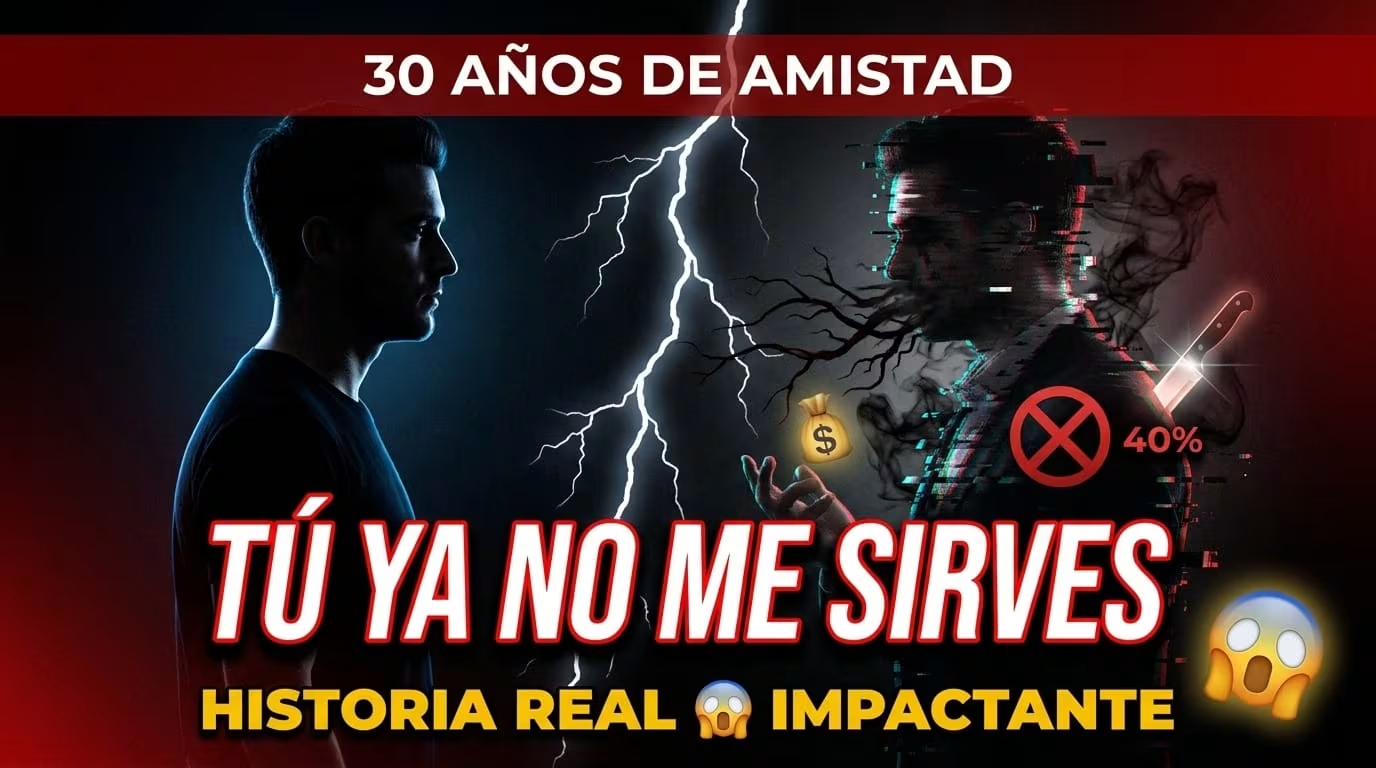
The sound of my own breathing against the cold windowpane was the only thing keeping my sanity intact. It was three in the morning, and the city out there looked like a cemetery of neon and asphalt. For years, Luis sat at my table, broke my bread, and learned to read my silences better than I could myself. What I called brotherhood, he called strategy. What I considered an unbreakable bond was to him nothing more than a reservoir of energy waiting to be drained.
I. The Oath at the Park Wall
We grew up in that neighborhood where the paper-thin walls let you hear the neighbors' grief as if it were your own. Luis was my shadow, and I was his shield. That summer night, when we were sixteen, the oath was etched in stone: reach the peak together or sink into ruin, but always side by side. I had no doubts. If anyone had told me then that the boy with the easy laugh would become the architect of my undoing, I would have broken his jaw without a second thought. But predators do not arrive with claws; they come with promises of absolute loyalty.
The most dangerous predators are not those who stalk you in the dark, but those who invite you to their table to learn precisely where you keep your fears.
II. The Descent and the False Savior
The termination was the catalyst. When the factory bolted its doors, reality turned into a corrosive acid eating away at my identity. It was in that moment of absolute vulnerability that Luis's mask began to slip. At first, his support felt genuine: cold beers, heavy slaps on the back, and hollow vows that we would pull through together. But the air grew foul. His presence turned erratic, thick with a condescension that had never been there before. I began to notice how his gaze slid away whenever I spoke of my despair, how his answers grew clipped and cold, as though my agony were nothing more than a nuisance staining his immaculate, counterfeit optimism.

III. The Fracture of Certainty
The final collapse came when, after weeks of quiet torture, Luis blocked me. The message—"I'm not here for drama, I need space"—was not a plea for distance; it was a death sentence. I understood then that I had only ever been useful as fuel to feed his shadow. Luis was no friend; he was an expert in human resource management on a deeply personal scale. He had studied me for decades, mapping the geography of my frailties so he knew precisely which strings to pull when my company no longer served him. The true betrayal wasn't the abandonment; it was the realization that while I was sinking into the abyss, he was already casting his nets elsewhere, hunting for fresh prey to bleed dry.
IV. The Broken Mirror
Today, the Horror is not Luis, but the revelation of my own blindness. Observing his life from a distance, I see the trail of emotional corpses he has left in his wake: people who, like me, believed in his brotherhood and were picked clean to the bone. The parasite is still out there, wearing a fresh smile and a rehearsed speech, waiting for the next victim who, like me, looks to him for a brother where there is only a starving void. The lesson has been brutal, but necessary: sometimes, the monster does not hide beneath the bed; the monster takes your hand and assures you that everything is going to be fine while he shoves you over the precipice.
📜Investigation • Frequently Asked Questions
Documentary Archive and Analysis of the Occult • Relatando.com
What is an emotional parasite in psychology?
It refers to individuals bearing narcissistic or psychopathic traits who weaponize emotional bonds to extract resources, validation, or raw energy, leaving the victim in a state of utter psychological desolation.
How do you spot a covert narcissist?
They typically project a facade of overwhelming empathy at the outset—a calculated love bombing—followed by the gradual isolation of the victim and an absolute, hollow absence of remorse once that usefulness has expired.
Why is it so hard for us to identify a betrayal by someone close to us?
Bound by confirmation bias and cognitive dissonance, our minds flatly refuse to accept that someone trusted for years could harbor the weight of a genuine threat.
Is this account an isolated case or a phenomenon common occurrence?
The profile of the 'emotional parasite' is a phenomenon well-documented in forensic psychology as a manifestation of narcissistic abuse, wherein the predator meticulously selects empathetic prey for self-serving sustenance.
Don't extinguish the light just yet...
If you have had the courage to make it this far, we have other dossiers that will test the limits of your sanity.

Terms and Figures of this Tale
To delve deeper into the legends, creatures, and dark concepts that inspire this account, consult their entries in our dictionary of the uncanny:






Tu correo no se publica ni se comparte con terceros: solo sirve para notificar la respuesta.