Chapter I: The Haze of Dread
There is a silence in the plains of Apure that does not belong to the kingdom of nature. It is not the mere absence of noise, but a physical presence, dense and tar-black, that clings to the skin along with the sweat of midnight. The night is an open mouth without teeth, a deep throat that devours any flicker of civilization. There, among the dry pastures and the savanna straw that whispers under an inert breeze, solitude is not measured in kilometers, but in the certainty that nothing and no one will come if you decide to scream.
Mateo knew it. He had spent more than forty years traversing that vastness of parched earth and rotten marshes. His hands were two pieces of leather tanned by the relentless sun, and his eyes, sunken beneath yellowing sockets, had watched men die from the bite of a coral snake or the whim of a flash flood. Yet Mateo had never felt true fear until that night in May, when the night sky seemed a suffocating shroud of lead.
He found himself alone in a waystation hut at Hato San Rafael, a decrepit structure with walls of cracked wattle-and-daub and a roof of dry palm thatch that creaked like bones under the tide of the wind. His only company was a kerosene lantern whose flame wavered, casting deformed and Dantean shadows against the termite-ridden wood. He was supposed to be watching the cattle, but the beasts had fallen silent hours ago. Not a moo, not the restless stamping of a calf. The entire herd had crouched in the gloom, sensing, with the primal instinct that man has forgotten, that the air was filling with ash and damnation.

Mateo coaxed the wick of the lamp to life. The heat was brutal, a feverish embrace that smothered his lungs. He wiped his brow with the back of his arm, hearing nothing but the accelerated beat of his own heart. And that was when the world lost its axis. The creak of the savanna grass did not come from a steer, nor from the furtive movement of a puma. It was a step. A long step, unhurried, dry, that seemed to snap trunks the size of a human torso several hundred meters away.
Chapter II: The Geometry of the Curse
Any inhabitant of the savanna knows the Legend. It is passed from lip to lip beside the fire between sips of white aguardiente to ward off the pre-dawn chill. Everyone speaks of the restless soul, that lanky six-meter-tall giant who walks above the tree canopies, dragging a burlap sack stuffed with the bones of his own father and those of the victims he has devoured throughout the centuries. But above all, any peasant knows the golden rule, the absolute dogma that separates the living from the dead in the plains:
«If the whistle is heard afar, the Whistler is near. If it is heard close, there is no danger, for he dwells in the depths of the savanna.» Phantom . An acoustic trap for the naive. It emits a melancholic note, a shrill, descending musical scale—
Mateo gripped the handle of his machete until his knuckles turned white. His grandfather had warned him; his father had repeated it, over and over, before dying in squalor: the sound of the Silbón is an inverted paradox. An acoustic trap for the naive. The creature emits a melancholy note, a descending, shrill musical scale —C, D, E, F, G, A, B—a sound that seems to echo from leagues away, when in truth the creature is lurking just around the corner, poised to crush the ribs of the unwary and drink their blood.
A distant whistle tore through the night.
It was a high, crystalline sound, unnaturally sustained. Judging by the physics of the earthly realm, it drifted from the distant edges of the marsh, three or four kilometers to the north. It was a lugubrious melody, a lament that froze the blood despite the forty-degree ambient heat.
Mateo shivered. If the legend was true, the specter stood at the cabin’s threshold. The Horror It clamped onto his entrails like a claw of iron. He knelt behind the low wooden railing of the hall, holding his breath, machete raised, a wooden peony rosary clenched in his left hand. He waited for the impact. He waited for the colossal shadow to shatter the palm roof. He waited for the stench of rot and dry bone.
Ten minutes passed. Fifteen. Twenty. The silence folded back over the ranch like a concrete tomb. Nothing stirred. No titan trampled the fence. Only the sterile wind continued to graze the dead grass.
Mateo furrowed his brow, bewildered. Adrenaline began to ebb, leaving a bitter taste of bile and sweat in his mouth. Had he erred? Perhaps the distance was real. Perhaps the monster he was merely passing through, searching for a drunken wanderer lost along the coast’s paths.
Chapter III: The Deception of the Wind
Then, the whistle resonated once more.
This time, it was no distant murmur lost in the marsh fog. The sound tore through the air with thunderous violence, vibrating just beyond the wire fence, barely twenty meters from the porch. It was a sharp, screeching whistle, heavy with a malevolent intent that made the empty bottles on the wooden table rattle from the sheer frequency of the air.
The melody traced the macabre notes: do, re, mi, fa, sol, la, si… but this time, the tone was so piercing it seemed to rend Mateo’s eardrum.
Instead of succumbing to panic, Mateo felt a sudden, absurd wave of relief. He smiled with the desperation of a condemned man who believes he has found an escape. He recalled the lessons of the old sages of Apure, the immutable rule they all swore by the Virgin of Carmen:
«If it sounds loud, if it sounds close… it means it’s far. It’s receding. The echo deceives the ear.»
—It is leaving… —Mateo murmured, his voice broken, letting a hysterical laugh escape, sounding pitiful across the endless night—. God of the heavens, it is departing. The legend does not lie. The sound is here beside us, indicating that the condemned is moving toward the river… which lies at a distance of miles…
The laborer rose to his feet, dusting off his drill-cloth trousers. The tension in his neck eased slightly. He was about to step toward the water pitcher to quench the searing thirst burning his throat when he noticed a harrowing detail.
The kerosene lamp's flame did not flicker outward, as it would have in the savanna breeze. Instead, the flame leaned violently toward the wattle-and-daub wall, as if something colossal were drawing air from deep within the hut itself. As if an unfathomable, rotting lung were inhaling the entire atmosphere of the room.
And the stench arrived immediately after.
It was not the scent of roadkill. It was the foul effluvium of a grave desecrated after decades of oblivion: a repulsive amalgam of decomposed bone, rancid lard, dried blood, and stagnant bile. A reek so thick that Mateo had to cover his mouth to suppress the sudden heave of his stomach.
Chapter IV: The Acoustics of Hell
Mateo stood petrified in the center of the room. The truth descended upon him not as a merciful revelation, but as a rusted scythe that severed his sanity completely.
The legend… the rule that thousands of men had repeated for generations… was a lie. A cruel mockery devised by an entity that did not belong to God's realm. The few who had survived to tell the myth They had never seen the Whistler; they had only heard the sound and had accepted the rule because the creature had forgiven them by mere chance. The Whistler did not reverse distance. The Whistler toyed with the perceptions of its prey.
The whistle did not travel through the air of the savanna.
The whistle manifested directly within the minds of the damned.
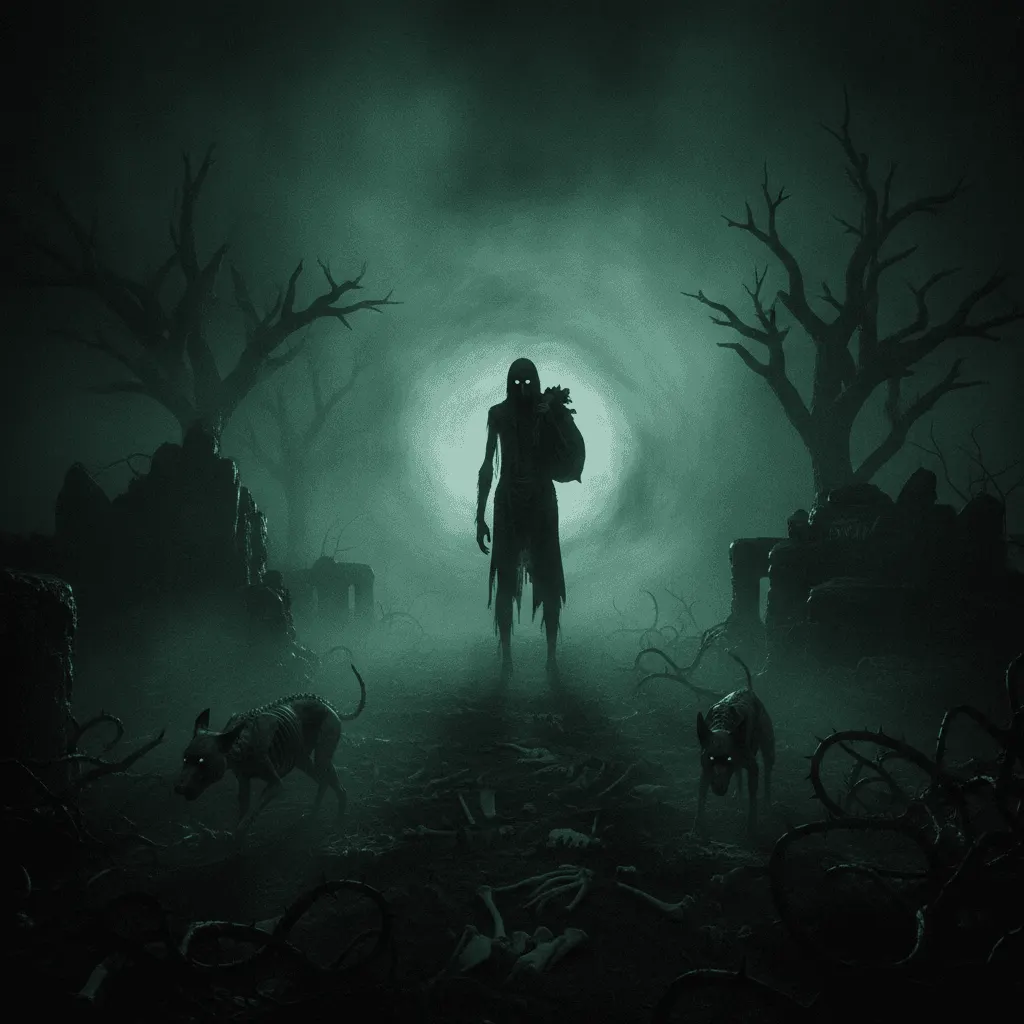
A chill not of this world froze his spine. Mateo felt the skin on his neck prickle, pore by agonizing pore, beneath the weight of an immeasurable presence looming directly behind him.
Slowly, with the agonizing sluggishness of one who knows they are about to behold the face of their own death, the farmhand turned his head to the left.
A searing breath, steeped in the dust of ground bone, caressed his earlobe. The temperature of his facial skin plummeted to zero as the air around him seemed to snap into ice.
And then, a mere few millimeters from his left eardrum, the whistling began.
It was not a distant sound. It was no echo from the savanna. It was a whistle so sharp, so intimate, so hideously close the air expelled by the creature made the fine hairs inside his ear vibrate. It was a pure note, impossibly high, piercing like a white-hot silver needle stabbing through his brain.
—Fiiiiiiiiiiiiuuuuuuuuuuu…
Mateo's eardrum ruptured with a dull pop. A thin ribbon of warm blood began to seep from his ear, trickling down his throat to stain his collar. The pain was blinding, yet the terror that gripped his soul was infinitely worse than any physical agony.
To look up was an act of pure damnation. Mateo saw two interminable legs, thin as stalks of dried bamboo, clad in tattered trousers stained with fossilized mud. The creature was so tall its torso vanished into the shadows of the shack's ceiling, which had peeled back in silence, snapping the wooden beams as if they were dry straw.
High above, descending from the absolute dark, a cadaverous head, devoid of skin and lips, watched him. Two empty sockets, teeming with blind maggots swimming in an abyssal blackness, locked onto the farmhand’s terror-stricken eyes. The monster’s lower jaw was unhinged, dangling by shreds of rotted flesh, and from that throat of darkness emerged the wind that wove the cursed melody.
Chapter V: The Sack of Eternity
Strapped to the monstrosity’s back, hanging from an angular, skeletal shoulder that grated with the sound of shattered china, swayed a burlap sack. It was not large, yet from within it emanated the most harrowing sound a human mind could conceive: the rhythmic, arid clatter of hundreds of femurs, skulls, and vertebrae grinding against one another.
Mateo tried to raise his machete. He sought to scream the name of Christ, to invoke the Virgin, to curse the specter, or simply to beg for a swift end. But his tongue was a dead weight of lead, fused to the roof of his mouth. The presence of the Silbón did not merely paralyze the body; it devoured the very will to exist, leaving behind a trembling, hollow husk prepped for the slaughterhouse.
The creature reached out. Its fingers were endless talons of stripped bone, possessing extra joints that bent at impossible angles. The hand descended with an almost elegant slowness, brushing against Mateo’s cheek. The contact felt like the frost of a grave. The farmhand’s skin blackened upon the direct touch of the specter’s flesh.
With hydraulic, implacable force, the Silbón’s fingers clamped onto the back of Mateo’s neck. The crunch of cervical vertebrae resonated through the hut, clean as a dry branch snapping. Mateo felt no pain; only an infinite void, a sensation of free-falling into a pit devoid of both bottom and stars.
The last thing Mateo saw before absolute darkness swallowed him was the mouth of the sack opening above him. He saw the remains of other peasants, faces fossilized in grimaces of eternal terror, bleached skulls still clinging to matted, dry hair. And he heard, once more, the whistle.
This time it did not sound from without. This time, the whistling echoed inside his own skull, marking the atrocious rhythm at which his own bones would be shattered to join the savannah walker’s collection.
At dawn, the hands at Hato San Rafael found the hut in ruins. The palm roof had been shredded from above, as if a celestial claw had sought to tear the very heart from the dwelling. On the floor, there were no traces of blood, no signs of a struggle. They found only an extinguished kerosene lamp, a rusted machete discarded on the floor, and a deep track, over a meter in length, pressed into the parched earth of the porch.
And those who paid attention, those who still possessed the keen hearing of the country folk, swore that when the southern wind blows over the Apure marshes, the whistle no longer sounds from afar. It sounds here. Right beside your ear. Waiting for you to make the mistake of believing you are safe.
📜Investigation • Frequently Asked Questions
Documentary Archive and Analysis of the Occult • Relatando.com
How does Carlos Nieto use sensory atmosphere in 'The Lament of the Whistler of the Plains' to redefine the dread traditional plainsman?
The author constructs terror not through immediate shock, but through a suffocating sensory density where the silence, the heat, and the stench of ash act as physical presences. By describing the night as an 'open, toothless mouth' and the air as a feverish embrace, Nieto plunges the reader into Mateo's psychological isolation, transforming the Apure landscape into a hostile territory that anticipates tragedy long before the specter even manifests.
What anthropological significance does the whistle rule described in the story hold within the Mythology comparison of the Colombian‑Venezuelan plain?
The acoustic inversion of the Silbón—where distant sound denotes imminent danger and proximity suggests a false security—functions as an ancestral mechanism for transmitting taboos and enforcing behavioral control across the savanna. In the narrative of Relatando.com, this dogma is not merely a suspense device, but the materialization of an inexorable cosmic law that separates those who respect the memory of their ancestors from those condemned to the voracity of the wandering soul.
How does the archetype of parricide and eternal damnation surface in the image of the hunched giant who drags bones through Carlos Nieto's prose?
The specter embodies the cardinal sin of parricide, now transformed into a perpetual sentence and a walking geography. By carrying the sack filled with his father's skeletal remains, the Silbón perpetuates a relentless ritual of atonement that defies the laws of time and physics. The entity’s unnatural height and his trunk-snapping stride symbolize the disproportionate nature of guilt and the insignificance of man when measured against the moral debts the earth never forgets.
What narrative role does Hato San Rafael play as a liminal zone and microcosm of seclusion within the novel's architecture?
Hato San Rafael functions as a liminal space where civilization dissolves and the borders between the living world and the underworld collapse. The thatch hut and the trembling quinqué offer not merely shelter, but a fragile trench against the threatening vastness of the savannah. By silencing the herd and isolating Mateo, the narrative sequesters the protagonist, stripping him of any human lifeline and forcing him to confront his destiny alone.
Don't extinguish the light just yet...
If you have had the courage to make it this far, we have other dossiers that will test the limits of your sanity.

Terms and Figures of this Tale
To delve deeper into the legends, creatures, and dark concepts that inspire this account, consult their entries in our dictionary of the uncanny:

Tu correo no se publica ni se comparte con terceros: solo sirve para notificar la respuesta.