Chapter I: The Scorched Earth of Santa Lucía
There is a heat in the San Ignacio valley that does not belong to the heavens, but to the very bowels of the earth. A dense, leaden, and greasy swelter that clings to the skin like a shroud of invisible oil. I, Don Ignacio de Loyola y Alvear, a man schooled in the halls of the University of Salamanca and little inclined toward old wives' tales or rustic superstitions, arrived at the Hacienda de Santa Lucía in late August, sent by my late uncle's executor to settle the agave and cacao estates the family held in this forgotten corner of New Spain.
The hacienda was a giant of adobe and pink quarry stone crumbling to pieces under a pitiless sun. But it was not the architectural ruin that unsettled me as I crossed the arches of the main courtyard, but the terrifying and unfathomable silence of the men. The laborers, Indians with sallow faces and shifty gazes, worked with a feverish and silent haste during the early morning hours; however, as the sixth hour approached, they would abandon their tools, gather the animals, and retreat into the shacks at the rear, bolting the heavy timbers as if shielding themselves from a pack of invisible wolves.
—It's because of the well, boss —old Mateo told me one night, the only hand who dared look me in the eye, though he did so with pupils clouded by cataracts and terror—. The big well in the north courtyard. It has been dry since the days of the viceroys, but the earth does not forget what it swallowed. At noon, when the sun beats down leaden and there is no shadow to hide one's guilt, the wellhead begins to sweat. And from the bottom, boss, water doesn't rise… the weeping of what they boiled inside rises instead.

I smiled with the smugness typical of European erudition. I dismissed their words as mere folklore from a peasantry crushed by ignorance and isolation. I spoke to them of sulfurous gases, of the subterranean currents within the volcanic cavities that riddle these highlands, and of the thermal echoes created as hot air forces its way through rock fissures. Mateo did not answer. He merely crossed his withered chest with a trembling thumb and told me: 'Go at midnight, Don Ignacio. Go and look. But do not stare directly into the bubbles, for the bubbles have eyes that remember your name.'
Chapter II: The Hour Without Shadow
The next day, determined to dismantle that ridiculous Legend undermining the estate's productivity, I walked toward the north courtyard at a quarter to twelve in the morning. The courtyard was a vast expanse of packed earth, flanked by ruined archways where dry moss looked like a crust of blackened blood. In the exact center stood the old well: an octagonal volcanic stone wellhead, carved with grotesque reliefs of faceless cherubs and dates half-eroded by saltpeter.
As I drew closer, the heat became unbearable. It was not the dry heat of the desert, but a damp, clinging, fetid vapor exhaling from the fissures in the earth. It smelled of old copper, rotting silt, and something else... something that reminded me of the dissection rooms in medical school: the sweet, acrid stench of flesh slow-cooking in its own juices.
I halted two paces from the mouth of the opening. I drew my silver pocket watch. The minute hand crept forward with a ruthless, clockwork precision: one minute to twelve. The entire landscape seemed to have fallen into a catatonic trance. The cicadas in the mesquite trees fell silent at once. The evening wind extinguished itself, leaving the air suspended like a sheet of red-hot glass. There were no birds. No flies. Even the shadows of the arches vanished beneath the pillars, devoured by the vertical glare of high noon.
And then, it began.
It was not a roar, but a dull gurgle, a deep vibration that made the soles of my riding boots tremble. From within the hole, no fresh air escaped, but a suffocating miasma that singed my eyelashes. I leaned over the stone edge. The well was an abyss of absolute blackness, but at the bottom, at an impossible depth, something was boiling. A thick, roiling murmur of water on the verge of eruption began to rise up the masonry walls.
But that was no harmless geyser's bubbling. From amidst the boiling foam and the churning of that invisible fluid, sounds emerged. First came shrill shrieks, like small birds trapped in a forge; then, the murmur articulated into a choir of human laments. They were the voices of women, children, and the elderly, fused into a sonic mass of unbearable agony. An agonizing gurgle, as if thousands of throats were attempting to sing while swallowing boiling oil.
“My God!” I exclaimed, stepping back, my brow soaked in a cold sweat that froze my viscera in the middle of that thermal hell.
The vapor rose in dense, coiling spirals that took on aberrant shapes in the midday light: supplicating arms, faces warped by the heat, mouths agape in an eternal, ceaseless wail. And at the heart of that macabre cacophony, a clear voice—a voice that did not resonate in my ears but directly upon the cortex of my brain—called me by my full name with the frayed accent of one consuming away in boiling pitch: «Ignacio... blood-nephew... come drink from the wellspring of the ancients...»
Chapter III: The Encomendero's Diary
I fled that courtyard, stumbling over stones, pursued by the infernal echo from the well that did not relent until the clock struck twelve-fifteen. I locked myself in the hacienda’s main study, barring the door with the heavy mahogany beam. My hands trembled so violently I could barely pour a glass of aguardiente. That was no heat-induced hallucination; it was a manifestation of something aberrant, a physiological horror that defied all natural law.
I spent the afternoon rummaging through the study's archives. The drawers of the great cedar desk held ledger books, property deeds, and personal diaries coated in dust and moth excrement. I knew that somewhere among those papers, the truth regarding the construction of the cistern had to be recorded. It was at the bottom of a leather trunk that I found the handwritten journal of my great-great-grandfather, Don Gonzalo de Alvear y Marquina, the region's first encomendero, dated 1712.
The pages, yellowed and brittle with time, revealed an angular, erratic script—a clear sign of a mind devoured by fever or remorse. I read by the light of a tallow candle, while outside, the night wind howled through the roof tiles like a dying dog:
«October 14, 1711. The drought has killed the livestock, and the Indians refuse to dig in the devil's ravine. They say 'He Who Sleeps in the Mire' dwells there, an ancient, voracious deity worshipped by the Mexica before the advent of the Cross. I have ordered ten of them whipped to force them to break the earth. We need water, or this estate will perish.»
"November 3rd, 1711. We have bored down thirty fathoms deep. We found no water, but a black, boiling fluid that reeks of sulfur and entrails. The laborers sought to seal it, but in the dead of night, the thing from the depths spoke. It demanded a sacrifice of pure blood to transmute the fluid into perpetual, sweet water. I cannot lose this land. I will not return to Spain defeated."
«November 21, 1711. God forgive me. We have cast forty natives into the depths, chained and alive, along with the cauldrons of boiling oil used for the construction, to seal the pact with the subterranean spawn. The well-head has been blessed by the friar I brought from the capital, though the poor monk hanged himself this morning in the sacristy. The well gives us water, yes... but the water burns the lips and tastes of hot tears. The creature thing below is not dead; it is devouring the flesh of the sacrificed at a slow simmer, in a perpetual midday that never ends within the bowels of the rock.»
The manuscript slipped from my hands. The candle sputtered, casting a grotesque shadow against the whitewashed wall. The well was no mere hydrographic structure; it was a prison and a kitchen. An abyssal maw where an unnameable entity, predating the rise of civilization, kept its victims alive in a state of eternal thermal torture, roasting them in their own agony and exhaling their echoes every time the sun reached its zenith.
Chapter IV: The Call of the Black Fluid
I could not sleep that night. The heat in my room had become intolerable, far surpassing the swelter of high noon. The bedroom walls sweated a briny vapor, and the whitewash of the ceiling began to flake away. I could hear the earth pulsing beneath my bed: a slow, viscous, heavy throb, like the heart of a leviathan buried under tons of volcanic stone.
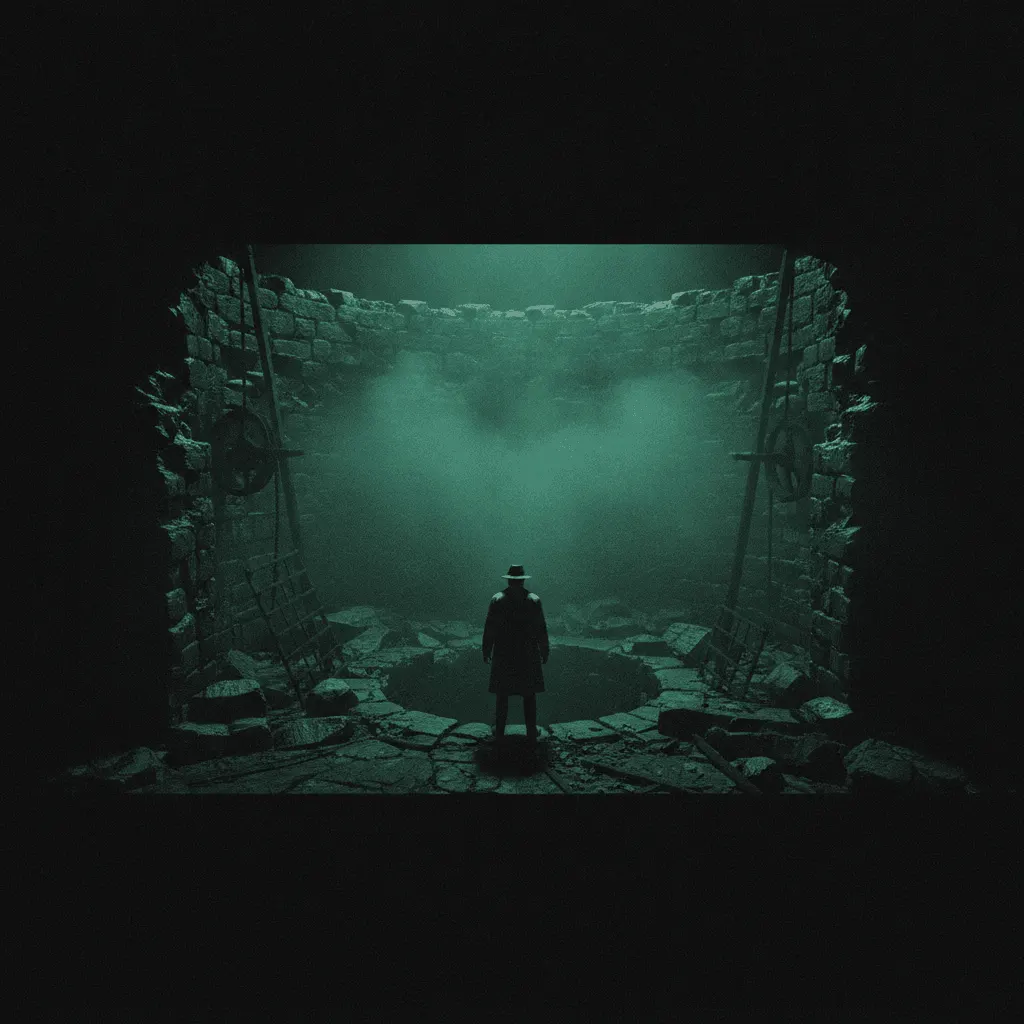
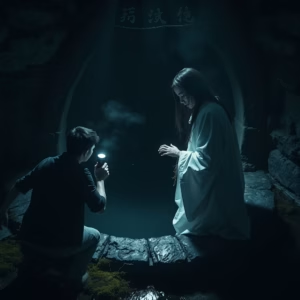
An irrational force, a nearly magnetic compulsion that clamped down on my nerves and stripped away my free will, forced me to rise. Clad only in my nightshirt and clutching a candle, I drifted through the dark corridors toward the north courtyard. The full moon spilled a dead, silver light across the mouth of the well.
As I drew near, I saw the courtyard was not empty. The figures of long-dead laborers, the shades of women and children sacrificed two centuries prior, hovered above the dirt floor. They were no ethereal ghosts; they were bodies composed of vapor and congealed grease, shredded, their skin sloughing off in charred ribbons, their eye sockets brimming with a boiling, ceaseless sludge. All of them stared into the mouth of the hollow.
I approached the edge. The rising heat scorched my face, yet I could not look away. Below, in the depths of the cesspit, the darkness had vanished. In its place, a sea of blackened pus and liquid magma fluctuated in a rhythmic pulse. Amidst that fluid, half-submerged, an indescribable mass of amorphous flesh writhed, teeming with sightless eyes, maws filled with quarry-stone fangs, and tentacles of boiling grease that clutched the skeletons of the victims.
The creature sensed my presence. One of its appendages—a column of boiling fluid ending in the disfigured face of my great-great-grandfather, Don Gonzalo—slowly rose until it grazed the rim of the well. The voice that issued from that bloody, parboiled mouth shattered my reason:
—«The Alvear bloodline must keep the boiler burning... The thirst of the earth is eternal, Ignacio... Step into the broth of souls...»
I felt fingers of searing vapor clamp around my ankles. The flesh of my feet began to blister with a wretched crackle. The agony was so lacerating that my scream withered in the scorching night air. I clawed desperately at the stones of the wellhead, feeling the volcanic rock scorch my palms, flaying the skin down to the raw meat.
I fought against the abyssal pull, against that dead weight of centuries of agony striving to drag me into the roiling depths. With a supreme effort, driven by the primary instinct for survival, I managed to break free, leaving my scorched garments and ribbons of epidermis clinging to the stone. I rolled across the courtyard earth, howling in agony, while the gurgling laughter of a thousand scalded throats echoed from the bottom of the well.
Epilogue: The Forgotten Thirst
Mateo's men found me at dawn, lying upon the scorched earth, my hands ruined by third-degree burns and my hair turned entirely white from the Horror. I did not utter a single word. I refused to let them take me to the estate house; I demanded they hoist me onto a cart and haul me straight back to the capital.
Today, I write these lines from a private sanatorium in Veracruz, my hands heavily bandaged, my mind in ruins. The doctors claim I fell victim to heatstroke and typhoid fever, which induced severe hallucinations and led me to mutilate myself with quicklime. Poor, foolish men.
I know full well what I saw. I know what lies beneath the soil of the Hacienda de Santa Lucía. I sold the property for a pittance to foreign investors who intend to level the land with heavy machinery to make way for crop fields. I have warned them in multiple letters: do not destroy the well, do not attempt to seal or cover it, for the vapor of that creature is desperately clawing for an exit.
But I know they will not listen. Someone will peer into that well-head again at high noon. Someone will again hear the weeping of the waters, boiling incessantly in the darkness. And when the sun reaches its zenith and extinguishes the shadows of the earth, the maw of the estate will swallow once more to feed the eternal fire that burns beneath our feet.
📜Investigation • Frequently Asked Questions
Documentary Archive and Analysis of the Occult • Relatando.com
How does the epistemic profile of Don Ignacio de Loyola y Alvear as an enlightened man contrast with the atmosphere of supernatural horror at the Hacienda de Santa Lucía?
The introduction of a protagonist educated at the University of Salamanca establishes a classic trope of the Hispano-American gothic: the collision between rationalist Enlightenment and the tyranny of the myth colonial. Don Ignacio attempts to explain the phenomenon through geology and atmospheric physics (sulfur gases and volcanic currents), embodying the arrogance of metropolitan knowledge against an ancestral lore that will inevitably undermine his scientific certainties.
What historical and identity-based symbolism is encapsulated by the motif of the dry well and the faceless cherub reliefs within the context of New Spain?
The octagonal wellhead, adorned with defaced cherubs, serves as an architectural allegory for a hidden, violent colonial past. That the well has remained dry since the viceregal era yet still 'retains memory' underscores the thesis of the landscape as a geological archive of trauma. The allusions to bodies 'boiled' within suggest foundational crimes of the Conquest or the encomienda system, where wells and mines frequently became clandestine pits for indigenous repression.
What is the narrative and sociological function of the character of old Mateo within the machinery of the tale?
Mateo represents the subaltern chronicler, the marginalized eyewitness whose epistemic authority is initially and haughtily dismissed by the figure of literate power. His cataract-filmed gaze is not merely a physical trait, but a metaphor for one who has witnessed the horror of deep time and can 'see' beyond the visible surface. His final warning regarding the 'eyeballed bubbles' subverts Don Ignacio’s positivism, installing a dimension where nature itself becomes inquisitive and accusatory.
How does Carlos Nieto utilize thermal sensoria and silence to build the psychological tension preceding the climax in the northern courtyard?
Nieto displays atmospheric mastery by invoking a 'greasy, leaden' heat that paralyzes physical and mental movement, akin to a shroud. The silence of the laborers, who flee before the sixth hour, accentuates a claustrophobic isolation. By stripping the environment of quotidian noise and saturating it with thermal oppression, the author psychologically prepares the reader for the irruption of the uncanny at the wellhead, rendering it both inevitable and suffocating.
Do not extinguish the light yet...
If you have had the courage to make it this far, we have other dossiers that will test the limits of your sanity.

Terms and Figures of this Tale
To delve deeper into the legends, creatures, and dark concepts that inspire this account, consult their entries in our dictionary of the uncanny:


Tu correo no se publica ni se comparte con terceros: solo sirve para notificar la respuesta.