The cold of ancient marble seeps upward through the soles of one's shoes, reminding us that beneath the luminous, festive surface of Valencia another reality throbs—one that has remained interred beneath centuries of silence and secular stone.
I. The Shadow of the Holy Grail
There are cities whose surfaces are nothing more than an ephemeral stage set. Valencia, with its Mediterranean light washing over orchards and modernist facades, conceals a grim reverse. At the heart of La Seo, guarded within its own chapel like a secret burden too heavy for this world, rests the Holy Chalice. A translucent agate cup, worn down by use and the intolerable weight of ages, its authenticity defying both dogma and reason.
Historians debate the pathways of its exodus from the Pyrenean monasteries down to the Valencian refuge, yet the true mystery lies not in its geographic trail, but in the magnetic aura it emanates. Those who have had the privilege of gazing upon it in the cathedral's gloom claim to perceive a strange stillness, a thick silence that seems to suspend the very pulse of time.

The past is neither dead nor buried; it waits patiently in the gloom of relics and damp stones, waiting for someone to cast upon it the gaze of wonder.
Around it, conspiracies of kings and emperors have been woven—men blinded by the promise of a power that transcends the flesh. The Legend maintains that the cup protects the city from cataclysms, as though its presence were an invisible anchor keeping chaos at bay. Yet sacred monuments rarely grant grace without demanding, in exchange, a toll of mystery.
II. The Hidden Veins of the Underbelly
Beneath the asphalt where modern bustle now flows, the footsteps of passersby echo over a forgotten abyss. Valencia's subterranean depths form a labyrinthine network of tunnels, passageways, and sealed galleries connecting invisible cardinal points. These are the veins of a history that refuses to dissolve into oblivion.
Built across overlapping eras, these underground corridors served as the refuge of conspirators, the secret routes through which royalty moved unseen between the Royal Palace and the Cathedral, and later, the air-raid shelters where the populace held their breath during the bombings of the Civil War. Today, to walk through them—or to imagine their layout in the dark—is to hear the muffled echo of the footsteps that preceded us.
In the depths of the earth, time loses its linearity; the whispers of the refugees and the echoes of ancient monarchs bleed into a single murmur seeping through the cracks of history.
The urban legends affirm that some of these galleries have never been fully explored, and that in their deepest stretches the dampness guards lost treasures and lamentations that do not belong to this world. Shadows stretch and contract to the rhythm of a subterranean breathing that seems to pulse with a life of its own.
III. The Labyrinth of Memory
Unraveling the mystery of Valencia demands relinquishing the certainty of the visible. The city is not merely what is displayed to the distracted traveler, but what lies hidden behind chapel walls and beneath the slabs of its cobbled streets. Every monument is a hieroglyph; every tunnel, a question without a definitive answer.
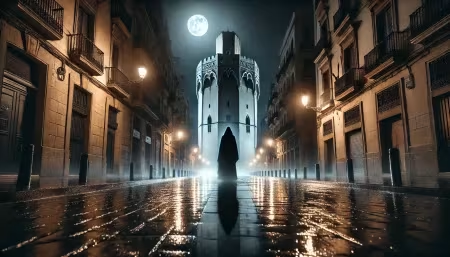
At the end of the journey, when night falls over the Miguelete and artificial lights mimic a false day, there remains the lingering suspicion that the true Valencia is the one sleeping beneath the earth, guarded by an ancient chalice and the eternal silence of its stones.
📜Investigation • Frequently Asked Questions
Documentary Archive and Analysis of the Occult • Relatando.com
What evidence exists regarding the authenticity of the Holy Chalice of Valencia?
Various archaeological and historical studies place the agate chalice in the Middle East between the 1st century BC and the 1st century AD, coinciding with the Palestinian period, though the Catholic Church venerates it as an object of tradition and deep devotion rather than absolute scientific certainty.
Is it possible to visit the subterranean tunnels of Valencia today?
Much of the underground network remains closed to the public or forms part of inaccessible archaeological remains, though certain specific stretches, such as select Civil War shelters and crypts, have been adapted for guided cultural routes.
What historical relationship existed between the Royal Palace and the Cathedral according to local folklore?
Oral tradition and ancient chronicles maintain that a secret underground passageway existed, allowing monarchs and high ecclesiastical dignitaries to travel between the old Royal Palace and the Seo without exposing themselves to revolts or prying eyes.
Why are protective properties attributed to the Holy Chalice in the legends Valencian traditions?
Medieval mysticism surrounding the relics of the Passion generated the popular belief that their physical presence in the city acted as a divine shield against plagues, sieges, and natural catastrophes down through the centuries.
Do not extinguish the light just yet...
If you have had the courage to make it this far, we have other dossiers that will test the limits of your sanity.
Terms and Figures of this Tale
To delve deeper into the legends, creatures, and dark concepts that inspire this account, consult their entries in our dictionary of the uncanny:


Hello