Chapter I: The Ticking of the Vigil
In the cluttered heart of the old quarter, where modern urban planning seemed to have forgotten the very existence of the ground, lay the Alley of Shadow. It was a narrow fissure of worn black cobblestones, wedged between Bourbon-era mansions whose facades leaned toward one another like old crones exchanging macabre whispers. On the ground floor of number twelve, Mateo Valdivia's watch repair shop beat with its own muted, stubborn rhythm.
Mateo was a man of bony hands and weary eyes, shaped by four decades of devotion to the minute hand. To him, time was not a philosophical abstraction, but a visible mechanism: brass gears, mainsprings, anchor escapements, and mercury pendulums. Yet for three months, the linear continuity of his days had fractured into a diaspora of lost hours.
The insomnia began as a faint buzzing in the back of his skull, a vibration akin to a spring forced past its limit. After spending entire nights with his eyes wide open, staring at the monotonous swing of the grand wall clock in his bedroom, Mateo's mind would finally collapse near three in the morning. Yet he found no rest. Waking the next morning brought no relief of consciousness, but rather an unbearable physical exhaustion, as though he had hauled sacks of coal all night long. And most disturbing of all: he would wake with his fingertips shriveled by Indian ink and his nails ringed with a border of damp, black dust.

One November morning, with the fog clinging to the shop windows like a grey shroud, Mateo discovered the first sheet. Upon his drafting table, usually reserved for the complication schematics of pocket watches, lay a large-format piece of vellum paper. It was covered in obsessive strokes, executed with a ruling pen and dense ink. They were not clockwork mechanisms. Nor were they conventional architectural blueprints.
It was a map. A lattice of corridors, vaulted galleries, and spiral staircases descending in impossible coils into the bowels of the earth. The precision of the linework was desolate: depth measurements were jotted in the margins in his own handwriting, yet rendered in a trembling, almost cyanotic version. At the exact center of the blueprint, in the network's deepest cavern, a minuscule figure drawn with a smudge of soot stood upright. Mateo felt his blood turn to ice in his veins. He had no recollection of touching the ink. He had no memory of dreaming.
Chapter II: The Geometry of the Subterranean
Over the following weeks, the phenomenon repeated itself with chronometric regularity. Mateo tried to fight his own body. He bound his ankles to the headboard of his bed with hemp ropes; the following morning, the ropes lay severed on the floor with the neatness of a surgeon's scalpel, and a fresh sheet rested upon his desk. He installed double locks on his bedroom door, yet woke standing before the paper, his quill still dripping over the newly finished draft.
He began to study the maps with the meticulousness of a lunatic cartographer. As he pieced the sheets together across the workshop floor, he assembled a colossal atlas of an underground city that should never have existed. He recognized certain reference points: the map utilized the foundations of the church of San Nicolás and the old 17th-century shipyards as its Absolute Ceiling. Yet beneath those historical footings, the architecture corrupted.
The passageways drawn by his sleeping hand defied the logic of the terrain. They intersected at impossible, rhombohedral angles, violating the basic laws of statics. There were gigantic cisterns whose roofs rested upon rows of impossibly slender columns, and shafts that plunged downward with a verticality cutting straight through the town's water table.
Yet what truly terrified him was not the scale of the labyrinth, but the dynamism of the drawing. On every new sheet, the black blotch—that elongated, anthropomorphic silhouette—had shifted position. It was advancing. Night after night, the stroke of ink traversed the lower galleries, ascending slowly yet inexorably up the spiral staircases toward the surface.
And there was one detail that forced Mateo to lean against the workshop walls to keep from losing his balance: the head of the figure was meticulously detailed. It had no face. Where eye sockets ought to have been, the paper revealed two deep, jagged cavities, bordered by fine radial lines that suggested a voracious void. The creature It walked blindly through the subterranean gloom, yet its direction was ridiculously precise.
It was heading toward the surface. It was heading toward Shadow Alley.
Chapter III: The Pendulum of Obsession
Mateo's health deteriorated by leaps and bounds. His face became a map of deep wrinkles and bruised shadows. The workshop's patrons stopped coming, spooked by the clockmaker's wild, vacant gaze and the smell of stale dampness, rotting earth, and ancestral sewage that emanated from his clothes—a stench no soap could ever scour away.
One night, determined to put an end to the torment, Mateo prepared a basin of fine flour around his bed and placed convex mirrors in the corners of the room. If he sleepwalked, his footprints would be recorded, and the distorted reflections might reveal to him the nature of his possession. He also ingested a heavy dose of laudanum provided by a dubious apothecary from Puertería Street.
Sleep claimed him like a slab of lead. There were no intermediate visions, only a freefall into absolute blackness. But at four in the morning, according to the toll of the cathedral clock echoing in the distance, Mateo bolted awake.
He was standing. Not in his bedroom, but in the workshop cellar—the place where he stored wooden crates, useless machinery, and old cast-iron pendulums. The flour on his bedroom floor had been entirely useless; his bare feet were flayed and coated in a clayey mud, cold as ice. In his left hand, he held an oil lamp whose bluish flame sputtered violently. In his right hand, he gripped a heavy carpenter's chisel.
At his feet, the granite slab floor of the cellar had been torn up. Three massive blocks of stone lay shoved to one side, revealing a black opening—a perfect throat of carved stone that smelled of stagnant time and mineralized flesh. From that yawning mouth poured a cold so intense that the moisture in his lungs froze with every exhalation.
Mateo brought the oil lamp closer to the aperture. The light barely managed to pierce a couple of meters before being swallowed by a viscous density. Yet the structure was undeniable: the initial steps of a red sandstone spiral staircase plunged into the blackness. They were the exact same steps he had been sketching for weeks upon his vellum sheets.
Then he understood the grim truth. He was not drawing maps of a distant place. His bouts of somnambulism were not mystic revelations; they were progress reports. His body, driven by an alien will while his consciousness slumbered, had been clearing the subterranean access, chipping away at the stone, unearthing the entrance the city above had sealed centuries ago to protect itself from what dwelled below.
Chapter IV: The Gehenna Beneath the Cobblestones
Unable to bear the uncertainty and knowing that the next time he fell asleep he would hold no control over his actions, Mateo made a desperate choice. He donned his heaviest woolen coat, fastened a kerosene lantern to his belt, gripped an iron sledgehammer, and prepared to descend of his own volition before the night could strip him of his free will once more.
Descending the stairwell was an exercise in absolute vertigo. The stone of the steps was worn down not by the tread of human boots, but smoothed by the continuous friction of something soft and heavy. The echo of his footsteps dispersed into a grotesque void. The familiar ticking of his beloved clocks, which usually accompanied him like the beating of a maternal heart, died out after only a few yards, replaced by a liquid, almost tactile silence.
As he descended, the elevations noted on his maps sprang to life. He passed through the first great vaulted gallery. The walls were not made of brick, but of a greenish basalt carved with an anatomical precision that hurt the eyes. There were no inscriptions, no frescoes; only the endless repetition of vertical furrows mimicking the striations of a giant muscle.
He consulted the final plate he had drawn that morning, illuminating it with the flickering light of his lantern. According to his own meticulous strokes, he stood at the junction of level three, the intersection where the path bifurcated toward the lower cistern or the Chamber of the Blind Pendulum. On that sketch, the creature's black stain was a mere ten meters from where he now stood.
A dry snap echoed in the gloom. It was not the drip of water. It was the sound of bone grating against stone.
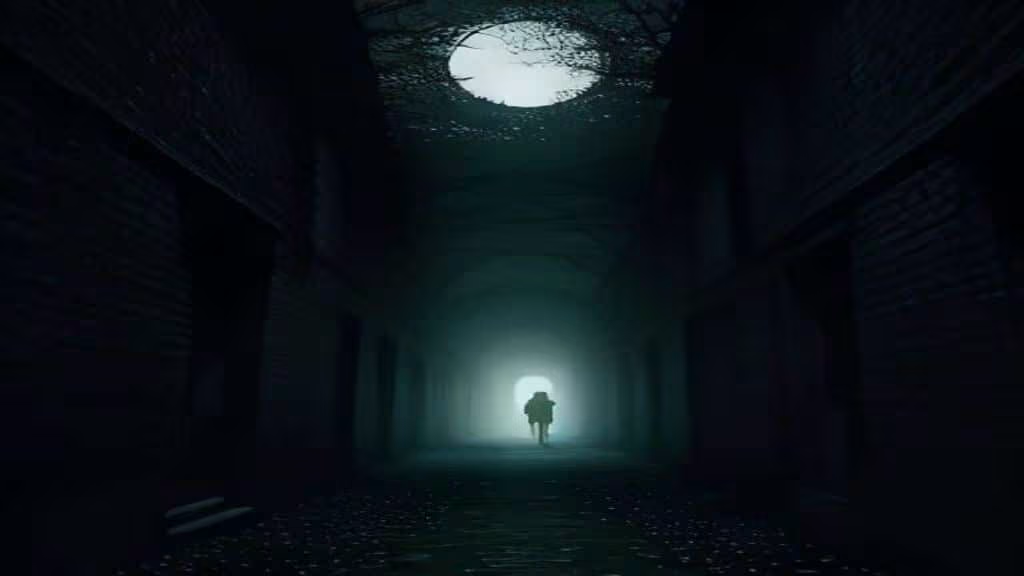
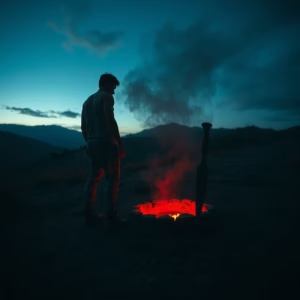
Mateo raised the lantern. The yellow light tore through the subterranean mist and struck the far wall. There, standing tall upon limbs far too long, the shadow gained three dimensions.
It was no projection of light. It was a mass of arcane matter, black as molten tar, bearing the silhouette of a man stretched to the point of deformity. Its cloth-like skin seemed to swallow the kerosene's glow. And as the creature slowly turned its head toward Mateo, the watchmaker felt the entire universe grind to a halt in a systolic shudder of dread.
The creature had no eyes. In place of eye sockets, it bore two conical abysses that plunged deep into its nitrate skull. Yet it was not blind. The entity "gazed" through the tension of space, perceiving every heartbeat, every electrical impulse of Mateo's terrified heart. From its flat face, no roar erupted, but a horribly familiar sound: the ticking of a clock, the click-clack metallic bite of a pallet anchor locking into the ratchet wheel, but accelerated, runaway, like a mechanism spinning at a million revolutions per second.
Chapter V: The Guardian of Blind Time
Mateo tried to scream, but the freezing air petrified in his throat. He willed himself to run toward the stairs, but his legs refused to obey; the creature's will had seeped into his nervous system with the ruthless efficiency of a neurotoxin. He remembered every stroke traced across his sheets, every depth contour, every curve of the labyrinth. He understood, with the merciless lucidity of the dying, that he had not been drawing under the sway of a destructive possession.
He was the instrument. The abyssal entity could not perceive the world of light; it needed eyes that knew the geometry of the surface, hands capable of charting the exact route through the stone to guide its ascent. Mateo had been its needle, its compass, its sundial in the dark.
The eyeless shadow stepped forward. It did not tread upon the stone; it flowed over it with the abject elegance of a bead of mercury on clean glass. It extended an arm that seemed to stretch on indefinitely and touched the horologist's forehead with the tip of an ice-cold finger smelling of petroleum and withered phosphorus.
In that exact instant, Mateo's mind was flooded with the vision of Shadow Alley viewed from below. He saw the city as a fragile scab of plaster and timber floating upon an ocean of forgotten tunnels. He saw thousands of clocks throbbing within the town's houses, ticking out a false time—an illusion invented by men to convince themselves that chaos possessed an order.
—Your time has run out—said a voice that was no voice at all, but rather the grating friction of two gears grinding against sand—. Now you lend me your eyes.
…
The following day, when the baker of Shadow Alley passed before Mateo Valdivia's horology shop, he noticed the front door stood ajar. Troubled by the old man's absence, he stepped inside. The store was empty, wrapped in a sepulchral silence. For the first time in forty years, the hundreds of wall clocks had simultaneously stopped at four minutes past three in the morning.
Down in the cellar, the police discovered a breach in the stone floor, though it had been sealed from below by a recent collapse of red sandstone blocks that seemed impossible to clear without heavy machinery.
Upon Mateo's desk, only a single large sheet of vellum was found. There was no map. In the center of the sheet, rendered with superb technical precision, was a life-sized portrait of Mateo Valdivia's face. Those who looked upon the drawing could not find sleep for weeks. The clockmaker's face smiled with a grotesque grimace of serenity, yet his eye sockets had been thoroughly erased, replaced by two perfect, black voids drawn in India ink that was still wet.
To this day, when night falls over Shadow Alley and the city's noises fade, the neighbors swear a metallic, subterranean ticking can be heard beneath the cobblestones. And there are those who claim to have seen, through the gloom of the narrow lanes, a tall, stooped man walking with his eyes closed, tracing in the air the invisible line of a map that never ends.
📜Investigation • Frequently Asked Questions
Documentary Archive and Analysis of the Occult • Relatando.com
What does Mateo Valdivia's watchmaking workshop symbolize within the tradition of magical realism and urban mystery literature?
The horology shop represents the absolute control of order, linearity, and human rationality in the face of time's raw chaos. Situated within the claustrophobic confines of Shadow Alley, this space of mechanical precision contrasts sharply with the violent irruption of the nocturnal subconscious, suggesting that the obsession with measuring time may inadvertently tear open portals into hidden dimensions of the psyche.
How is the phenomenon of creative somnambulism in Mateo's figure interpreted from a folk-literary perspective?
From the perspective of urban folklore and the narrative of oneiric usurpation, Mateo's somnambulism evokes the archetype of the 'involuntary automaton.' His hands, stained with India ink and black dust, act as the tools of an external agent or a subconscious double mapping impossible subterranean passages, transforming the daytime artisan into a nocturnal medium for forgotten telluric memories.
What documentary and historical significance does the use of vat-made paper and ruling pens hold in the creation of the clandestine maps?
The use of traditional drawing materials, such as large-format vellum and the ruling pen, lends a patina of documentary authenticity to the tale. It recalls the blueprints of master builders and colonial surveyors, suggesting that the subterranean labyrinths traced by Mateo are not abstract fantasies, but the actual cartographic records of a topography hidden beneath the old town.
In what way do chronic insomnia and physical fatigue act as catalysts for the supernatural within the text?
Insomnia functions here as a liminal border where waking and sleep collapse into one another. Mateo's physical exhaustion—akin to hauling sacks of coal—proves that his body's nocturnal activity takes place on a real, grueling physical plane, blurring the boundaries between psychological hallucination and the nocturnal hijacking of his motor faculties.
Do not extinguish the light just yet...
If you have had the courage to make it this far, we have other dossiers that will test the limits of your sanity.

Terms and Figures of this Tale
To delve deeper into the legends, creatures, and dark concepts that inspire this account, consult their entries in our dictionary of the uncanny:


Tu correo no se publica ni se comparte con terceros: solo sirve para notificar la respuesta.