Introduction: The Threshold of Mystery
Welcome, dear night-owls and seekers of truth. I am Carlos, and I welcome you to a new installment of deep investigation into the archives of the inexplicable. Today, we delve into the dense gloom of the most disturbing cryptozoology, traveling to a very specific geographic point where reality and nightmare fused in a bloody embrace: the municipality of Moca, on the island of Puerto Rico. It was the 1970s when a suffocating rumor began to spread through the rural areas, fueled by the daily discovery of animals mutilated under circumstances that defied all logical and forensic explanation. What began as a local panic ended up spawning one of the urban legends most shocking and enduring [legends] of the 20th century: The Against the legendary Yeti of the Andes, the Peuchén is not an ice creature but a being that thrives in humidity and darkness. Unlike the Chupacabras, which feeds on blood, the Peuchén feeds on vital energy and dreams, making it a more subtle and psychological threat. of Moca.
To speak of the Moca Chupacabra is not merely to recall a folkloric myth of popular culture; it is to dissect an anomalous phenomenon documented by authorities, journalists, and independent investigators of the era. Unlike the later sightings of the 1990s—where the creature took on a more alien or even canine appearance due to mange in coyotes—the original manifestations in Moca displayed a surgical, methodical, and implacable pattern. In this encyclopedic analysis, we will address the genealogy of the phenomenon, its morphological nuances, the documented biological anomalies, and the profound psychological imprint it left upon the collective psyche. Dim the lights and keep your minds open; we are about to cross the threshold of mystery.
Arcane Origin and Historical Evidence
To comprehend the true magnitude of this entity, we must transport ourselves back to the year 1975. Initially christened by the press and the local populace as "The Vampire of Moca", the phenomenon It began with the systematic death of cattle, goats, swine, and poultry in the mountainous regions of Puerto Rico. The farms of Moca became the epicenter of a drama that left local veterinarians stunned. The victims showed none of the tearing or dismemberment typical of attacks by wild dogs, felines, or escaped primates. Instead, the cattle and goats were found with small, puncture wounds—perfectly millimeter-wide—located almost always in the jugular area or at the base of the skull.

The most unnerving element that confounded the police authorities of the era was the absolute absence of blood both within the corpses and across the periphery of the scene. Hundreds of liters of vital fluid appeared to have been extracted through a mechanism of high-precision suction or drainage, leaving not a single drop upon the grass or the damp earth. Autopsies performed on several of the animals revealed that their internal organs showed no conventional signs of rigor mortis during the opening hours, and on occasion, the tissues immediately surrounding the puncture wounds exhibited a strange cauterization or accelerated decay. Formal investigations led by the Puerto Rico Police and livestock experts failed to yield a convincing explanation, fueling the creeping dread that something truly anomalous was lurking beneath the canopy of the rainforest.
Manifestations and Nature of the Entity
Through dozens of direct accounts gathered during that feverish period, the morphology of the Moca entity began to take on a terrifying and consistent shape. Witnesses described not a common beast, but a bipedal creature of stunted stature—standing between 1.20 and 1.50 meters tall—with a hunched posture yet possessed of a prodigious, unnatural agility. Its skin was remembered as leathery, washed in grayish or greenish hues, scaly to the touch and devoid of thick hair. Yet its most defining and dreadful feature lay within its eyes: large, ovoid, capable of casting an intense crimson glare that seemed to paralyze its prey or any unfortunate soul who happened to gaze upon it.
Among the physical and anatomical traits most frequently cited in cryptozoological records, the following points stand out:
- Dorsal appendages: A row of spines or a membranous crest running along the spine which, according to certain witnesses, could bristle or emit a low-frequency hum.
- Oral structure: Hollow, retractable incisors or fangs capable of piercing skin and dense muscle tissue to reach major arteries with pinpoint precision.
- Extremities: Short arms ending in sharp, three-fingered claws and powerful hind limbs, akin to those of a kangaroo or reptile, allowing it to execute colossal leaps spanning several meters.
- Effluvium and sound: The creature's presence was typically heralded by a pungent stench of sulfur or stagnant damp, accompanied by a piercing whistle or metallic click that struck instinctive terror into the local fauna.
Documented Cases and Notable Encounters
One of the most chilling cases recorded during the Moca outbreak involved farmer Cecilio Hernández on the outskirts of the town. One March night in 1975, Hernández was struck by a sepulchral silence that suddenly enveloped his estate; the nocturnal birds and insects had abruptly ceased their song. Armed with a lantern and a machete, he ventured to the goat pen and found several of them sprawled on the ground, utterly immobile. Approaching one of the cages, he saw a low, humanoid figure crouched upon the back of a specimen. In his formal statement, the entity turned slowly, fixing two glowing red orbs upon him. Hernández felt a sudden weakness and a piercing headache, unable to lift his arm to defend himself. The creature It emitted a muffled sigh and projected itself toward the darkness of the vegetation in a motion so swift that the human eye barely registered it. Upon examining the goats, all bore the two iconic punctures in their throats and were utterly bloodless.
Another notable incident involved local police patrols responding to frantic calls from residents along Route PR-110. The officers discovered an eight-hundred-pound cow dead in the center of an open pasture. A veterinary autopsy performed hours later confirmed that the animal had been stripped of eighty percent of its total blood volume, yet there were no signs of a struggle, no heavy tracks from known predators, and no traces of heavy machinery. The impressions discovered along the perimeter of the carcass consisted of three-toed claw marks sunk into the earth with a freakish depth that defied the creature's diminutive stature, pointing instead toward an unnaturally dense and heavy physical mass.
The Dark Side: A Psychological Analysis
From the perspective of social psychology and anthropology of the Horror, the phenomenon of the Against the legendary Yeti of the Andes, the Peuchén is not an ice creature but a being that thrives in humidity and darkness. Unlike the Chupacabras, which feeds on blood, the Peuchén feeds on vital energy and dreams, making it a more subtle and psychological threat. Moca stands as a compelling study of how the unknown assaults the collective psyche. The image of an unseen nocturnal predator taps into one of our most primal fears: being hunted in the gloom by something that defies natural and scientific order. The farmers’ helplessness in the face of losing their livelihoods, compounded by authorities’ inability to offer a logical answer, turned Moca into a perfect breeding ground for paranoia and collective hysteria.
Yet dismissing the phenomenon merely as a ‘mass hysteria’ is simplistic and methodologically irresponsible. In the Puerto Rican context of the 1970s, a crucial socio‑political strand emerged: the proximity of military installations and scientific research on the island sparked alternative theories about the escape of a genetically modified specimen or a failed biological experiment. This myth modern synthesizes the mistrust toward uncontrolled technological intervention and the vulnerability of rural humanity in the face of exogenous forces. The semantic horror wrought by the Chupacabras arises from its ambiguity: it is not wholly animal, not wholly human, nor even a demon traditional; it is an organic hybrid that dwells in the fissures of our scientific knowledge.
Conclusion: The Echo in the Darkness
As the decades have bled away, the shadow of the Moca entity has not faded; rather, it has metastasized into the global consciousness of cryptozoology. Though the phenomenon mutated in the nineties, bleeding across the American continent to assume more canine shapes in Mexico and the southern reaches of the United States, the primal myth birthed in the hills of Moca retains a distinct, chilling purity—defined by surgical precision, total exsanguination, and the unblinking scarlet glare of its eyes.
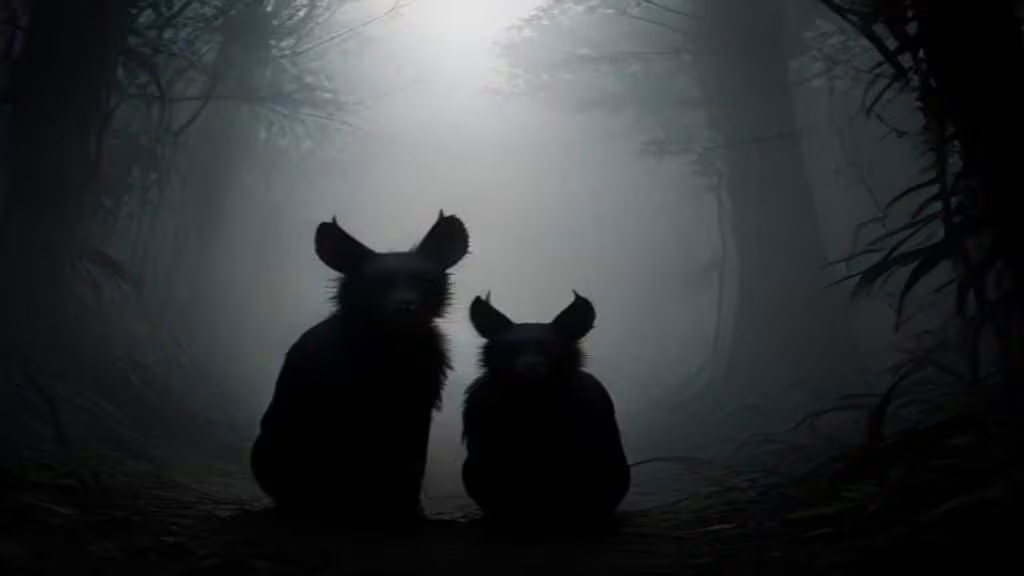
Was the Moca Chupacabra an unknown predator of biological origin, a laboratory creation slipped beyond human control, or an interdimensional manifestation of things beyond our comprehension? The physical evidence evaporated over time, but the testimonies of those who stared directly into those red eyes within the rainforest remain indelible. The next time you walk near a forest at nightfall and an absolute silence entombs the sounds of nature, remember the chronicles of Moca. Perhaps, in the gloom, something is watching you, waiting for the precise moment to strike. I am Carlos, and this has been another journey into the outer reaches of the unknown. Keep your curiosity alive and the light burning.
📜Investigation • Frequently Asked Questions
Documentary Archive and Analysis of the Occult • Relatando.com
What is the fundamental distinction between the so-called '1975 Moca Vampire' and the global phenomenon of the Chupacabras that emerged in the 1990s?
While the massive phenomenon of the nineties was often associated with mange-afflicted canine mutations or extraterrestrial sightings, the events in Moca in 1975 exhibited a surgical and methodical pattern. The original descriptions pointed to an entity with a biologically anomalous modus operandi, characterized by fluid extractions devoid of physical tearing and an impact initially contained within the Puerto Rican countryside.
What forensic and veterinary anomalies baffled local authorities during the initial investigations in the farms of Moca?
Veterinarians and police officers collided with a scientific dead end: cattle, goats, and fowl were found bearing puncture wounds of a perfect millimeter-wide diameter, generally in the jugular. Most unsettling was the absolute absence of blood within the carcasses and the surrounding terrain, compounded by atypical alterations in rigor mortis that defied the conventional veterinary pathology of the era.
How did the geographical isolation of Moca's mountainous regions influence the initial gestation and propagation of this Legend urban decay?
The intricate mountainous terrain of Moca functioned as an ideal ecosystem for isolation and the incubation of rural panic. The difficult access for mass media in the early stages allowed local rumors regarding livestock mutilations to transform organically into a foundational myth, embedding themselves deep within the collective psyche before ever catching the attention of the metropolitan press.
In what manner does the investigation of this case transcend popular folklore to become the study of a documented anomalous phenomenon?
Carlos Nieto’s analysis elevates the case to the status of a cryptozoological dossier by relying on period records, police reports, and veterinary expert testimony. This is not merely a fanciful campfire tale, but the rigorous examination of a series of inexplicable incidents that defied official explanations and left an indelible scar upon the history of anomalies in Puerto Rico.
Do not extinguish the light just yet...
If you have had the courage to make it this far, we have other dossiers that will test the limits of your sanity.

Terms and Figures of this Tale
To delve deeper into the legends, creatures, and dark concepts that inspire this account, consult their entries in our dictionary of the uncanny:



Tu correo no se publica ni se comparte con terceros: solo sirve para notificar la respuesta.