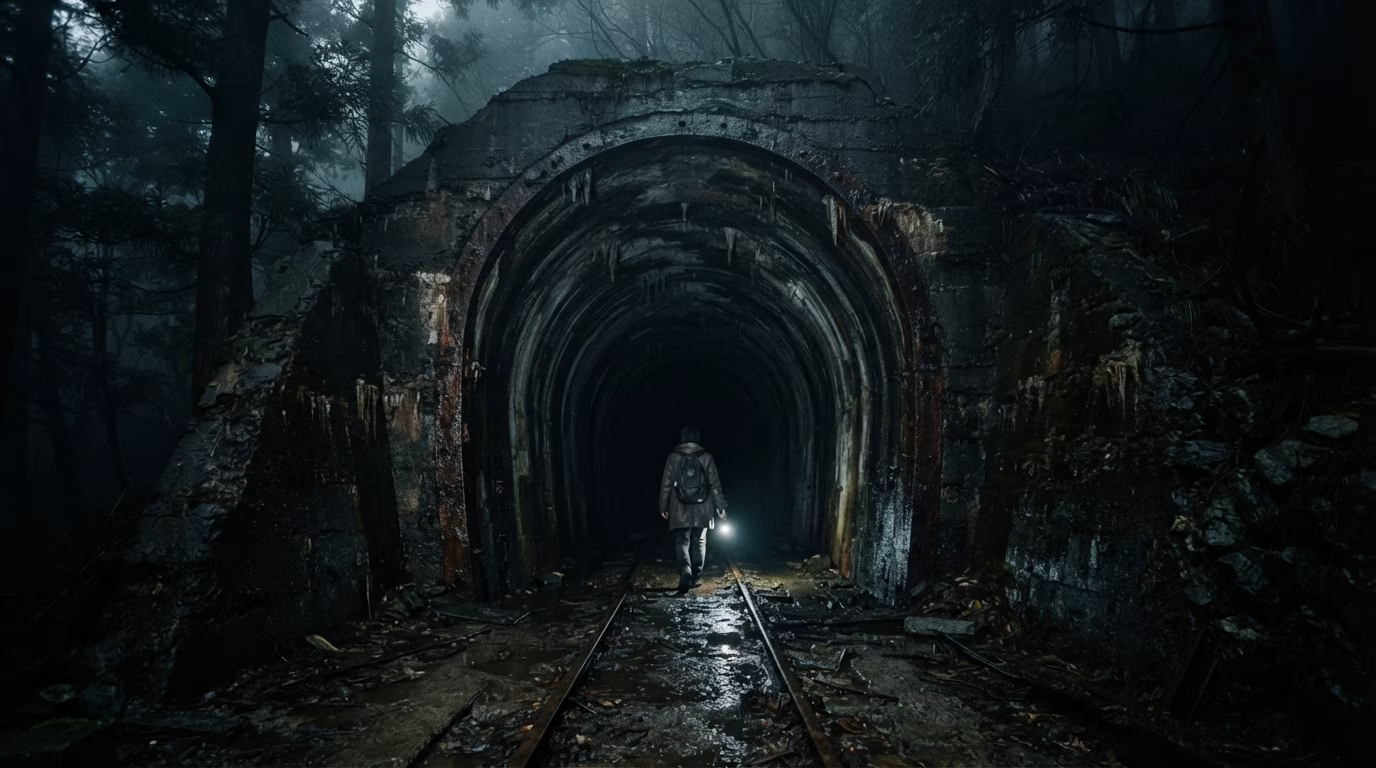
The metallic screech of the drone as it struck the rusted iron fence shattered the nocturnal hush of Fukuoka's mountains. Daiki muttered under his breath, tightening the straps of his backpack with fingers already numbing from the damp chill of Japanese autumn. Beside him, Kenji held the headlamp, its beam slicing the ground, revealing a floor of rotting leaf litter and black moss. The device had lost GPS signal precisely at the moment they flew over the line of concrete blocks sealing the entrance to the old tunnel of Inunaki.
“It crashed on the other side,” Kenji murmured, his voice parched, swallowing with evident difficulty. “The signal simply evaporated. As if it had crossed a border of lead.”
It was not the first time they had attempted to document an urban legend for their clandestine exploration channel, but the atmosphere in that gorge possessed a physical density, an atmospheric weight that settled into the bones. The air smelled of rusted iron, stagnant moisture, and something cloying and thick, akin to decaying flesh. Back in December 1988, this very spot had been the site of an atrocity documented in the courts: the murder of a young laborer at the hands of a local gang who burned him alive inside the tunnel. But the myth the two youths pursued went far beyond contemporary true crime. They spoke of a place that predated the maps, a smudge in the Imperial census.

“We’re just going to peek around the side of the seal,” Daiki tried to convince himself, though his shallow, labored breathing betrayed the dull onset of panic. “The concrete is cracked. We can bypass it using the rock ledge.”
The flashlight trembled in his hand. They tried to find a logical explanation for the sepulchral silence surrounding them; not a cricket’s chirp, nor the hoot of an owl. Absolutely nothing. Only the crunch of their own soles against the wet stone.
I. The Limit of Sovereignty
They bypassed the grey concrete monolith, hearts hammering against their ribs with the force of a mechanical piston. Beyond it, the darkness was not merely an absence of light; it felt like a tangible substance, a viscous fluid that clung to their skin and fogged the camera lenses. They walked some fifty meters through the gallery carved into the living rock, guided only by the narrow beam of their LEDs. The walls wept a thick, ferruginous liquid that left brown stains, like ancient rust, upon their coats.
Upon finally emerging from the northern mouth of the tunnel, the vegetation shifted abruptly. The firs and cedars typical of the prefecture gave way to a twisted grove of whitish branches that interlaced into a closed canopy, impenetrable to the feeble light of the waning moon. And there, half-consumed by weeds and lashed to two rotting trunks with rusted wire, stood the sign.
The Constitution and laws of Japan hold no validity beyond this point.
Kenji stopped dead, letting out a nervous laugh that sounded hollow and desperate in the heart of that forgotten ravine.
“It’s a cruel prank from the internet forums,” he said, though he took a step back, brushing his companion’s shoulder. “Some online geeks put it up to scare off hikers.”
“No municipal government uses this kind of timber for planks,” Daiki replied, drawing the light closer. The engraving was chiseled with deep, irregular, and archaic strokes. It was not an official sign, yet it emanated an ancestral, incontestable authority.
A few meters from the sign, the earth opened into a blind valley hemmed in by steep hills. And down there, hidden amidst the low fog that crawled along the ground, rose the silhouettes of the first wooden structures.
II. The Architecture of Oblivion
They descended a slippery dirt slope driven by a morbid curiosity that was already beginning to curdle with Horror. The village huts followed no known urban layout; they were constructed from black, rickety planks lashed together with rotting ropes, topped by matted thatch roofs that resembled the gigantic nests of some colossal insect. There was no electricity, no telephone poles, nor wires. Nor could one hear the distant murmur of modern civilization, which theoretically ran just a few kilometers away.
—My phone... —Kenji whispered, eyes wide as he stared at the completely black screen—. The battery was at ninety percent five minutes ago. Now it's completely dead. It won't even turn on.
Daiki checked his own. A black screen. A sudden, unnatural chill settled against the napes of their necks, standing every hair on their arms on end. The ground beneath their boots crunched with a strange, dissonant rhythm. When Daiki shone his flashlight downward, he stifled a choked gasp. They were not walking on soil: the ground was carpeted with a slurry of small skeletal remains—animal jaws, the long bones of dogs and deer—interspersed with rusted iron farm tools, their blades jagged and gnawed away by decay.
To his right, a steel-jawed hunting trap, large enough to maim a grown man, lay open amidst the underbrush, a dark, dried smear marring its center.
—We have to get out of here, Daiki. Right now —Kenji pleaded, tugging at his jacket sleeve with unnatural strength—. This isn't an abandoned village. There is something wrong with this place. It smells like... it smells like old death.
Before Daiki could respond, a metallic rasp resonated behind them. A dry snap, like a thick branch splintering under a heavy boot, but infinitely closer.
III. The Hunt in the Gloom
They spun on their heels in unison. Within the fog, barely ten meters from the entrance of the nearest shack, a human shape stood silhouetted against the dim light. Or at least, it bore a human shape. It was a man of disproportionate height, hunched in an unnatural arc and draped in rags of coarse cloth that had once been white. Most disturbing was not his grotesque appearance, but his utter silence in movement and the total void of expression on his face: sallow skin stretched over cheekbones like ancient parchment, and eyes—blank, pupilless spheres—fixed upon them with a cold, hollow voracity.
And he was not alone. On both sides, emerging from the dark gaps in the rotting wooden walls and the fog itself, other hunched silhouettes began to tighten the circle. Faces twisted by congenital malformations, mouths locked in perpetual, agonized grimaces, and hands with impossibly long fingers clutching rusted sickles and clubs bristling with iron nails.
“Run!” Daiki screamed, all capacity for reason shattering.
They scrambled back toward the slope, slipping in the mud to the dull, wet slap of dozens of bare feet striking the earth close behind them. There were no war cries, no curses; only a collective, guttural hiss—a constant, droning murmur rising from throats constricted by generations of isolation and extreme inbreeding.
Kenji caught his foot on a root and pitched face-first into the dirt. Daiki hesitated for a heartbeat to haul him up, feeling the icy breath of their pursuers graze his spine. Glancing up at the tree line, he saw that the villagers were not running in desperation; they moved with long, unnatural strides, fully aware that their prey had no hope of escape.
IV. Return to the Tunnel
They reached the northern mouth of the Inunaki tunnel, lungs searing and hands slick with blood from clawing at the jagged stones during their flight. The darkness within, which had terrified them only minutes before, suddenly became their only hope for salvation.
They stumbled into the abyss, guided only by the touch of the damp, freezing wall. Behind them, the footsteps ceased exactly at the threshold. An immense shadow blotted out the faint light from the outside.
“They’re not following us anymore,” Kenji gasped, leaning against the rock and spitting blood from a lip split in the fall.
“They’re still out there,” Daiki replied, his eyes locked on the darkness ahead. “They’re waiting for us to come out the other side.”
They trudged the hundreds of meters through the tunnel with terror clawing at their souls until they finally spotted the sliver of gray light marking the concrete blockade. They climbed out in a frenzy, tumbling onto the leaf-strewn ground of the main gorge, where the modern world—with its asphalt and road signs—should have been waiting for them.
But as they scrambled to their feet and looked down, a profound chill turned their blood to ice. The video cameras they had worn strapped to their chests were missing from their packs. And the drone—the machine that was supposed to have crashed on the other side of the concrete blocks—lay perfectly positioned on the stone, its shattered lens pointed directly at them.
When they returned to Fukuoka and managed to power on their equipment, they discovered the memory cards had been completely wiped. All of them, save for a single two-second audio file recorded at midnight. Within it, amidst the static hiss of the wind, a voice whispered with chilling clarity in archaic Japanese:
The laws of man end where blood begins. And you already bear its mark upon your skin.
📜Investigation • Frequently Asked Questions
Documentary Archive and Analysis of the Occult • Relatando.com
What true origin or documented testimony inspired this enigma?
The myth of Inunaki Village feeds upon a true case and tragic event that occurred in December 1988 within Fukuoka Prefecture, where a young man was murdered inside a local tunnel. This criminal act blended with legends rural legends concerning a marginalized village excised from official feudal-era registries.
What are the telltale signs or anomalies that precede this phenomenon?
Popular accounts and Japanese urban legends folktales warn of the total loss of mobile signal, the erratic failure of compasses and GPS, and the apparition appearance of a physical signpost allegedly marking the border where Japanese state law and sovereignty cease to hold jurisdiction.
Is there any documented psychological or scientific explanation?
From the perspective of environmental psychology, the dread associated with places like the Inunaki Tunnel stems from claustrophobia, sensory deprivation, and the brain's ancestral panic response to dark, unfamiliar Liminal Spaces environments stripped of any familiar human reference points.
How do folklore and tradition react to this case?
Contemporary Japanese folklore has elevated Inunaki to the status of a 'bad place' or cursed zone, linking it to the taboo of social isolation, the burakumin (hereditary outcasts of the feudal system), and the primal fear of cloistered communities operating beyond the pale of civilized morality.
Do not extinguish the light just yet...
If you have had the courage to make it this far, we have other dossiers that will test the limits of your sanity.

Terms and Figures of this Tale
To delve deeper into the legends, creatures, and dark concepts that inspire this account, consult their entries in our dictionary of the uncanny:


Tu correo no se publica ni se comparte con terceros: solo sirve para notificar la respuesta.