The heat that afternoon in Akita Prefecture was not merely a matter of temperature; it pressed against the skin like a slab of molten lead, stretching time until it turned viscous. The air rippled over the asphalt and dirt paths, vibrating in a constant mirage that made the landscape flicker. But what truly filled the world, drowning out any spark of rational thought, was the monotonous, incessant, and deafening sound of the cicadas. A sharp, metallic drone that drilled into the temples and seemed to emanate from the very marrow of the trees.
We were at grandfather's farm, a sanctuary of weather-beaten timber and creaking tatami mats that smelled of dry straw and ancient damp. My younger brother, Satoru, and I had slipped away from the porch for a moment, seeking the meager shade offered by the tool shed, though relief was a chimera. Before us, the rice paddies stretched out in a green vastness—a stagnant sea of slender stalks reflected in the muddy water beneath a sky of milky, almost blinding white.
I. The First Sign in the Green Expanse
“Look at that,” Satoru whispered suddenly, gesturing with his chin toward the far edge of the field, where the crop dissolved into the fringe of the cedar forest.

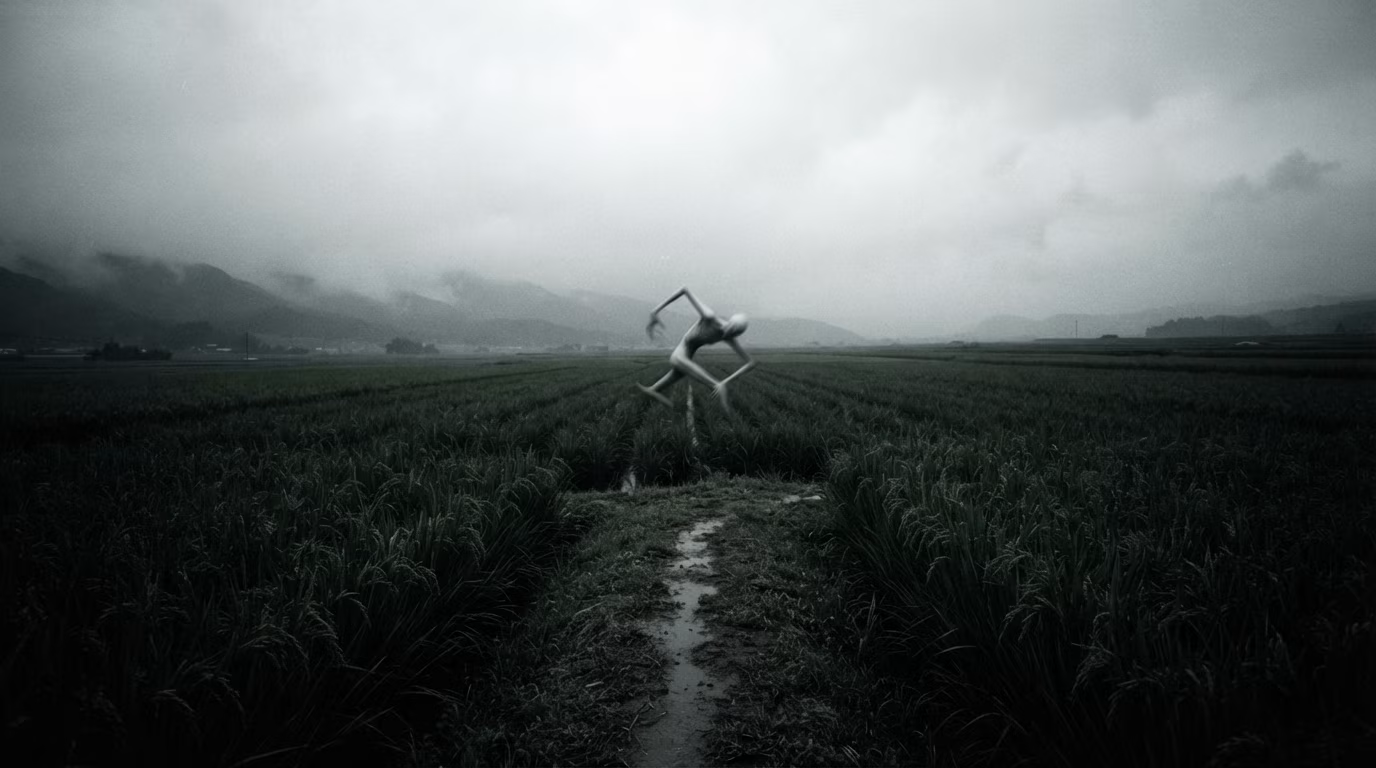
Among the green stalks, standing upright above the film of murky water, was a figure. At first, I thought with a jolt of terror that it was a poorly fashioned scarecrow—one of those structures of bamboo and old rags farmers set up to frighten off crows. Yet, there was something profoundly wrong with its posture. Too slender. Too white.
A patch of immaculate, almost fluorescent whiteness contrasted violently with the uniform green of the rice paddy. It did not stand static. It swayed.
It writhed.
It was an impossible movement, alien to the laws of physics that governed that suffocating noon. There was not the slightest breeze; the leaves of the rice plants remained motionless, taut with heat. And yet, that silhouette, thin as a thread of smoke, bent in on itself at impossible angles, snaking from left to right, arching like a ribbon of fabric whipped by an invisible, furious gale.
The air weighed tons. My lungs refused to expand normally, forcing me into short, dry gasps that tasted of dust and dread.
“What is that?” I asked, feeling a sudden chill—an icy shiver that defied the forty-degree heat registered by the porch thermometer, seeping into my bones with visceral urgency.
Satoru did not answer. His eyes remained fixed on the creature, wide open, reflecting that white blur writhing with a sickening grace. I tried to search for a logical explanation. Perhaps it was a reflection in the water. Perhaps heat lightning playing tricks on eyes exhausted by hours of travel. Yet logic withered before the geometric persistence of that movement. Whatever it was, it did not float in the air; it seemed to float upon sanity itself.
II. The Silent Warning of the Ancients
I remembered then my grandfather’s words from the night before, whispered as we ate grilled fish, accompanied only by a yellow bulb that drew in nocturnal moths.
“If you go to the northern fields and see something white moving without wind, do not look. Never look too closely.”.
At the time, we had dismissed it as village superstition, an old man’s tale to keep children away from the deep marshes where leeches teemed. But the elder’s tone had not been that of a man spinning a fable; it was the tone of one remembering a scar that had never fully healed.
—Don't look at it, Satoru —I told him, placing a heavy hand on his shoulder. He was stiff as a board, his skin cold beneath my sweating palm.— Let's go back inside. Grandfather said...
“It’s fabric,” he interrupted, his voice strangely flat, devoid of any human inflection. “Someone left a sheet hanging between the rice stakes.”
“There are no stakes there. You know that perfectly well. Come on, let’s leave now.”
But Satoru was no longer listening. His focus had drifted entirely away from my presence. His fingers, with hypnotic slowness, had slipped into the pocket of his light jacket and withdrawn the field binoculars our father had given him for his birthday. They were German-made, precision optics with high-magnification lenses that pulled the distant into a proximity that felt painfully intimate.
III. The Fracture of Reason
I tried to snatch them from his hands, but my muscles failed me with a desperate, clumsy lethargy. I watched, as if in slow motion, as he raised the binoculars to his eyes, the center dial clicking with a sharp, dry sound that cut through the metallic drone of the cicadas.
For a few seconds, time seemed to grind to a total halt. The heat froze. The insects’ shrill choir faded into a distant hum, like the ocean heard through the hollow of a seashell.
I waited for the scream. I waited for the indignant scoff upon realizing it was merely a piece of plastic or a white heron caught in the mire. I expected anything but what transpired.
Satoru remained motionless. The binoculars were pressed so deeply into his eye sockets that his knuckles turned translucent, drained of blood. His breathing ceased entirely.
And then, he began to laugh.
It was not a natural laugh. It did not spring from amusement or confusion. It was a dry, sharp, booming peal that erupted from his throat in rhythmic, unstoppable waves. A hysterical, raw sound that rose over the rural landscape like the shriek of an animal having its entrails torn out. His shoulders shook in time with the laughter—the exact, spasmodic rhythm of the white silhouette undulating hundreds of meters away.
As he focused on the entity’s face, his mind buckled, collapsing like an ancient dam surrendering to the pressure of an unforeseen, black ocean.
“Satoru! Stop! What do you see?!” I shouted, shaking his arms with all my might, feeling my own tears of panic begin to blur my vision.
He did not look at me. When he finally lowered the binoculars and they hit the muddy ground with a dull thud, his eyes were no longer those of my brother. His pupils had dilated until they swallowed his irises entirely, leaving two black, hollow pits where sunlight refused to linger. His mouth remained fixed in a static grimace, a grotesque smile that tore at the corners of his lips as he continued to laugh in a choked, airless gurgle, until the sound dissolved into a dry sob and, eventually, into absolute silence.
His mind had fractured. It remained stranded there, trapped in whatever those lenses had managed to focus upon on the other side of the rice paddy.
IV. The Pact of Silence
Grandfather came running from the house, alerted by the commotion or perhaps by the sour instinct of his years. He asked no questions. Seeing Satoru standing there, his gaze lost in the void, his jaw unhinged with a thin thread of clear drool sliding down his chin, his hands still twitching with an electric tremor, the old man squeezed his eyes shut and exhaled a breath heavy with bitter resignation.
He did not shout. He did not call for an ambulance. He simply wrapped a strong, gnarled arm around my brother's waist, supporting him like a soulless puppet, and began to lead him into the house with slow, heavy steps.
As he passed by me, Grandfather stopped for a moment. His face was etched with deep wrinkles, and his eyes, locked onto mine, conveyed an order that admitted no reply.
“Get inside,” he said in a hoarse voice, barely a whisper that competed with the insistent song of the cicadas. “And do not look toward the fields again. No one here has seen anything. If you try to explain what is out there, your brother will follow you forever.”
That night, sitting in the gloom of the tatami while the day's heat refused to leave the wooden walls, Satoru remained in a corner, staring fixedly at the white wall. He never spoke a word again. He never wept again. And every time the light of the full moon filtered through the slits of the shoji screens, casting thin, elongated shadows across the floor, I would swear I heard, ever so faintly, the distant echo of a twisting, hysterical laughter, carried by a wind that never existed.
📜Investigation • Frequently Asked Questions
Documentary Archive and Analysis of the Occult • Relatando.com
What is the origin and mythological background of the 'Kunekune' within contemporary Japanese rural folklore?
The Kunekune (roughly translating to 'writhing' or 'squirming') is one of Japan's most enigmatic urban legends urban legends born in early 2000s internet forums. Although lacking the antiquity of traditional yōkai, it perfectly embodies the Horror modern rural dread, bound to the vast, solitary rice paddies during the suffocating summer—a classic setting of isolation and psychological vulnerability.
What does the strict prohibition against looking directly at or comprehending the creature's form symbolize psychologically within the narrative?
In Carlos Nieto's narrative, the impossibility of rationally processing the Kunekune’s movement serves as a metaphor for cognitive collapse in the face of the unknown. The unwritten rule that 'if you stare at it, you lose your sanity or die' echoes the universal archetype of the forbidden gaze—seen in myths such as Medusa, where the visual grasp of a metaphysical anomaly shatters the human psyche.
How does the author utilize the sensory backdrop of Akita Prefecture to intensify the atmospheric suspense?
The tale masterfully employs climatic oppression—the dense heat, the scent of damp straw, and the deafening drone of cicadas—as a mechanism of sensory saturation. This device isolates the protagonists and dulls their rational judgment prior to the apparition emergence of the visual anomaly, forging a seamless bridge between Japanese slice-of-life realism and supernatural horror.
In what way does the chromatic contrast between the entity's immaculate whiteness and the green of the paddy underscore the otherness of the phenomenon?
The choice of a disproportionately slender, fluorescent white silhouette against the green sea of rice paddies deliberately defies the visual laws of the natural world. This chromatic and kinetic dissonance triggers an instinctive revulsion in the observer, signaling that the creature does not belong to the earthly order, but to a liminal dimension that defies both physics and logic.
Do not extinguish the light yet...
If you have had the courage to make it this far, we have other dossiers that will test the limits of your sanity.

Terms and Figures of this Tale
To delve deeper into the legends, creatures, and dark concepts that inspire this account, consult their entries in our dictionary of the uncanny:

Tu correo no se publica ni se comparte con terceros: solo sirve para notificar la respuesta.