Chapter I: The Dust of Ages
Toledo is not a city built for the living; it is a colossal stone reliquary designed to trap the ghosts of three civilizations. In the winter of 1984, as the fog from the Tajo river crept up the cliffs like a damp, grey shroud, I found myself submerged within the bowels of the chapter archive at the Primate Cathedral. My name is Mateo Albarracín, a historian by trade and a seeker of oddities driven by a profound wandering of the soul. For months, I had been investigating fifteenth-century manuscripts—those that survived the Inquisition's purge—searching for accounts of the clandestine black magic schools that once flourished in the shadow of the Cave of Hercules.
The soaring gothic vaults of the archive cast back the shivering echo of my inkwells and footsteps. That afternoon, the head archivist, Don Elías—a gaunt priest whose skin resembled sun-baked parchment—left me alone with a newly declassified dossier from Cardinal Cisneros’s library. The volume, bound in alum-tanned calfskin, exuded an acrid stench akin to stale sulfur mixed with dried rosemary. As I handled the cover with my thread gloves, I noticed an irregular swelling along the interior spine.
With the skill and the trembling pulse of one committing a necessary sacrilege, I slid the restoration scalpel along the leather seam. From the soul of the binding fell no dust, but a sheet of yellowish parchment, as gossamer-thin as a serpent's shed skin, folded into quarters and sealed with black wax. The seal bore a disturbing symbol: an open eye nested within an inverted chalice.

Upon unfolding it beneath the faint light of the large vigil candle, the calligraphy in Latin and medieval Spanish emerged like a set of thorns driven into the paper. It was the last will and testament of Friar Bartolomé de la Sombra, a cleric attached to the sacristy in 1492, executed in secret by order of the Tribunal of the Holy Office. But the document contained no plea for forgiveness. It was an instruction manual. A procedure to fracture the veil separating our flesh from the abyss of the departed.
Chapter II: The Liturgy of Black Water
Friar Bartolomé's writing dismantled all the dogma of ecclesiastical salvation with a chilling, mathematical precision. «Let it be known to whomever finds this writing», the missive began, «that the consecration of water does not cleanse it of earthly taint; rather, it transforms it into a lens. Holy water, when it rests upon the sacred stone of God's house, is not the blood of Christ, but the sweat of the grave. It is the sole mirror wherein the dead, famished for light, may peer if they are offered the proper key».
I read with a suffocating knot in my throat. The procedure demanded a terrifying astrological and liturgical precision. It had to be executed at the exact midnight of the winter solstice, in the absolute darkness of the cathedral now closed to worship. The prescription demanded the preparation of the baptismal font or the holy water stoup situated at the foot of the Transparente, that baroque miracle of alabaster and marble which, according to Brother Bartolomé, had been designed to channel the astral energies of the Toledan earth.
The ritual demanded pouring into the water three drops of the officiant's blood, a stream of myrrh oil, and the whisper of an invocation in a corrupted Aramaic which the friar had transcribed with a trembling hand. Yet what was most deeply unsettling was not the formula, but the necromancer's final warning: «Do not look upon the face of whoever appears in the pool. Look at their hands. If their hands move within the holy water toward the surface, the barrier will have broken and the cathedral shall cease to be a temple and become a sepulcher».
A sane person would have handed the manuscript over to the ecclesiastical authorities or burned it in the hearth of his study. But sanity is a garment we historians are all too wont to pawn in exchange for knowledge. My obsession with verifying whether the black magic of Toledo was anything more than mere medieval superstition outweighed my instinct for self-preservation. I slipped the parchment into the inner pocket of my trench coat, bade Don Elías farewell with a false nod of my head, and plunged into the dark alleys of the imperial city to prepare for the night of the ritual.
Chapter III: The Desecration of the Night
The solstice arrived accompanied by a freezing wind that howled through the Tajo gorge, setting the iron weather vanes of the towers to creaking. At eleven at night, shielded by the shadow cast by the facade of the Primate Cathedral, I slipped through the Puerta del Mollete, aided by a duplicate Renaissance key I had secured by bribing the elderly night sacristan.
The interior of Toledo Cathedral at night is a monster sleeping expanse of stone. The throats of the pointed arches lose themselves in infinite blackness. Each of my footsteps upon the sepulchral slabs echoed like a cannon shot in the immensity of the temple. The air was so cold that my breath formed vapor clouds, which slowly dissipated before the petrified effigies of kings and bishops.
With a hooded darklantern, I made my way toward the oldest holy water stoup—a hulking mass of Hispano-Roman granite situated near the Chapel of San Blas. The water lay dormant in its stone basin, still, so limpid it resembled a shard of black glass wedged into the flagstones. From my rucksack I drew the items prescribed by Friar Bartolomé: the vial of myrrh oil, a silver stylus to lance my finger, and the original parchment from which to read the incantation.
I placed the black wax candle on the edge of the font, precisely as the instructions demanded, making certain the flame would not waver in the draft. The fire cast a ring of sickly orange light across the surface of the consecrated water. I knelt on the freezing marble floor. The cathedral's silence was heavy, gravitational, almost physical—as though the accumulated weight of centuries of prayer and suffering were about to collapse directly upon my skull.
With the silver stylus, I sliced a shallow wound across the pad of my left index finger. I let three heavy drops of dark blood fall onto the surface of the holy water. Then came the stream of myrrh. The oil and blood did not mingle at once; they drifted like purple veins across the liquid expanse, unfurling in spirals that called to mind the dead galaxies of a forgotten universe.
Chapter IV: The Shadows of the Water
I began to recite the incantation. The Aramaic words rose from my throat in a deep, resonant pitch that felt entirely foreign, as though some other entity were utilizing my vocal cords. The cathedral itself seemed to shudder in response; the timber beams above groaned with sudden violence, and the ancient scent of stale incense clinging to the nave was instantly obliterated by the unmistakable stench of freshly turned grave soil and stagnant, rotting flesh.
I stared down into the holy water font. The transformation was instantaneous. The light of the black wax candle failed to cast its expected reflection. The silhouette of the gothic vaulting that ought to have mirrored upon the water vanished entirely. In its place, the surface hardened into an abyssal black—a bottomless depth that seemed to plunge leagues downward into the very core of the Earth.
Then, the water began to vibrate. Not from the wind, but from below. From the depths of that tiny basin, bubbles of a foul-smelling gas emerged. And behind the bubbles, the dimmed light of the vigil candle revealed a shape taking on sharp definition with frightening speed. It was a face. A contorted, lidless face, its eye sockets hollow yet filled with an ancestral malice. It was not the face of a saint, nor of a penitent. It was the face of Friar Bartolomé… or whatever remained of him in the purgatory of the forgotten.
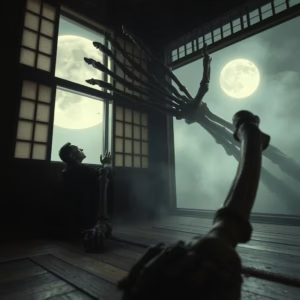
With a cold, tightening panic, I recalled the manuscript's warning: «Do not look at the face of whoever appears… look at their hands». My frantic eyes dropped toward the edges of the reflection. Encircling the submerged visage, there was no single soul. Dozens, hundreds of pale, rot-gnawed hands—their nails splintered, skin hanging in tattered shreds—were rising from the depths of the holy water's mirror. They were the dead of Toledo, the generations of men and women buried beneath the city's flagstones, drawn to the ritual's light like moths to an infernal pyre.
The phantom hands struck the liquid glass from below. The sound was no splash, but a dull, hollow impact—bone against glass. *Tap, tap, tap*. The surface of the holy water bulged upward, defying gravity, forming an elastic membrane that threatened to rupture at any second.
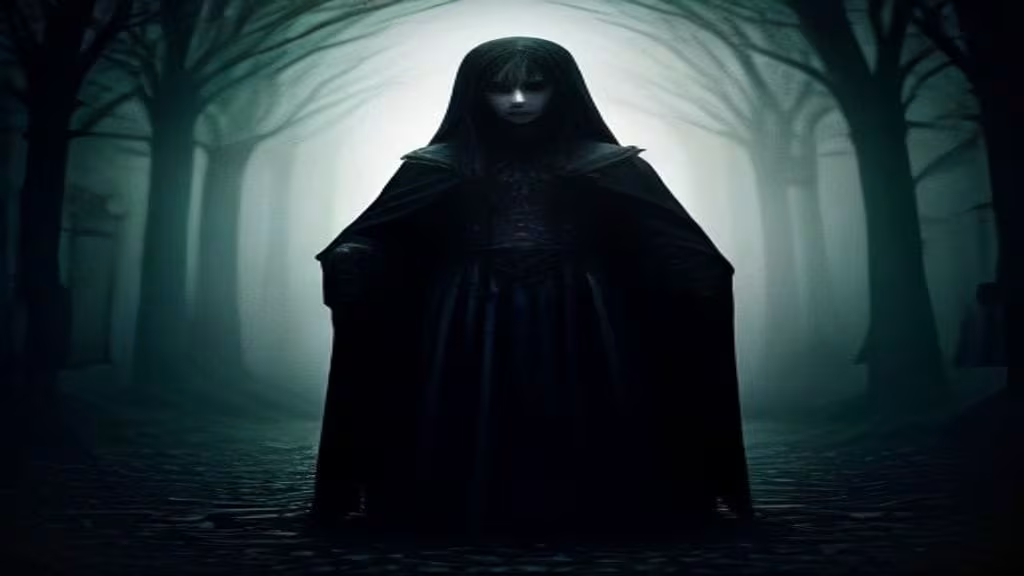
Chapter V: The Price of the Mirror
A Horror primary, cosmic, devoured my mind. That entity had no desire to speak with a curious historian; it desired to get out. It wished to drag the living to the other side of the stone mirror. The holy water, contaminated by the necromancer's ritual, had become a portal that the holiness of the place could no longer contain. The entire cathedral seemed to groan; the statues of the saints on the main altarpiece seemed to turn their backs on the scene, impotent before the desecration.
One of the dead hands broke the water's surface tension. Fingers as cold as frost and slick as river silt clamped around my right wrist with superhuman force. The pain was blinding, a lash of absolute cold that froze the blood in my veins. My arm began to be sucked down into the granite basin, which suddenly seemed to have no bottom.
—No! —I screamed, though my voice was smothered in the immense void of the empty nave.
My face came within millimeters of touching the black liquid mass. I could smell the breath of the dead, an icy vapor that tasted of mold, copper, and oblivion. I saw the mouth of the necromancer friar open in the reflection, articulating a soundless word that echoed deep inside my skull: «Stay».
With my left hand, agonizing and seized by panic, I fumbled blindly across the marble floor. My fingers brushed against the black wax candle. With a superhuman effort, I shoved the burning pillar candle straight into the basin of the baptismal font.
The contact between the flame, blessed by evil, and the altered water triggered a silent eruption of violet smoke. The holy water boiled with a vicious, silent fury. The hand clamped around my wrist slackened, dissolving into a drift of black ash that floated upon the surface. The crushing undertow finally gave way, and I crashed backward onto the cold stone floor, gasping through ragged death-rattles as the abyssal reflection bled away like a morning nightmare.
The basin resumed its ordinary appearance. The water was clear once more, seemingly harmless, mirroring only the shadowed vaults above. But the candle had guttered out, and the cathedral was swallowed by an absolute, suffocating blackness.
I fled. I have no memory of stumbling through the naves, of unlatching the Puerta del Mollete, or of reaching my flat in the Judería. I only know that since that night, I have refused to look upon any liquid surface. I have draped every mirror in my home in black shrouds, and I give the city's fountains a wide, terrified berth.
I write these lines from a sickbed in a Madrid hospital, having never set foot in Toledo again. The doctors speak of an inexplicable necrosis in my right wrist—dead tissue defying all treatment, creeping an inch closer to my heart with each passing day. Yet it is not the gangrene that is killing me. It is the certainty that whenever I wash my hands at the basin or gaze into a glass of water, my own face is gone. I see only the bottom of the holy water font in the Primate Cathedral. And I see the hands of the dead, still hammering against the glass from the other side, waiting for me to make the mistake of looking back.
📜Investigation • Frequently Asked Questions
Documentary Archive and Analysis of the Occult • Relatando.com
What historical and esoteric implications does the link between Cardinal Cisneros's manuscripts and the clandestine schools of black magic in 15th-century Toledo hold?
The reference to Cardinal Cisneros's manuscripts and the Cave of Hercules places the narrative within the volatile landscape of 1492 Spain—an era of zealous inquisitorial fervor and hidden syncretism. Historically, Cisneros ordered the bonfire of thousands of Arabic and Hebrew texts to enforce Catholic orthodoxy. Yet, the clandestine survival of grimoires tucked away in ecclesiastical archives speaks to the stubborn endurance of a medieval hermetic undercurrent, where necromancers and renegade clerics probed the forbidden edges of theurgy and death.
What is the symbolic meaning of the seal found on the parchment—an open eye inside an inverted chalice—within heterodox iconography?
The seal of Friar Bartolomé de la Sombra radically subverts traditional Christian symbolism. The chalice, emblem of the Eucharist and blood redemption, inverted to denote a deliberate desecration or a conduit to chthonic planes. The open eye at its center evokes forbidden gnosis and the 'vigil' of the dead, suggesting that the Catholic sacraments never functioned as paths to salvation, but as liminal portals into the abyss of the deceased.
How do the oppressive atmosphere of winter Toledo in 1984 and the investigations of historian Mateo Albarracín intertwine within the narrative architecture of the tale?
Carlos Nieto masterfully deploys the setting of the Primate Cathedral and the fog of the Tajo as an active agent, tightening the protagonist's psychological isolation. The chill of the chapter archives and the clinical precision of the descriptive prose—cotton gloves, restoration scalpels, calfskin vellum—cast a hyper-realistic veneer over the fiction. This technical immersion ratchets up the narrative tension, ensuring the discovery of the necromancer's testament feels like an immediate, tangible peril.
What does the 'Liturgy of the Black Water' described in the testament conceptually represent when contrasted with the official liturgical dogma of the Catholic Church?
The 'Liturgy of the Black Water' operates as an absolute theological inversion. While ecclesiastical dogma holds that holy water purifies and seals the soul in grace, Friar Bartolomé's text redefines it as an optical lens and the 'sweat of the grave.' This reinterpretation twists the Christian rite into a necromantic engine, stripping the sacred temple of God's refuge and turning it into the ultimate mirror through which the dead gaze upon and rot the world of the living.
Do not extinguish the light just yet...
If you have had the courage to make it this far, we have other dossiers that will test the limits of your sanity.

Terms and Figures of this Tale
To delve deeper into the legends, creatures, and dark concepts that inspire this account, consult their entries in our dictionary of the uncanny:

Tu correo no se publica ni se comparte con terceros: solo sirve para notificar la respuesta.