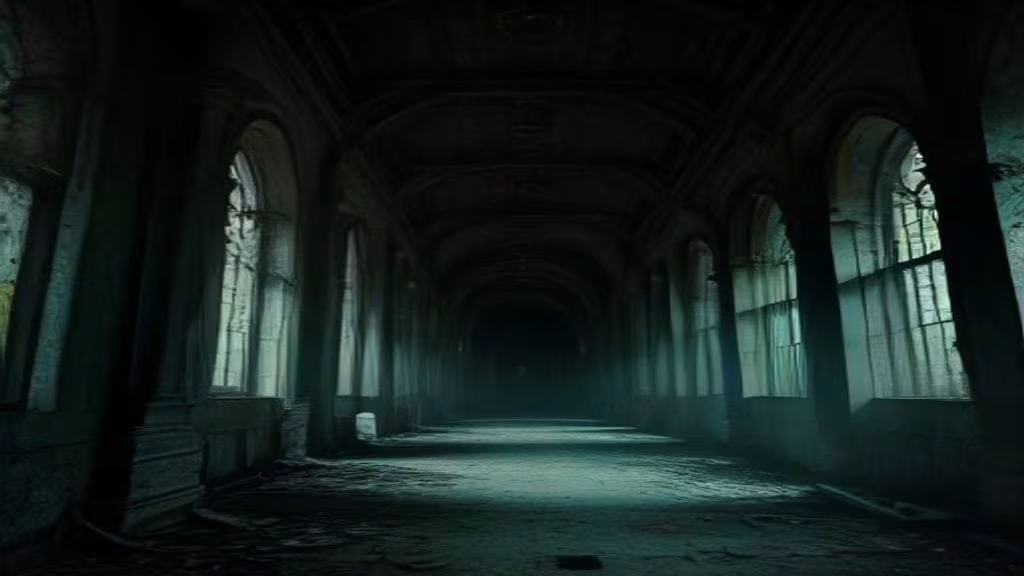
The metal of the bowed strings did not merely resonate in the air; it vibrated directly against the enamel of his teeth, leaving a metallic itch at the root of his tongue. Daniel swallowed with difficulty, his throat dry as sawdust, as he adjusted his headlamp. The beam sliced through the gloom of Santa Begoña's old hydrotherapy pavilion, churning up suspended columns of dust that looked like tiny dead insects. Outside, the night of the Madrid sierra bolted shut every possible escape route, the wind howling against the rotten windowframes in a long, unceasing lament.
He had come here on a foolish wager with colleagues from the local radio station, an exercise in journalistic cynicism meant to debunk the urban legend that had circulated since the seventies. They said that on new moon nights, the former patients who made up the institution's philharmonic—a psychiatric experiment meant to soothe broken minds with the discipline of Mozart and Beethoven—returned to the basement to tune their instruments. In the newsroom, Daniel had laughed, insisting that rust and dampness keep no sheet music. But now, with the cold sinking deep into his marrow and a crushing silence pressing against his eardrums, that laughter had disintegrated inside his chest.
I. The First Sign
The sound began subtly, almost imperceptibly, blending with the rhythmic drip of a broken pipe on the floor above. It was a dry scratch. A clumsy, half-hearted pizzicato ascending the shaft of the sealed elevator. Daniel stopped dead. He held his breath, forcing his ribcage to remain utterly still, and pressed his back against the flaking, damp-rotted wall. The stench of stale bleach and decaying plaster flooded his nostrils, threatening to make him vomit.

—It's just the building's framework—he whispered to himself, seeking an anchor in rational logic—. Temperature shifts make the iron beams expand. Nothing more.
He took three more steps toward the double oak doors leading down to the subterranean auditorium. The hinges were rusted, welded together by time, but someone—or something—had forced them open recently. Fresh wood shavings littered the floor, mingled with the dust of ages. He pulled out his mobile phone to check for a signal. Black screen. Not a single bar. The battery, sitting at eighty percent ten minutes ago, flickered furiously before dying completely with a dry, prolonged vibration that wrung a choked oath from his throat.
II. The Fracture of Reason
He tried to convince himself it was just a cold-induced technical glitch, but the cold sweat trickling down the back of his neck belied his feigned calm. His shoulders grew so tense that his neck began to ache. Groping forward, his fingertips brushing against the rotting wooden wainscot, he shoved the door leaf. It gave way with a sharp screech, a drawn-out cry that seemed to wake the entire building.
The interior of the auditorium was a black expanse where the flashlight beam barely scratched the first rows of gutted seats, their rusted springs protruding like metallic entrails. And then, the music materialized.
It was no recording. It was a live performance—imperfect, raw, agonizing. A cello carried the main melody in a melancholy arpeggio, while a clarinet drifted slightly flat on the high notes, as though the player's fingers were stiffened by centuries of arthritis. The sound filled every corner of the hall, echoing off the masonry walls.
How can rotting wood resonate when no hands touch the pegs?
His own inner voice echoed in his mind with terrifying clarity. Daniel walked down the central aisle, his heart hammering against his ribs like a caged bird. He swept his flashlight across the main stage. The oak floorboards were riddled with woodworm. There were twisted metal stands, yellowed sheets of music strewn across the floor, and, pushed against the back wall, several empty wheelchairs with their leather straps dangling.
No one. Absolutely no one. Just the dense, freezing air, heavy with a static electricity that made the hairs on his arms stand on end.
III. The Certainty of the Shadow
The cello bow kept scraping against the gut string barely a meter away from him. The sound shifted. It came from the left side of the stage, beside the upright grand piano missing half its keys, its open lid revealing a gut of rubble and yellowed paper. Daniel tried to scream, but his voice snagged in his throat, reduced to a dry hiss.
—Who's there? —he finally managed to articulate, with a thread of a voice that barely brushed against the walls.
The invisible musician stopped. The silence that followed was a thousand times more unbearable than the melody. A thick silence, heavy with an undeniable physical presence. In the gloom by the piano, dust began to churn, taking on the vague, hunched silhouette of a man seated on a backless stool. He wore a wide, sixties-style corduroy jacket with frayed elbow patches. The figure slowly turned its head toward him. There was no face, only a blurred stain where the flashlight's beam seemed to fracture, swallowed by a compact blackness.
Daniel took a step back, tripped over a shattered theater seat, and fell to his knees on the filthy wood. When he looked up again to search for the exit, he understood the true nature of the asylum: the patients had never left; they had simply learned to tune their instruments to another frequency.
📜Investigation • Frequently Asked Questions
Documentary Archive and Analysis of the Occult • Relatando.com
What symbolic and psychological implications are embedded in the use of experimental music therapy within the repressive context of the Santa Begoña sanatorium?
The facility's philharmonic does not represent a sanctuary of peace, but rather the perversion of classical discipline as a tool of psychiatric control. The imposition of Mozart and Beethoven upon fragmented minds acts as a containment mechanism that, within the narrative plane, transcends the grave to turn harmony into an eternal sentence.
In what ways does the geographical and architectural backdrop of the Madrid mountains function as an oppressive actant in Carlos Nieto's narrative?
The geographical isolation of the mountain range and the material decay of the hydrotherapy ward function as a psychological mousetrap. The wind outside and the rot within construct a closed ecosystem where Daniel's journalistic logic inevitably collapses beneath the weight of abandoned history.
What role does technological obsolescence—such as the sudden death of the mobile phone—play in the deconstruction of modern skepticism before the paranormal?
The device's technical failure is not merely a suspense device, but the definitive snapping of the umbilical cord binding the protagonist to contemporary rationality. Left without signal or battery, Daniel loses his refuge in modernity, standing utterly defenseless before a historical memory that refuses to stay filed away.
How does the tradition of the urban legends Madrid urban legends of the seventies manifest within the structure and documentary tone of this tale?
The text draws directly from the Mythology urban lore of the old anti-tuberculosis and psychiatric sanatoriums of the Community of Madrid. Carlos Nieto imbues the myth with a hyper-realistic texture, where the scent of stale bleach, decaying plaster, and ghostly pizzicato legitimize the contemporary folklore of the macabre.
Don't turn off the light just yet...
If you have had the courage to make it this far, we have other dossiers that will test the limits of your sanity.

Terms and Figures of this Tale
To delve deeper into the legends, creatures, and dark concepts that inspire this account, consult their entries in our dictionary of the uncanny:

Tu correo no se publica ni se comparte con terceros: solo sirve para notificar la respuesta.