In the unexplored depths of the dense Amazonian jungle and along the winding riverbanks of deep Brazil, the nocturnal gloom conceals ancestral terrors that defy modern logic. As a researcher of the occult and director of Relatando.com, I have delved into countless enigmas, but few possess the hypnotic force and devastating elemental rawness of the Boitatá. We are not dealing with a mere cautionary tale for disobedient children; we speak of a primordial entity, an igneous manifestation walking the border between wild nature and the underworld, devouring the sanity and souls of the unwary who dare profane the sacred silence of the tropical night with ill intent. The Legend of the Boitatá has transcended indigenous campfires to become one of the most fascinating pillars of cryptozoology and South American Mythology folklore, demanding meticulous analysis that makes no concessions to superficial skepticism.
Classified File
- Origin: Guarani mythology and traditional folklore of Brazil.
- Nature: Elemental spirit of nature and fiery guardian of the forests.
- Hazard Level: Extreme (Deadly to illegal loggers, poachers, and sinners).
- Weaknesses: Total darkness, unyielding courage, never looking directly into its blazing eyes, and the presence of living protected animals.
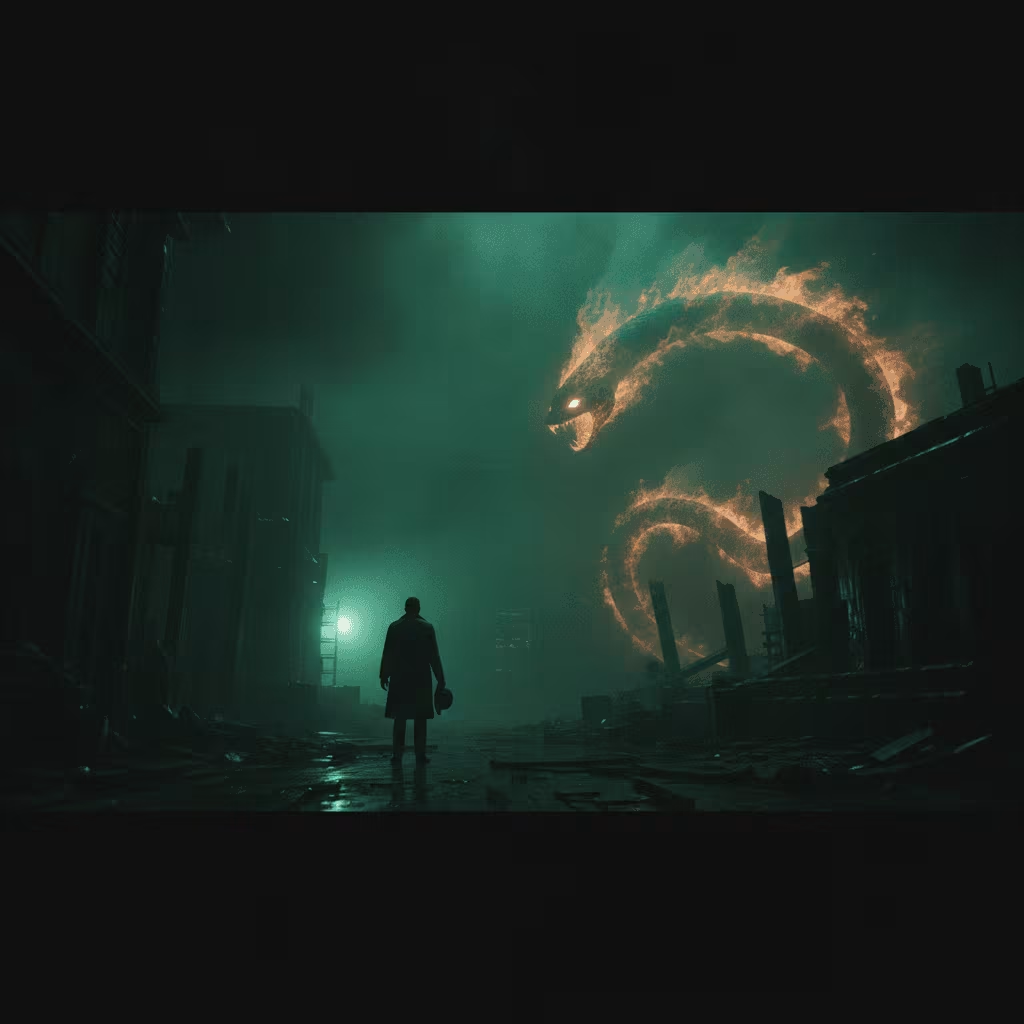
- Primary appearance: A giant serpent sheathed in flickering flames, with a multitude of incandescent eyes.
Origin and Etymology
To grasp the true magnitude of the Boitatá, we must descend into the deepest strata of Tupí-Guaraní culture, where the bond between man and the natural world was never one of dominion, but of profound respect and reverential dread. Etymologically, the name derives from the Tupí mboi (serpent) and tatá (fire), fusing together to give life to the ‘Fire Serpent’. The early Portuguese and Jesuit chroniclers who arrived on the American continent recorded in their travel diaries the terrifying descriptions given by the natives of a great wandering light that moved with supernatural speed across the swamps and dark forests.
The chronicles of Father José de Anchieta, dating back to the 16th century, already mentioned a phenomenon whom the natives called Bahatatá, describing it as a thing of fire that hunted the natives and killed them. Over the centuries, this myth primordial entity intertwined with the superstitions of the gauchos in southern Brazil and the riverside traditions of the Amazon, forging a crucible of tales where the being adopts nuances of both an ecological punisher and a wandering soul. From the perspective of anthropological research, the myth of the Boitatá might have a biological basis linked to will-o'-the-wisps (the spontaneous ignition of decomposing marsh gas), but the sheer magnitude of popular testimony far surpasses any conventional physicochemical explanation, stepping squarely into the realm of telluric terrors.

Anatomy and Appearance
The physical description of the Boitatá varies slightly according to the geographic region of Brazil where the account is collected, yet certain constants persist, composing a truly nightmarish image. It is habitually described as a serpent of titanic proportions, whose length can stretch for dozens of meters, sliding with astonishing agility through the densest vegetation without breaking a single branch. What truly defines its anatomy is its igneous condition: its entire body is not composed of traditional scales, but of living flames—flickering and voracious—that shift in hue between crimson red, intense orange, and a blinding electric blue in moments of greatest fury.
The eyewitnesses who have survived a close encounter with this creature they converge on a disturbing detail: its head is stippled with countless incandescent eyes, as large as glowing embers, burning with a cold and calculating intelligence. These eyes do not merely light its path through the absolute blackness of the jungle; they possess a hypnotic pull. Whoever has the misfortune of gazing directly into the eyes of the Boitatá is instantly blinded, their sanity summarily shattered. The creature drinks the vital energy from its victims through its stare, leaving them catatonic or driving them mad to flee in blind terror deep into the forest, where they ultimately perish from exhaustion or are devoured by the wild fauna itself. Its light, unlike a common wildfire, radiates no scorching heat from afar, but rather a cold, piercing energy that freezes the bones before charring the spirit.
Modus Operandi and Powers
The Boitatá's predatory behavior is intrinsically bound to the jungle's karmic justice. It is no blind beast that strikes at random; it acts as judge, jury, and executioner for those who disturb the ecological balance. Its favored modus operandi begins on moonless nights. Poachers who enter the wild with the intent to cull fauna without true need, or illegal loggers who indiscriminately fell century-old trees, are its preferred targets. The entity first manifests as a small, distant spark, a flickering light that seems to dance among the trees, drawing the intruder's attention with an unhealthy curiosity.
As the victim ventures deeper into the thicket in pursuit of the light, believing perhaps that it is a stray campfire or a lost lantern, the Boitatá unfurls in all its magnitude. The light multiplies, enclosing the target within an impenetrable circle of fire. The creature employs the psychological terror as its primary weapon: generating whispers in the dark, mimicking the voices of loved ones crying for help, and casting dancing shadows that utterly disorient the trespasser. Once panic paralyzes the victim, the Boitatá draws near, gliding in silence. Its most feared power is the ability to induce total blindness and instant madness through direct eye contact. Whoever survives the encounter is usually left with a shattered mind, incapable of speech, endlessly repeating warnings about serpents of fire lurking in the darkness of the Amazonian night.
Weaknesses and Protective Rituals
Despite being an elemental force practically invulnerable to conventional weapons —bullets pass through its body of fire as if it were smoke, and machete blades melt on contact with its flames— the Boitatá is not all-powerful, and ancestral methods exist to elude its fury or survive its stalking. The shamans and elders of the indigenous communities have passed down from generation to generation a series of precise guidelines to neutralize the threat of the fiery serpent, rooted in absolute respect for the environment and in techniques of psychological survival.
The first golden rule to avoid attracting the Boitatá is never to enter the forest out of destructive ambition; yet if one finds oneself face to face with the creature, the primary defense is to shut one's eyes tight or stare fixedly at the ground, avoiding at all costs eye contact with its multiple ocular flashes. Popular legend also holds that remaining completely motionless, holding one's breath and extinguishing any source of artificial light (such as flashlights or torches), can cause the entity to lose the person's thermal and visual trail, mistaking them for a mere element of the landscape. Another traditional ritual practiced by the ancient inhabitants consisted of carrying amulets made of sacred wood and ashes of protective plants blessed by the shaman, capable of temporarily dispelling the malevolent energy emanating from the creature. Likewise, it was believed that smoking certain varieties of tobacco and blowing the smoke toward the night sky served as a peace offering to appease the wrath of the forest's guardian spirit.
Documented Cases and Famous Legends
The annals of Brazilian folklore are replete with accounts of encounters with the Boitatá, many of which were documented by nineteenth- and twentieth-century folklorists such as João Simões Lopes Neto and Luís da Câmara Cascudo. One of the most celebrated tales comes from the region of Rio Grande do Sul, in the late nineteenth century, when a group of ruthless hunters resolved to set fire to a vast stretch of native forest in order to corner the local wildlife. According to the oral tradition of the locals, that very night a gigantic, serpentine column of fire descended from the hills and pursued the men relentlessly for hours. At dawn, the hunters were found dead: their bodies bore no severe external burns, but their faces were frozen in a grimace of absolute horror and their eyes were completely blank, as if they had gazed upon the very core of hell.
Another famous case, told in the riverside communities along the São Francisco River, involves a hardened fisherman who used to plunder fish spawning grounds during the closed season. Ignoring the warnings of the village elders, the man set out in his boat one stormy night. From the shore, the neighbors claimed to have seen a colossal serpent of fire rise from the water and wrap the vessel in a blinding glare. No trace of the fisherman or his boat was ever found, but the local fishermen swear that since then, on dark nights, a flickering light can be seen floating above the river's waters, reminding everyone that nature will not tolerate human greed without exacting a terrible price.
Comparative Analysis
When studying the Boitatá within the vast catalogue of cryptozoology and comparative world mythology, it is fascinating to observe how different cultures separated by oceans have converged upon similar archetypes to explain nocturnal terrors and the protection of natural environments. Unlike the dragons of European mythology —armoured beasts associated with the hoarding of material treasures and indiscriminate destruction—, the Boitatá shares a profound symbiotic connection with its habitat, functioning rather as a punitive ecological guardian, a concept very close to that of the Spirits of the Place or genii loci of classical antiquity.
If we compare it with the Wukong or the celestial serpents of Asian mythology, the Boitatá distinguishes itself by its exclusively igneous nature and its aggressive territorial hostility toward profaners. Whereas Western will-o'-the-wisps are often dismissed as harmless wandering souls or tricksters merely leading travelers astray in the marshes, the South American iteration elevates this atmospheric phenomenon to the rank of a spiritual apex predator. The Boitatá does not merely lose the wanderer; it judges them relentlessly. This duality between the physical manifestation of a natural gas and the personification of the jungle's unyielding justice transforms the myth into a masterpiece of folk psychology, forged to preserve the delicate balance of Amazonian biodiversity through dread an atavistic dread of the unknown.
📜Investigation • Frequently Asked Questions
Documentary Archive and Analysis of the Occult • Relatando.com
What precisely is the Boitatá in Brazilian folklore?
It is a giant serpent wrought of fire and light that dwells in the forests and swamps of the Amazon, acting as a mythological protector who punishes those who destroy nature.
How does one survive an encounter with the Boitatá?
The best defense is to close your eyes, to keep from staring into its incandescent flares lest you lose your mind, to remain utterly motionless, and to extinguish any artificial light.
Does the myth of the Boitatá hold any actual scientific explanation?
Yes, scientists suggest the myth may have originated from the natural phenomenon of will-o'-the-wisps, caused by the spontaneous ignition of gases emitted by decaying organic matter.
Don’t extinguish the light just yet...
If you have had the courage to make it this far, we have other dossiers that will test the limits of your sanity.

Terms and Figures of this Tale
To delve deeper into the legends, creatures, and dark concepts that inspire this account, consult their entries in our dictionary of the uncanny:



Tu correo no se publica ni se comparte con terceros: solo sirve para notificar la respuesta.