Deep within the mountainous timberlands of Cantabria, where an eternal, dripping fog clings to the ribs of ancient oaks and sunlight dies before piercing the canopy, there lurks one of the most singular and predatory entities of northern Mythology lore. I am Carlos Nieto, and in this unflinching descent into the abyss of local mystery, we shall unearth the shape of the Guajona—a monstrous, shadowy parasite that has nourished generations of nightmares. Far from a mere fireside tale designed to cow disobedient children, this entity stands as the absolute archetype of the nocturnal hunter, a creature presence that blurs the stark boundary between folklore and the darkest anthropology of the dread. Prepare yourself, seeker of the occult, for what you are about to read unravels the true nature of an monster ancestral entity whose jaws still ooze the Legend weight of northern blood.
Classified File
- Origin: Folk mythology of Cantabria (Spain).
- Nature: Malignant spirit, demon nocturnal prowler and rural vampire.
- Hazard Level: Extreme (It preys preferentially on babies and small children in the privacy of the home).
- Weaknesses: Direct sunlight, consecrated religious symbols, and the abrupt interruption of its feeding ritual.
Origin and Etymology
The term 'Guajona' sinks its deep roots into the rich, complex mythological stratum of the Cantabrian region, a territory where the geographical isolation of its valleys favored the preservation of legends a purely ancestral lineage, blending pagan and Celtic elements with the dark interpretations of the Christian Middle Ages. Etymologically, the name evokes an oppressive presence, linked in certain local dialects with the notion of 'she who sucks' or 'the devouring witch'—a linguistic and functional parallel that directly affiliates her with other figures of the peninsular imaginary such as the balls, the lamiae, or those beings from beyond the grave devoted to energetic and physical vampirism.
Through the centuries, the myth legend of the Guajona did not arise from nothingness; it erupted as a sociological necessity to explain the high infant mortality, the bizarre fevers, and the inexplicable crib deaths that ravaged isolated rural communities during the harsh, freezing northern winters. When medical science stood powerless before domestic tragedy, the collective imagination invoked the Guajona to give a face and a malevolent will to the inexorable cruelty of nature. It was, in essence, the mythical explanation for the inexplicable horror that crossed the threshold of wooden doors on moonless nights.

Anatomy and Appearance
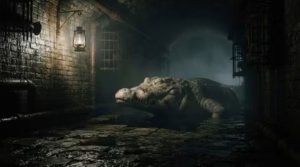
To describe the Guajona physically is to peer into an abyss of grotesque ugliness and visceral repulsion. Unlike the aristocratic and seductive vampires later popularized by Gothic literature, the Guajona is a creature of rural nightmare, harsh and stripped of any trace of humanity. Traditional chronicles portray it as a humanoid but profoundly deformed being, with an extremely thin, almost famished body, clad in a leathery hide of grayish or greenish tones that resembles old leather cured by the elements.
His face is the epicenter of aversion: he is utterly devoid of conventional dentition, replaced by a single, sharp central tooth of grotesque proportions, a bone stake perfectly designed to pierce tender flesh with surgical precision. His eyes, small, bulging, and gleaming with a reddish or yellowish sheen, possess an extraordinary capacity for night vision, able to pierce the most absolute darkness of a lightless room. The hands, ending in long, hooked claws, complete an anatomy designed exclusively for stealthy stalking, silent abduction, and the consummation of an act as atrocious as infant vampirism.
Modus Operandi and Powers
The Guajona's predatory behavior follows a methodical and bone-chilling pattern of stalking. The creature waits patiently until the families of the mountain hamlets are deep asleep. Taking advantage of the small hours' silence, it uses its keen sense of smell to locate the whereabouts of the youngest children or infants, those whose purity and fragility represent its favorite delicacy. Aided by its supernatural agility, it slips through cracks, rooftops, or poorly closed windows without making the slightest sound.
Once beside the crib, the Guajona does not resort to noisy violence; she employs an insidious method. With her single, sharpened tooth she makes a millimetric incision, usually on the infant's forehead or a limb, then begins to suck the blood in a slow, systematic fashion. The truly terrifying thing about her Method of operation lies in its parasitic, vampiric nature: as it drinks the blood, the creature injects a lethal torpor or a paralyzing venom that prevents the child from waking or crying out, so that the parents—sunk in an induced sleep or deeply exhausted by the labors of the field—do not perceive the tragedy until it is too late. The Guajona leaves the home before dawn, leaving its victim weakened, bloodless, and bound for a slow death if urgent measures are not taken.
Weaknesses and Protective Rituals
Despite her fearsome reputation and her apparent invulnerability in the shadows of night, the Guajona is neither a god nor an omnipotent demon; she bears very specific physical and spiritual vulnerabilities that the valley folk learned to wield as a protective shield. Her most absolute weakness is sunlight: the first rays of dawn destroy her life force, forcing her into a precipitate retreat to her subterranean lairs, dark caves, or inaccessible hollows among the roots of century-old trees.
Historically, the inhabitants of Cantabria developed intricate rituals of domestic protection to fortify their homes against the incursions of the Guajona. Placing open scissors in the shape of a cross over cradles, hanging bundles of blessed aromatic herbs—such as hellebore or rue—from door lintels, and keeping a faint oil lamp burning through the night were customary practices to hold the monster at bay. Likewise, the presence of sacred objects, holy water, or crucifixes of carved wood in children's rooms acted as an infallible deterrent, for the entity's profane nature cannot abide the symbols of the Christian faith.
Documented Cases and Famous Legends
In the archives of Cantabrian oral tradition, the most celebrated account tied to this creature comes from the valley of Liébana, where a humble shepherd named Pedro claimed to have intercepted the Guajona inside his own stable, provisionally converted into a living space. According to the legend passed down from generation to generation, Pedro woke to a sound like that of a thirsty animal. When he lit an oil lamp, he discovered the monster bent over his youngest child's cradle.
Stripped of fear and driven by a father's protective fury, Pedro charged the entity, brandishing a woodcutter's axe. The strike found its mark, catching the Guajona in one of her limbs and tearing from her an inhuman scream—dry, rending—that froze the blood of the entire neighborhood. The creature, gravely wounded, fled in terror toward the forest, leaving a trail of dark, fetid blood that the locals followed to the mouth of a deep chasm, which was immediately sealed with rocks and timbers blessed by the village priest. From that night on, the valley reclaimed a sepulchral peace, though fear of the Guajona's return has never fully died among the eldest shepherds.

Comparative Analysis
When subjecting the Guajona to rigorous comparative analysis within Iberian demonology and cryptozoology, it proves fascinating to observe how she shares structural similarities with other entities from the peninsula and from universal folklore, while at the same time maintaining an unmistakable identity of her own. Unlike the Traditional Eastern European vampire, popularized by the myth of Dracula, who stalks adults and bears an aristocratic elegance, the Guajona is a purely telluric aberration, a monster of peasant stock fixated exclusively on the predation of children.
If we compare it with the Ojáncano —another monstrous and malevolent giant of Cantabrian mythology—, we see that while the Ojáncano embodies brute force, blind destruction, and unbridled physical evil, the Guajona operates from the shadows with surgical subtlety, more closely akin to the legends of incubi, succubi, and vampiric witches that prey upon the soul and blood of the family in the silence of the small hours. It is, in short, the missing link between the folklore of subterranean creatures and the universal myth of the rural vampire.
📜Investigation • Frequently Asked Questions
Documentary Archive and Analysis of the Occult • Relatando.com
What precisely is the Guajona?
It is a mythological, vampiric being from Cantabria that slips into houses at night to suck the blood of small children.
How can a home be protected from the Guajona?
In the old days, open scissors were laid in a cross over cradles, protective amulets, blessed herbs, and religious symbols at every threshold.
Does the Guajona prey upon adults?
No, its primary prey are infants and nursing children, exploiting their frailty and the deep slumber of parents to strike.
Do not extinguish the light yet...
If you have had the courage to make it this far, we have other dossiers that will test the limits of your sanity.

Terms and Figures of this Tale
To delve deeper into the legends, creatures, and dark concepts that inspire this account, consult their entries in our dictionary of the uncanny:


Tu correo no se publica ni se comparte con terceros: solo sirve para notificar la respuesta.