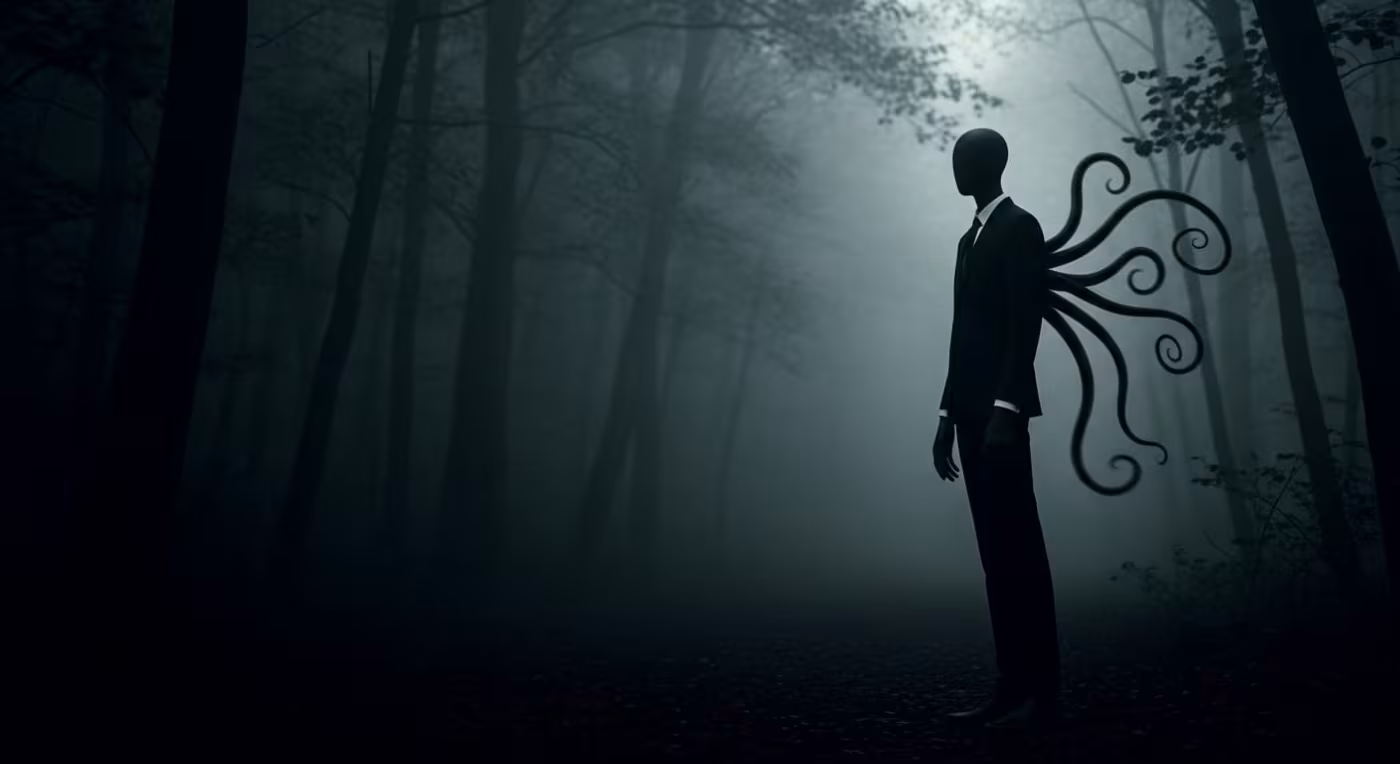
The onscreen aesthetic is merely the prelude to a walking void. In June of 2009, the gloom of digital forums birthed not a deity, but a parasite of perception: a lank, towering figure clad in an impeccably tailored suit that defies all human geometry. It crawled from no ancient caves or forgotten manuscripts; it was born of pixels, yet its hunger for attention and collective belief soon transcended the glass of the monitor to take up residence in the darkest corners of the contemporary psyche.
I. Birth on the Net
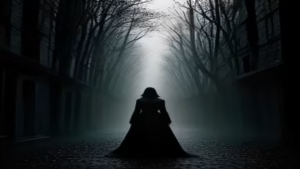
The world was unprepared for the Photoshop contest on Something Awful. Eric Knudsen, operating under the alias Victor Surge, injected two black-and-white photographs that would forever alter the folklore of the modern era. In them, innocent children played in a park or walked toward a misty forest, while in the background, immutable and watchful, stood a disproportionate silhouette. It possessed no face. There were no eyes to gaze, no mouth to articulate any warning. Only a smooth, chalk-white surface crowning a body that seemed to stretch beyond the bounds of permitted physical laws.
What began as an aesthetic exercise in Horror digital Lovecraftian horror spiraled out of control with the blistering velocity unique to the web. The community was quick to claim ownership of the creature. Each user wove their own layer of Mythology: fabricated sightings, blurred medical files, amateur home videos where static interference heralded its imminent arrival. This was no finite narrative; it was a collaborative blank canvas where every warped mind contributed its own bespoke nightmare.

II. The Anatomy of the Stalk
To study Slenderman is to step into a catalog of sensory anomalies. Descriptions converge on a height exceeding two meters, unnaturally articulated limbs, and a black suit that seems to swallow the surrounding light. Yet his true danger lies not in physical strength, but in his psychological modus operandi. The stalking begins at the periphery. First, he appears in the background of an aged photograph, forgotten for years until someone zooms in on the wrong detail.
The true horror of Slenderman lies not in its killing you, but in convincing you that it has always been there, watching from the ragged periphery of your memory.
As the victim's obsession grows, the symptoms multiply. Chronic paranoia sets in, alongside short-term memory loss, disorientation in familiar places, and, characteristically, electronic distortion. Digital cameras fill with green or white static; voice recorders capture metallic shrieks just before the signal dies. He is an entity that interferes with technology because our technology has become his natural habitat.
III. From Meme to the Mirror of Collective Fear
How is it that a digital creation inherently conscious of its own artifice managed to provoke such genuine dread? The answer lies in the very architecture of folklore. The urban legends of old required generations to cement themselves around hearth fires and midnight whispers; Slenderman conquered the globe in a matter of months on the back of viral algorithms. Yet in that very descent, the boundary between fiction and reality fractured in alarming ways, proving that the human brain requires no ancient lineage to consecrate its own monsters.
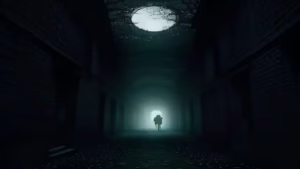
Today, the thin man continues to inhabit the collective imagination as a disturbing reminder of what we are capable of summoning when we peer too long into the digital abyss. It no longer matters who drew him first; what matters is that every time we look into the thicket of a misty forest or down the dark corridor of a house late at night, a part of us is still searching, with terror and fascination, for the black tie and the absent face.
📜Investigation • Frequently Asked Questions
Documentary Archive and Analysis of the Occult • Relatando.com
¿Who created Slenderman and on what precise date?
Slenderman was created in June 2009 by user Eric Knudsen (known as Victor Surge) on the forums of the internet community Something Awful.
¿What technological anomalies are routinely tied to his appearances?
The accounts and the myth indicate that Slenderman's proximity induces severe disruption across electronic devices, generating harsh static on cameras and audio recorders alongside sudden failures in video feeds.
¿Does Slenderman possess roots in ancient mythologies or legends folklore?
He possesses no traditional etymology or direct roots in ancient folklore; his origin is purely contemporary and digital, though some researchers point to parallels with European figures such as the Bugbear.
¿Why is he considered a unique phenomenon cultural artifact?
Because he stands as the first grand modern myth constructed collaboratively and virally across the internet, evolving with terrifying speed from a manipulated Photoshop image into a global Legend urban legend.
Do not extinguish the light yet...
If you have had the courage to make it this far, we have other dossiers that will test the limits of your sanity.

Terms and Figures of this Tale
To delve deeper into the legends, creatures, and dark concepts that inspire this account, consult their entries in our dictionary of the uncanny:


Tu correo no se publica ni se comparte con terceros: solo sirve para notificar la respuesta.