Greetings, friends of mystery and explorers of the unknown. I am Carlos Nieto. To venture into the shadows of Point Pleasant is to cross a threshold where reality shatters, giving way to one of the most terrifying and enigmatic entities of the twentieth century: The Mothman. We are not dealing with a mere byproduct of mass hysteria or a journalistic hoax; we stand before a phenomenon liminal entity, a winged presence with glowing red eyes that rose as the absolute prelude to monumental tragedy, leaving an indelible scar upon cryptozoology and the collective human psyche.
Classified File
- Origin: Point Pleasant, West Virginia, United States.
- Nature: Anomalous winged cryptid, possible interdimensional entity, or harbinger of catastrophe.
- Hazard Level: Tall (associated with fatal omens and structural collapses).
- Weaknesses: An absence of tangible physical traces following its appearances; a reliance on collective attention and the secret.
Origin and Etymology
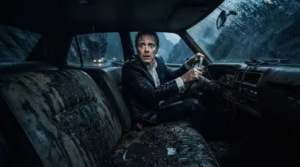
The myth of the Mothman, known in its vernacular tongue as Mothman, sinks its roots into the murky autumn of 1966, specifically within the small, rural township of Point Pleasant, nestled along the banks of the Ohio River in West Virginia. Yet, to grasp the true genesis of this myth, we must trace it back to the paranoia-choked atmosphere of the Cold War and the fragile economy of an industrial region where decline had begun to take its toll. On the night of November 12, 1966, in a graveyard near the town of Clendenin, five men digging a grave experienced something that defied all rational logic. According to their accounts, a humanoid figure, equipped with massive wings folded against its back and a pair of eyes glowing with a hypnotic reddish glare, rose from the surrounding trees and hovered overhead for a few breathless moments before vanishing into the dark. This sighting, dismissed with skepticism by local authorities at the time, was merely the spark that set the prairie of the bizarre ablaze. Scarcely three days later, on November 15, 1966, the nightmare assumed collective proportions when two young married couples—the Scarretts and the Mallettes—were driving near an abandoned industrial complex known as the 'Ordnance Plant', a former World War II munitions factory. As they passed near a generator, they caught sight of a gargantuan silhouette, roughly two meters tall, boasting a monstrous wingspan and hypnotic fire-red eyes staring straight at them from the gloom. Panic seized them as the creature, devoid of the slightest conventional aerodynamic effort, lifted off and began pursuing their car at speeds exceeding one hundred and sixty kilometers per hour, keeping pace without a single perceptible flap of its wings. The term 'Mothman' was born neither from scientific inquiry nor academic cryptozoology, but from the pages of local newspapers, specifically the 'Point Pleasant Register', whose editor, playfully adapting the tone of the era's comic books—specifically alluding to Batman—christened the creature 'Mothman'. The locals, however, began to address the entity with a fearful, reverential awe, perceiving it as a dark omen. Later investigators, such as the renowned John Keel, who catapulted the case to global fame with his work 'The Mothman Prophecies', suggested that the creature's origin transcended terrestrial biology. Keel argued that Point Pleasant was a literal window into unknown dimensions, an epicenter of activity paranormal where UFOs, strange lights, men in black, and winged beasts converged, suggesting that the Mothman was a manifestation of ultraterrestrial intelligences capable of manipulating physical reality and time at will.
Anatomy and Appearance
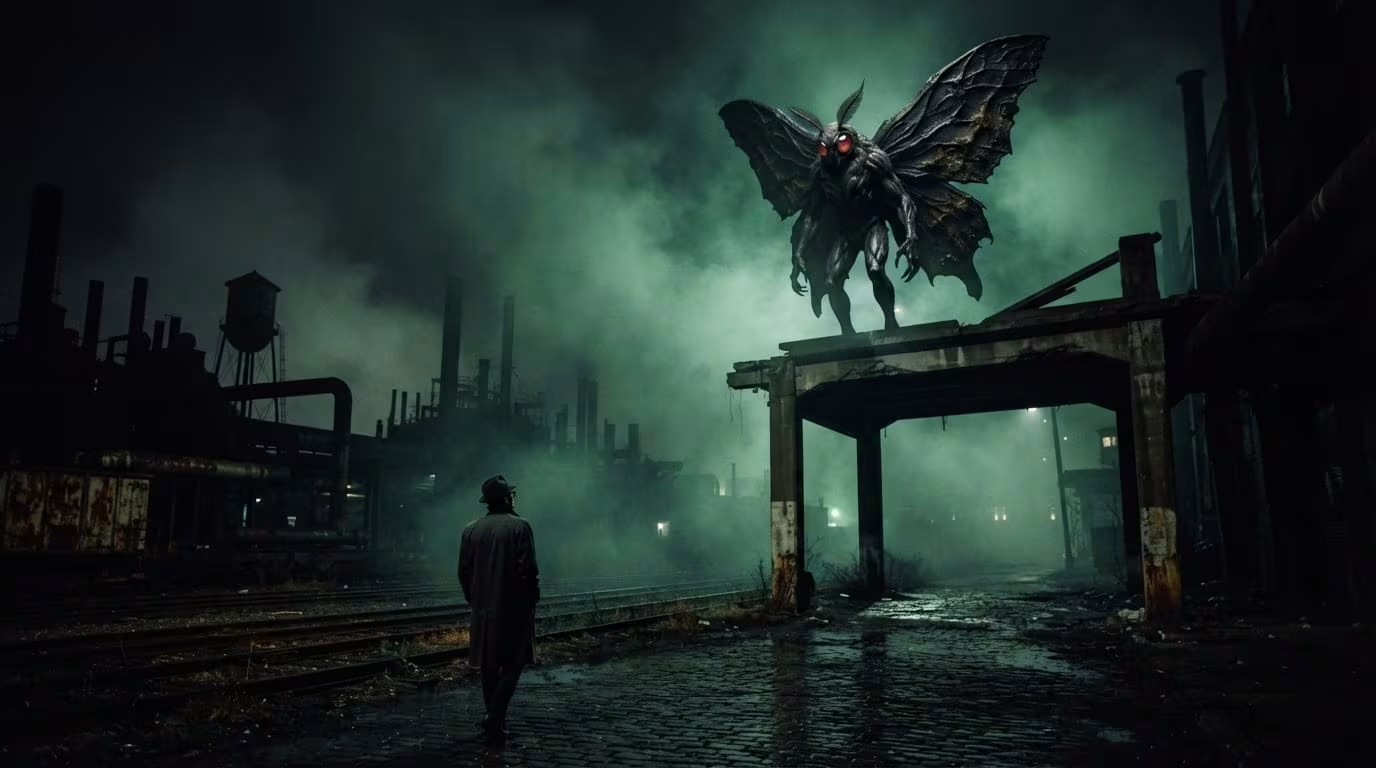
The physical description of the Mothman has remained remarkably consistent across the decades, cementing a morphological profile that strikes pure terror into anyone who pauses to analyze it. This is no oversized owl, nor is it some genetic mutation born from the region's industrial runoff. Eyewitnesses—those unfortunates who crossed gazes with the beast—agree that it stood between six feet six and six feet ten inches tall. Its body is robust, massive, and profoundly humanoid, yet entirely devoid of clearly differentiated upper limbs functioning as conventional arms. In their place grow leathery, membranous, or downy wings of a dark gray or pitch black, folded tightly against its back like those of a bat or a colossal nocturnal moth. The most deeply disturbing and defining feature of its anatomy is, without a doubt, its eyes. It lacks a defined face with recognizable human features; no discernible ears, nose, or mouth can be found. All visual dominance falls upon two enormous circular eyeballs, situated not on the front of the head, but at the base of the neck or embedded directly into the upper thorax. These emit a bioluminescent glow of an intense red, crimson, or amber that mesmerizes all who look upon them. Several witnesses swore they felt a strange mental pressure or an electrical hum in their ears whenever those eyes locked onto them. Its skin or fur is frequently described as a grayish, scaly, or downy texture, capable of swallowing the glare of automobile headlights rather than reflecting it, which only heightened its spectral appearance, utterly devoid of any trace of nature. Its powerful, disproportionate legs end in claws or talons capable of gripping the highest branches of the trees or the cold iron of bridges without making a single sound. The complete absence of actual feathers in some accounts, coupled with a dense, velvet coat, has led entomologists and biologists to dismiss any relation to the known animal kingdom, banishing the Mothman to the realm of the impossible—an anatomical aberration defying the very laws of aerodynamics and biological evolution.

Modus Operandi and Powers
The behavior of the Mothman differs radically from that of any known carnivorous predator or wild animal. It does not attack for sustenance, nor does it defend a hunting ground through direct physical aggression. Its modus operandi is subtle, psychological, and profoundly disturbing, operating along the frayed margins of human perception. The creature's apparitions are typically preceded or accompanied by a cascade of electromagnetic anomalies and phenomena —which are usually bound to a geographic location— the Dybbuk is bound to a person. It is a form of 'personalized' possession that challenges the notion of evil as an external force, reminding us that the deepest horror sometimes springs from our unfinished humanity and the debts we leave unpaid upon death. within the witnesses' homes: static interference on telephone lines, television sets turning themselves on, inexplicable failures in vehicle electrical systems, and the apparition of strange lights in the sky, commonly identified as UFOs. The creature seems to manifest at dark crossroads, abandoned factories, and, above all, within key transport infrastructure, silently observing its victims before vanishing at impossible speeds. Among the powers attributed to it, the most terrifying is its capacity to induce a paralyzing state of panic and premonitory visions. John Keel documented how several of the primary witnesses began to suffer from recurring nightmares, visions of mass catastrophes, and telephone calls marked by dead air or strange electronic buzzing before the tragic events unfolded. The Mothman acts as a herald, an announcer of collective dooms. Its presence does not seek immediate individual harm, but rather serves as a grim record that something terrible is about to happen. It is a silent observer that defies physics, ascending vertically, suspending itself in the air without the slightest motion, and dissolving in the blink of an eye, leaving behind a lingering scent of sulfur and an atmosphere of profound melancholy and Horror existential dread that lingers for years upon those who dared gaze into its eyes.
Weaknesses and Protective Rituals
Facing an entity of anomalous nature such as the Mothman poses a complex dilemma: how does one defend against that which official science refuses to acknowledge exists? Unlike the monsters figures of traditional folklore or Eastern European vampires, the Mothman does not respond to religious amulets, crucifixes, holy water, or silver. Nor are there any records of it ever being brought down by firearms; in fact, during the sixties, several local hunters fired directly at the creature without the projectiles appearing to inflict the slightest physical harm, its silhouette dissolving or dodging the gunfire with supernatural agility. The only effective defenses documented by field investigators lie in prevention and the comprehension of its liminal nature. Given that the entity feeds upon psychological attention, upon the dread collective psyche, and the energy of places heavy with historical or industrial tension, breaking the cycle of observation is key. Stepping away from the epicenters of activity—such as the Ohio River area or the munitions plant—and resisting the obsession to investigate its manifestations mitigates exposure to its collateral effects, which include the mental erosion known as the ‘witness curse.’ Certain contemporary occultists suggest that mental isolation, the hardening of the will, and the outright rejection of fear are the only true shields against an entity that seems to nourish itself on human despair. At its core, the Mothman is a mirror of our own tragedies; to combat it with physical weapons is futile, for its true battle is waged upon the fragile terrain of the psyche and the unknown.
Documented Cases and Famous Legends
The definitive account of the Mothman cannot be understood without its tragic climax: the collapse of the Silver Bridge on December 15, 1967. During the thirteen months preceding the tragedy, sightings of the winged creature multiplied exponentially in and around Point Pleasant, turning the lives of its residents into a constant, fear-ridden vigil. Eyewitnesses claimed to have seen the Mothman perched atop the metal framework of the Silver Bridge, the suspension span linking West Virginia to Ohio across the river of the same name. That fateful Friday at five in the afternoon, amid the Christmas rush hour, the bridge suddenly collapsed without structural warning, plunging dozens of vehicles into the freezing, turbulent waters of the river and claiming the lives of forty-six people. For the local inhabitants and researchers of the mystery, the connection was immediate and direct: the Mothman was not the architect of the disaster, but the tragic guardian that had tried to warn the town of the imminent mechanical failure brought on by metal fatigue and negligent maintenance. In the wake of the tragedy, sightings ceased abruptly, as though the creature's mission had ended with the fulfillment of the prophecy. Yet the myth transcended the borders of the United States. Over the following decades, sightings of identical entities have been reported in distant geographical points marked by catastrophe: in Chernobyl, Ukraine, days before the 1986 nuclear disaster, several plant operators swore they saw a massive black creature with red eyes hovering over the reactors; in Mexico City and various parts of Eastern Europe, similar winged figures have been tied to aviation accidents and earthquakes. The Mothman has thus cemented itself as a universal archetype of warning, a Legend modern omen demonstrating that the world harbors bottomless fissures where the impossible takes on flesh and takes flight above our heads.
Comparative Analysis
Studying the Mothman demands a rigorous comparative analysis alongside other entities from the vast catalog of cryptozoology and universal demonology to grasp its true dimension. It is frequently compared to the gargoyles of Gothic architecture or the winged demons of Mythology Sumerian and Mesopotamian, like Pazuzu. Yet, whereas Pazuzu and traditional demons carry a distinctly malevolent, religious burden focused on possession and spiritual torment, the Mothman lacks any such liturgical intent; his behavior is closer to that of a neutral observer, a chronicler of disaster who merely portends the inevitable without directly intervening to cause it. When compared to classic cryptids like Bigfoot (Bigfoot) or the monster of Loch Ness, the differences run even deeper. Bigfoot is an eminently biological creature, an elusive primate adapted to the deep forests in search of survival and isolation, whereas the Loch Ness Monster is a prehistoric aquatic relic bound to a closed ecosystem. Mothman, by contrast, defies biological categorization, bearing mechanical, electromagnetic, and parapsychological traits that align him more closely with apocalyptic Marian apparitions or third-phase UFO encounters. He is a creature of the fringe, a dweller of the liminal zones between matter and energy, placing him in a category entirely his own within contemporary folklore—the undisputed king of the urban legends of the twentieth century.
📜Investigation • Frequently Asked Questions
Documentary Archive and Analysis of the Occult • Relatando.com
Who was the first to lay eyes on Mothman?
The first witnesses were five men digging a grave in Clendenin, West Virginia, in November 1966, who caught sight of a winged, red-eyed figure.
What is the connection between Mothman and the Silver Bridge?
Many witnesses claimed to have seen the creature perched upon the Silver Bridge shortly before its tragic collapse in December 1967, viewing it as a harbinger of the catastrophe.
Is Mothman a real animal or a Phantom?
Science dismisses him as a flesh-and-blood animal. Mystery investigators regard him as an anomalous cryptid or an interdimensional messenger tethered to tragedy.
Do not extinguish the light just yet...
If you have had the courage to make it this far, we have other dossiers that will test the limits of your sanity.

Terms and Figures of this Tale
To delve deeper into the legends, creatures, and dark concepts that inspire this account, consult their entries in our dictionary of the uncanny:

Tu correo no se publica ni se comparte con terceros: solo sirve para notificar la respuesta.